


Brewers Video
The Milwaukee Brewers’ pitching pipeline flows like a rushing river. There aren’t many teams in baseball who have been better at developing young pitchers. Jacob Misiorowski and Logan Henderson are two of the latest and most prominent examples. Both have electric stuff that overwhelms batters and misses bats, making it pretty easy to see why the Brewers are so excited about their futures—and their present, for that matter.
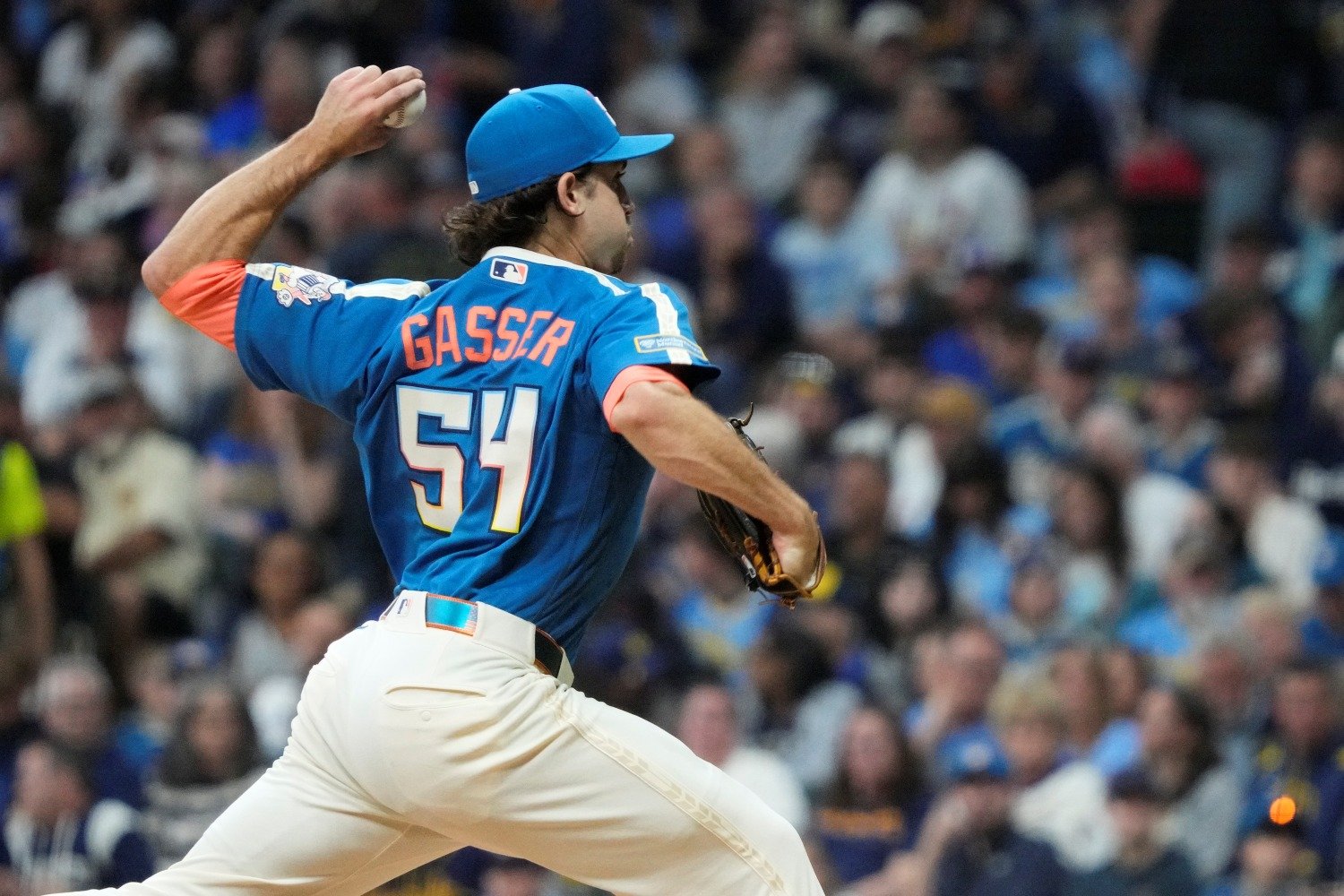
Robert Gasser doesn’t stand out in the same way. He doesn’t have incredible swing-and-miss stuff or an upper-90s fastball. He isn’t going to make hitters look completely helpless. But he’s gonna throw the kitchen sink at you, and if you think you’ve figured him out, there’s probably something hiding in the garbage disposal. Despite having merely average velocity, Gasser’s quality of contact metrics are excellent. Opponents' hard-hit rate and average exit velocity both rank in the 85th percentile or better among all major-league pitchers.
It starts with the sweeper. It's been Gasser’s most-used pitch throughout his major-league career, and it’s easy to understand why when you watch it come out of his hand. With his low arm angle and how far away from his body he lets the ball go, it looks like a left-handed hitter is about to get decapitated by the pitch, before it suddenly moves away. It has a Stuff+ grade of 122, with 100 being league average. Moral of the story: It’s nasty.
That’s a big reason why Gasser has been throwing his sinker nearly 30% of the time against left-handed hitters. If a hitter is sitting on a pitch that starts at them and veers away, only to get something that starts over the plate and runs in on them, squaring it up becomes pretty much impossible. Those are the pitches in Gasser’s arsenal that hitters are struggling to handle the most. But it doesn’t stop there.
Gasser’s four-seam fastball only averages around 93 MPH, but it's actually been his biggest swing-and-miss pitch this season. Throwing from so low a slot, he generates ample arm-side run on the pitch, while giving it a completely different shape than his sinker. That four-seamer also comes surprisingly close to his sweeper in terms of Stuff+, checking in at 114.
Hitters are getting underneath it consistently, because they have to respect the sinker and its much different movement. The average four-seamer induces a swing that barely clips the bottom part of the ball or misses underneath it 45% of the time; Gasser's makes that 55%. Despite the four-seamer being his second-most frequently thrown pitch, Gasser has allowed just two home runs on it all season. That’s a pretty strong profile for a pitch that doesn’t even crack 95 mph.

Then there’s the cutter. Many pitchers in modern baseball (and particularly in Milwaukee) have embraced the three-fastball mix, pairing a sinker and four-seamer with a cutter. Gasser is one of them, and his cutter might be the perfect complement to everything else he throws. Because hitters have to respect his four-seamer and sinker (as well as the sweeper, moving in the opposite direction), his cutter gives them another movement pattern to worry about. It moves to the glove side a foot more than the four-seamer and more like 18 inches more than the sinker, and it drops about 8 inches more than the four-seamer—all while coming in around 88 MPH, much firmer than the 81-MPH sweeper.
That combination makes it very challenging to identify out of his hand. Unlike his sweeper, four-seamer and sinker, Gasser isn’t really using his cutter as a put-away pitch. But when a pitcher can use a pitch to set everything else up and keep hitters off balance as effectively as Gasser has, it doesn’t necessarily need to be. It’s a darn good fourth pitch.
It also gives him options. Here's a glimpse of how, thanks to FanGraphs's nifty Paired Pitches visualization tool. If you think of Gasser's four-seamer as the pitch off which he's working (it's his most-used one against righties) and assume that its target is the top of the zone in the middle of the plate, this is how his other pitches play off of it.

The sinker keeps a batter honest; they have to respect the outside edge. But Gasser's ability to beat those hitters comes on the pitches that move in on them. The cutter is the one he can use against a disciplined hitter who has the outside half well-covered. The sweeper is the one he can throw at overly aggressive ones who are looking for the four-seamer or the cutter, to get a chase on a pitch ticketed for their back foot.
Then there’s the changeup, which is technically Gasser’s fifth pitch. He’s throwing it roughly 10% of the time, and according to Stuff+, it’s actually his worst offering, with a grade of just 83. That number feels a little misleading. He throws a firm changeup, averaging only about 4 MPH slower than his fastballs, but it serves its purpose. He’s getting plenty of hitters out in front of it, which is exactly what you want from a changeup.

There have been times when the pitch catches too much of the plate and hitters are able to square it up. But when Gasser locates it, it’s gross. He technically has a slider in the arsenal, too, but he’s thrown it just 10 times all season. I wouldn’t expect that pitch to factor much into his playoff pitch mix, especially when he already has five legitimate offerings to work with.
As the playoffs draw closer, it seems increasingly likely that Gasser will be Milwaukee’s Game 3 starter in the NLDS, taking the mound in what could be an elimination game for whichever team he faces. That’s a pretty important spot for a pitcher who doesn’t have the traditional profile of an ace, but when he's locating, Gasser has enough options to pitch at nearly that level.
None of it necessarily jumps off the page on its own. Put it all together, though, and you get a pitcher who can make hitters uncomfortable in just about every possible way. The Brewers have become very good at developing young pitching, and Gasser might be one of the best examples of why. He may not have the same kind of eye-popping arsenal as Misiorowski or Henderson, but there’s a lot more to pitching than throwing hard. Sometimes, you just need to throw the kitchen sink at them.
Are you optimistic about the Brewers right now?

Follow Brewer Fanatic For Milwaukee Brewers News & Analysis



-
 1
1


Recommended Comments
There are no comments to display.
Create an account or sign in to comment
You need to be a member in order to leave a comment
Create an account
Sign up for a new account in our community. It's easy!
Register a new accountSign in
Already have an account? Sign in here.
Sign In Now