


Brewers Video
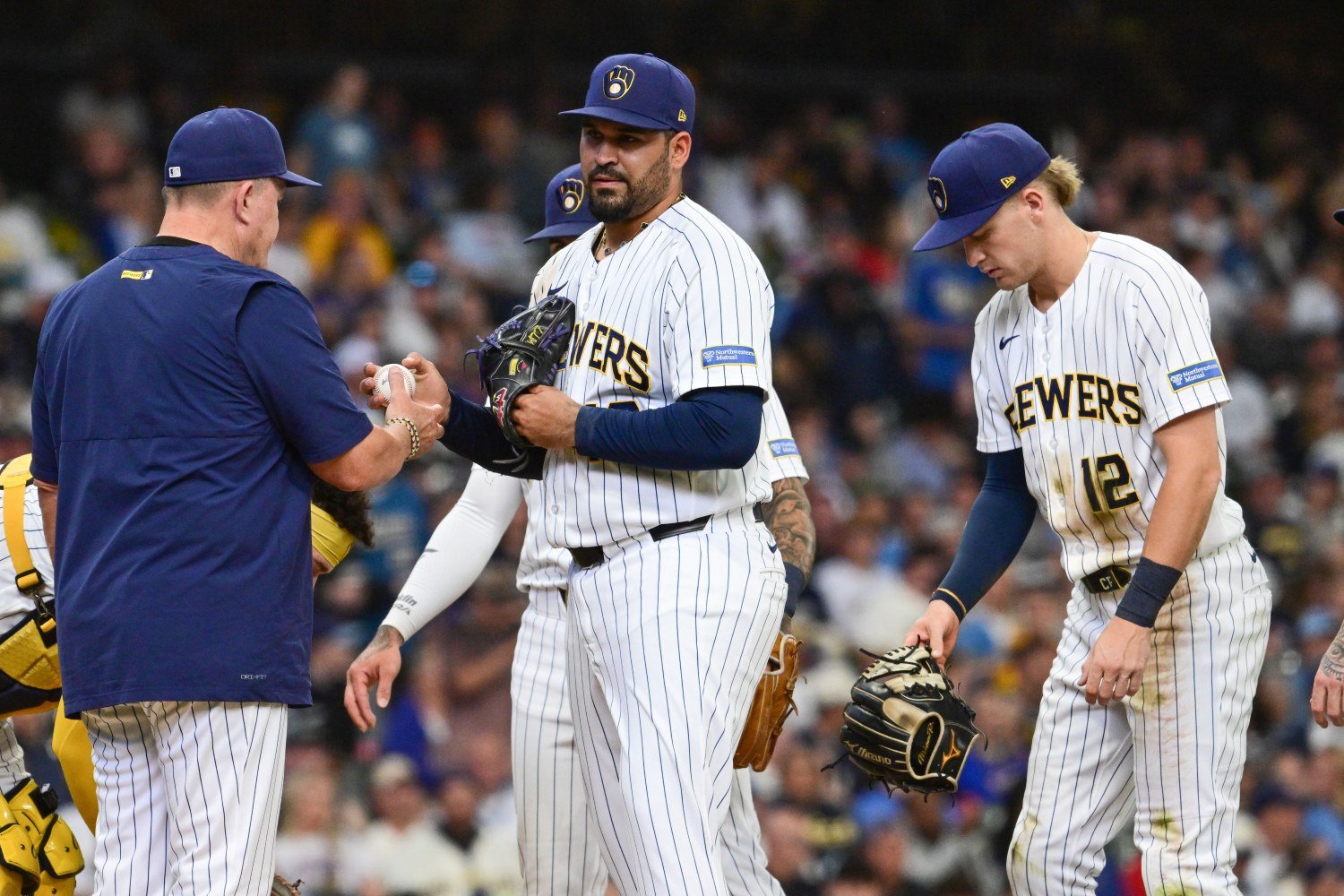
Since the Brewers acquired him from the Rockies at the trade deadline, Antonio Senzatela's tenure with his new team has gone poorly. In 18 appearances, many of them in high-leverage situations, the right-hander has pitched to a 6.48 ERA, 5.55 xERA, and 4.79 SIERA with a poor 2.7% strikeout-minus-walk percentage. From Daniel Norris to Andrew Chafin to Shelby Miller, Milwaukee's recent deadline relief acquisitions have an infamous track record. Even relievers with excellent stuff and strong peripherals at the time of a trade have pitched far worse after joining the Brewers. At this point, Senzatela's regular-season performance will not break that trend, but not for a lack of effort.
"I think we're still cracking the shell a little bit," pitching coordinator Jim Henderson said a couple of weeks ago. "We've made some adjustments."
Matt Trueblood recently broke down those adjustments, which have been a typical Brewersification. With the Rockies, Senzatela threw his four-seamer 40% of the time as his leading pitch, but the Brewers immediately converted him to their preferred sinker and cutter sequencing to both sides of the plate. They also moved him to the first-base side of the rubber, which makes that sinker easier to command and helps it enter the zone at a more deceptive angle.
The pitch mix change made sense, as the sinker is Senzatela's slightly better fastball, particularly away from Coors Field. He naturally cuts the ball at release and doesn't generate much spin, which usually limits the movement of a four-seamer but can create more seam-shifted sink on a two-seamer. Even after accounting for the Colorado altitude and his arm slot, Senzatela's four-seamer has less carry than average, while his sinker has more sink.

"We believe in good process of a pitch, and we believe that if he does that and keeps the ball in the ballpark with our defense, we're going to have success with it," Henderson said. "So we're kind of leaning into [the sinker and cutter] a bit more."
The move to the first-base side wasn't just about improving the overall angle of Senzatela's sinker. Henderson said it was also an attempt at making him more platoon-neutral. From the first-base side, the Brewers believed Senzatela could better execute front-door sinkers to lefties. They also felt the more extreme angle would freeze more lefties on back-door cutters that come back to the outside corner.
"We're just looking for more freezes, just to track a little bit better and get in there, and, if you have the eyes of a hitter, not being able to track him the whole way so much," Henderson said.
Senzatela's stuff would always benefit from leaving Coors Field, but the Brewers have helped it level up further. They've tightened his delivery and worked on landing more firmly with his front foot, allowing his hand to work on top of the ball. Those tweaks have contributed to a velocity bump, and they've given his sinker more depth (lower induced vertical break) and more arm-side run. In recent outings, he's gotten that sinker as low as 3 inches of IVB and as high as 18 inches of horizontal break.
| Team | Sinker MPH | Sinker IVB | Sinker HB | Sinker Stuff+ |
|---|---|---|---|---|
| COL | 96.0 | 7.1 | 12.9 | 99 |
| MIL | 97.2 | 6.4 | 14.6 | 105 |
"We're just trying to keep him a little bit tighter with delivery," Henderson said. "If you get through the ground and you have a tight rotation and you get your hand in the right spot, hopefully you can manipulate the ball any way you want. So just trying to get him through his heel, a little bit better posture, so that his hand can work out here. If he gets on his toe, then he starts losing his hand, and that's where he sees the runners instead of the sinkers."
It's all sound in theory. In practice, it isn't working. Senzatela's fastballs are his bread and butter, but as he's mixed those heaters differently and thrown more fastballs overall, their effectiveness has flipped.
| Team | Fastball% | FB xSLG | FB Run Value | FB Run Value/100p |
|---|---|---|---|---|
| COL | 80.4% | .332 | 5 | 0.798 |
| MIL | 94.1% | .422 | -3 | -0.951 |
Regressed command is a big part of the problem. Senzatela's Location+ (a metric that measures whether pitches were thrown to locations that produce the best results) has dropped from 108 as a Rockie to 94 as a Brewer. His in-zone rate has decreased from 50.1% to 44.9%, and his walk rate has jumped from 7.8% to 10.8%.
Throwing more fastballs hasn't helped. Since the start of August, Senzatela's 94.1% fastball usage effectively leads all pitchers to throw at least 250 total pitches (only Jose Alvardo is higher, but what's labeled his cutter has the velocity and movement of a slider). Only fellow Brewer Chad Patrick and Jonathan Pintaro are in the same realm.

The difference is that Patrick and Pintaro are mixing in plenty of four-seamers, so their high fastball usage consists of three different iterations. Senzatela is throwing mostly sinkers and cutters and only flashing the occasional four-seamer with two strikes.

Patrick and Pintaro change eye levels with their fastballs. Their four-seamers have more carry and create a different look at the top of the zone. Because his sinker and cutter have identical depth, Senzatela is currently showing the same vertical movement with roughly 85% of his pitches.

Even though Senzatela's sinker and cutter move in opposite directions horizontally, going all-in on that pairing has allowed hitters to sit on a tight velocity and vertical movement range. They know they're getting something hard, and they know it will have some sink.
Most of hitting is timing, and disrupting that timing is how a pitcher avoids barrels. Senzatela was doing that with the Rockies. According to Statcast bat tracking, hitters were on time with only 64% of swings against his three fastballs, well below the league average of 74% against fastballs. They were late on 34% of fastball swings, one of the highest rates in baseball.

As a Brewer, hitters have been on time with 74% of swings against Senzatela's fastballs – exactly the league average. They've made him the most extreme fastball pitcher in baseball, and it's allowed opponents to time him up.

Senzatela's whiff rate as a Brewer is still 22.1%, a decrease of only two percentage points since the trade, which speaks to how dominant the sinker-cutter pairing can be. The sinker has also boosted his ground ball rate. However, his strikeout rate has cratered to 13.5% with Milwaukee.
"I think that's the only thing that's missing right now, is just to try to find a little more whiff," Henderson said.
Those strikeouts are hard to find while throwing 94% fastballs.
"He's went to more sinker-cutter, sinker-cutter-curveball, and I think that when you're a sinkerball guy and you're throwing hard and people know you're coming at them, you're going to give up contact," Pat Murphy said on Sunday afternoon, after Senzatela allowed a go-ahead three-run home run in another fastball-only outing.
Let's be clear: Senzatela should throw lots of fastballs. Public stuff models see his curveball as a fine pitch, but it has clear limitations. It's a low-spin breaking ball, and he struggles to throw it for strikes. Senzatela noticeably raises his arm slot (the blue line in the graphic below) so he can get on top and in front of the ball.

The solution is not to throw this many fastballs, though. Even if Senzatela's curveball isn't a great pitch, it still shows the hitter a necessary change of speed. The Brewers have been working on his breaking pitches during his daily flatground work, but Henderson said the extreme fastball usage isn't just an attempt to get by until the breaking stuff improves to their liking.
"I think we're just leaning into his strength," Henderson said. "I don't think it's necessarily just trying to get away [without a good breaking ball]. But, you know, we have our systems."
At this extreme, Senzatela's strength has become a weakness. His most recent outings have hinted that tempering his fastball usage could improve his effectiveness.
After throwing 122 straight fastballs starting on August 25, Senzatela threw three curveballs in a scoreless inning against the Cubs last week. After Alex Bregman saw a curveball in the dirt, he fouled off a sinker on a late swing, then flew out to left field on a cutter. After Michael Busch saw two straight curveballs for balls, he whiffed and grounded out on two straight sinkers, both late swings.
On Saturday against the Reds, Senzetela threw four curveballs in another scoreless inning with a strikeout. One was a hard Ke'Bryan Hayes lineout to left. Dane Myers then saw three straight curveballs, swinging well in front of the third one and popping out to right.
On Sunday, all eight of Senzatela's pitches were fastballs. Sal Stewart punched a cutter back up the middle for a single, then Eugenio Suarez drove a sinker to right-center for that go-ahead homer. Without a threat of the breaking ball, his electric stuff doesn't flourish.
"We want him to mix in some of the slower stuff, for sure, but I can't tell you the exact difference in the contact quality," Pat Murphy said.
The Brewers will need Senzatela to record big outs in October, particularly if they deploy bullpen games behind Jacob Misiorowski and Logan Henderson. He's capable of that, but he needs the right pitch mix for things to fall into place. Even bringing his fastball usage down to 85% could be the difference between a dominant Senzatela and one who is easy for great hitters to time up in key situations.
"I think he's got a definite role for our team," Murphy said.
Do you approve of Brewers' ownership?

Follow Brewer Fanatic For Milwaukee Brewers News & Analysis



-
 3
3


Recommended Comments
Create an account or sign in to comment
You need to be a member in order to leave a comment
Create an account
Sign up for a new account in our community. It's easy!
Register a new accountSign in
Already have an account? Sign in here.
Sign In Now