


Brewers Video
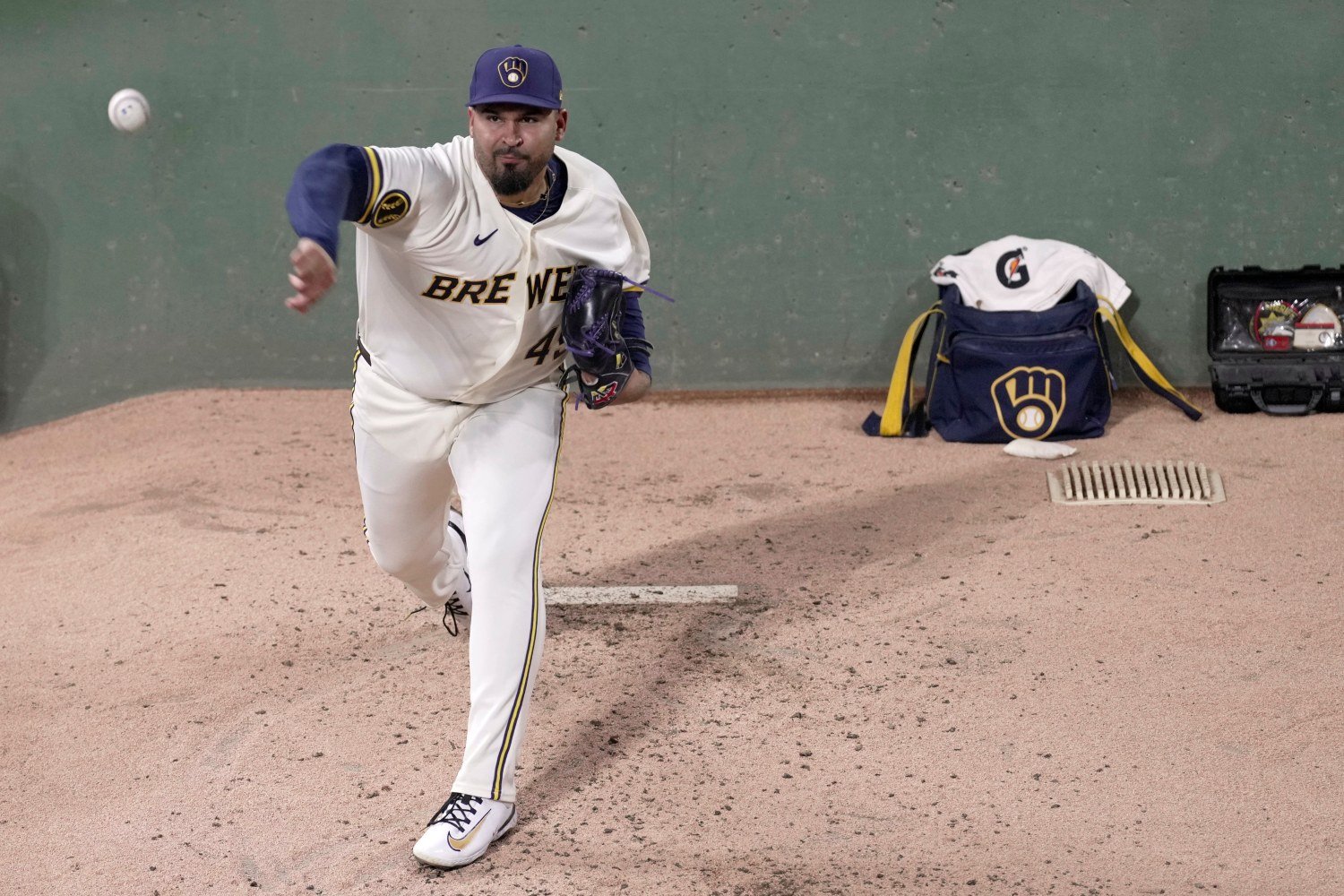
After years as an often-ineffective starter, Antonio Senzatela finally moved to the bullpen for the Colorado Rockies this season. Immediately, his results improved, as they nearly always do when a starter moves to the less demanding role of short reliever. Senzatela achieved his particular glow-up thanks mostly to a ferocious cutter that became a huge part of his arsenal, playing like a power slider off his high-90s four-seamer. It was an enticing enough package to get the Brewers interested, but once they traded for him at the trade deadline, they wanted to add something to it.
Maybe that's not even quite right. What's happened since Senzatela came to Milwaukee isn't a pure addition, so much as a substitution. While still with the Rockies, the righty leaned on his four-seamer and cutter. Since the trade, he's been a sinker-cutter guy.

This isn't wholly surprising, of course. The Brewers love to get a pitcher comfortable with all three fastball variations, wherever it makes sense to do so. For Senzatela, it certainly did, once he got out of the thin air of Coors Field. He throws from a higher arm slot than most sinkerballers, so he was naturally a four-seamer guy, and the movement he gets on his sinker comes mainly from his grip and the resulting movement of air over the seams of the ball (rather than from killing spin and manipulating spin axis), which doesn't work well at all at elevation. Therefore, he'd never used the sinker much before coming to the Crew. Once he arrived and they test-drove it a bit, though, Chris Hook and Jim Henderson recognized that that might be his best fastball.
There was a problem, though. Senzatela switched to the sinker right away, but in his first five outings with the Crew, it yielded dreadful results. He gave up five runs (four earned) over his first 3 2/3 innings and looked like he'd become one of the team's assemblage of disappointing deadline reliever acquisitions in recent years. Then, after a brutal outing in the first game of the Brewers' series at Dodger Stadium, the player and team found the right fix: a move across the mound, from the third-base side of the rubber to the first-base side.

The reason is simple, and probably self-evident. In addition to being an impressively heavy pitch from such a high slot, Senzatela's sinker moves quite a bit more to his arm side than does his four-seamer—about eight inches more.

It you throw a sinker that different from your usual fastball from your usual spot, two different bad things can happen, depending on where you're targeting the pitch.
- If you target the arm-side edge of the plate, you'll probably miss off the plate to that side by so much that the batter will easily let the pitch go for a ball.
- If you target the glove-side edge of the plate (much less likely, for sinkers, but more on that in a minute), you'll probably leave the ball right in the middle of the plate, where there be dragons.
Senzatela's sinker doesn't work quite the way most pitchers' does, so he had a bigger menu of ways to use it available to him. However, to access it, he needed to achieve greater conviction when throwing the pitch, and he needed to put the geometry of the game on his side. Moving to the first-base side of the rubber accomplished both objectives.
As it happens, the Brewers are one team who do ask their pitchers to hit the glove-side edge of the plate even with sinkers, which move to the arm side so much. That works best with guys whose sinkers come from relatively high slots and depend heavily on seam-shifted wake, as Senzatela's does; Quinn Priester (remember him?) is the same way. For it to work, though, Senzatela needed to get on that first-base side of the rubber. Once he did so, things clicked into place immediately. Here's a 2-1 sinker he threw to Teoscar Hernández in his first appearance after changing places on the mound.
You can see, just from the way Hernández reacts, what an unfair pitch that is. A hitter who readies himself to hit that pitch can only make irresponsible and terrible swing decisions. If he were to cover that pitch, Hernández would end up chasing a cutter even a foot off the plate, so he has to give up on it and accept the called strike if Senzatela can dot it like this. On the very next pitch in this sequence, Senzatela brought the sinker back over the plate a little more, but it was still down and dropping fast, and Hernández (probably longing for the more hittable version of this guy he remembered from past intradivisional matchups) grounded out boringly to shortstop.
Here's Senzatela doing the same thing to poor Christopher Morel, 12 days later and on the other side of the country.
It's hard to overstate how devastating a pitch that is, when it's located well. Even doing so occasionally makes a hitter cover a zone that's too big for most guys to manage. Avoid making mistakes in the middle of the zone with the pitch, and you're going to dominate, given this speed and movement and the cutter to play off it. Senzatela ended up inducing a pop-up from Morel to end the inning, on a sinker in on his hands that caught the hitter thinking about the other side of the zone.
This move also lines Senzatela up to throw a more traditional, arm-side sinker, and he's thrown some that snatched souls. This one easily overmatched Julio Rodríguez. The only momentary problem was that it was too nasty to catch.
Moving across the rubber and letting his sinker work back to the arm side as much as it wants has turned Senzatela into a ground-ball machine. He already did a good job keeping that pitch down, so he's rarely in danger of having it hit out of the park, even when he's in the center of the zone.

The Brewers' top tier of relievers consists of Trevor Megill, Abner Uribe and Aaron Ashby. That will remain true, as long as those three stay healthy the rest of the season. Senzatela's emergence as an exceptional ground-ball guy with a deceptive and overpowering pair of diverging fastballs is still vital, though. Down the stretch, Senzatela, JoJo Romero and Chad Patrick can keep the workload of the top trio light, but in October, they'll become even more important. Having all of those guys operating at peak capacity reinforces the advantage the Brewers treasure above all others: the best pitching depth in the league. They've turned a middle reliever who had flashed high-leverage potential but got off to a bad start into one who can be trusted much more; the tweak might pay dividends well beyond Game 162.
Do you approve of the job Pat Murphy is doing as Brewers manager?

Follow Brewer Fanatic For Milwaukee Brewers News & Analysis



-
 1
1
-
 1
1


Recommended Comments
Create an account or sign in to comment
You need to be a member in order to leave a comment
Create an account
Sign up for a new account in our community. It's easy!
Register a new accountSign in
Already have an account? Sign in here.
Sign In Now