


Brewers Video
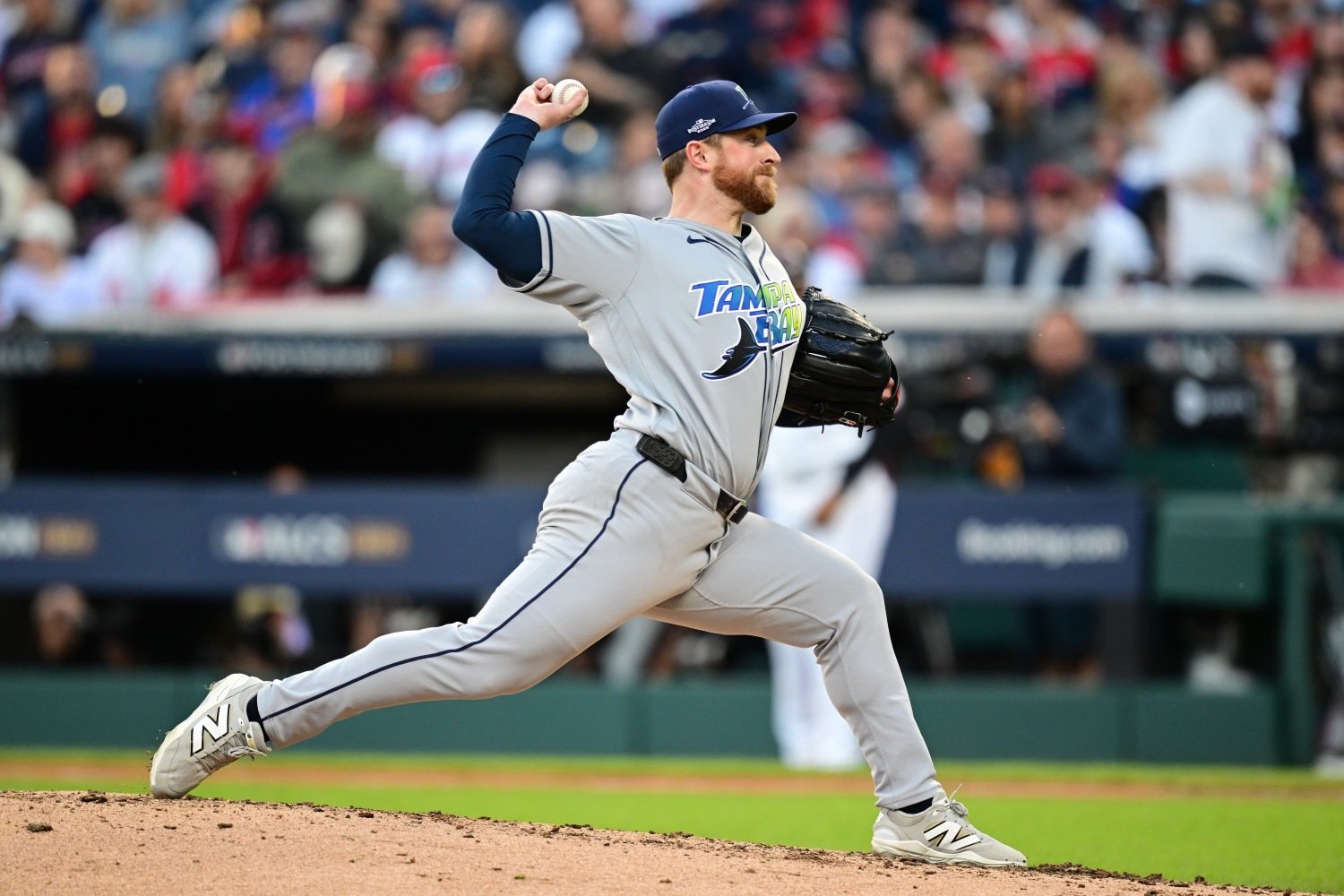
Drew Rasmussen and Freddy Peralta have been stars of the Tampa Bay Rays’ September and October run. Rasmussen has demonstrated the durability over the past two seasons to finally fulfill his potential, while Peralta has been revitalized in Tampa Bay, where the Rays have helped him become more explosive and make better use of his changeup. Both will prove formidable adversaries as the Rays arrive in Milwaukee for Games 1 and 2 this weekend. How can the Brewers get the better of their own former hurlers?
Drew Rasmussen: Hit Him, Or Else
Rasmussen has been the standout starting pitcher of the postseason so far. While the Guardians and Yankees have struggled offensively this year, he shut both lineups down emphatically. His three postseason starts have produced the following results:
- 8 innings, 1 hit, 2 walks, 10 strikeouts, 0 earned runs vs. Yankees
- 6 innings, 8 hits, 0 walks, 7 strikeouts, 2 earned runs vs. Guardians
- 7 innings, 4 hits, 1 walk, 6 strikeouts, 1 earned run vs. Guardians
Rasmussen looked most vulnerable in his first start against Cleveland, allowing two home runs and (perhaps) benefitting from favorable sequencing to limit the damage to two runs. Otherwise, his three-fastball mix, devastating changeup, and relentless strike-throwing have made him a nightmare for opposing hitters.
There are, however, some signs that Rasmussen has become more hittable beneath the surface this postseason. During the regular season, he excelled across several underlying metrics, ranking in the top third of the league in ground-ball rate, hard-hit rate, and called strikes plus whiffs. He consistently got ahead in counts, generated swings and misses, and limited hard contact while attacking the strike zone. That combination allowed him to work deep into games without sacrificing effectiveness.
The foundation of Rasmussen’s success is the combination of above-average command and plus stuff, particularly on his cutter and fastballs. His changeup is an especially effective put-away pitch when he gets ahead in the count, disrupting hitters’ timing after they have adjusted to his fastball-heavy approach.
Pitch Profiler’s metrics illustrate why this combination works. His ProPitching+ grades exceed his Stuff+ grades across his pitch mix, suggesting that his location and execution have added value beyond the quality of his raw stuff. Rasmussen keeps the ball away from the heart of the plate, disrupts timing with his fastball mix and changeup, and rarely wastes pitches. For hitters, that leaves very little margin for error.

Rasmussen has also simplified his arsenal. He previously featured a curveball and sweeper, but neither pitch offered the command or swing-and-miss potential he needed, while both allowed relatively hard contact, averaging over 92 MPH on balls in play. He has since moved away from those offerings, effectively settling into a four-pitch mix.
That change has helped him limit damaging contact. Of his four remaining pitches, only the four-seam fastball has an average exit velocity above 87 MPH, at 91. His sinker and cutter generate considerably more horizontal movement than is typical for a pitcher with his arm slot, making them difficult to square up. Even his four-seamer has been effective, particularly when he locates it at the top of the strike zone. Its high arm slot and induced vertical break make the pitch difficult to hit when elevated. The problem comes when Rasmussen misses down toward the middle or lower portion of the zone, where hitters have found more opportunities to do damage this year.

That distinction could be particularly important for Milwaukee. Rasmussen’s contact-quality numbers have dipped this postseason, and his commitment to attacking the strike zone has begun to carry some risk. His willingness to avoid walks has contributed to an excellent 26.4% strikeout-minus-walk rate, but that same aggressiveness can leave pitches over the heart of the plate. He now ranks below average in both barrel rate and hard-hit rate prevention, while his swing-and-miss rate sits just above average. Those numbers suggest that, although Rasmussen is still missing bats and limiting walks, hitters have had more opportunities to make solid contact when he does enter the zone. His control has been elite this month. The only hope you have is that he's making a (very) few more mistakes in the middle of the zone. Here's his run from June 1 through the end of the regular season, and in the playoffs, via the FanGraphs PitchingBot Visualizer tool.

The Brewers could be well placed to exploit that trade-off. They have shown they are willing to work an at-bat when a pitcher struggles to generate whiffs in the strike zone, waiting for a mistake they can drive rather than chasing pitches outside their ideal hitting zones. Against Rasmussen, that patience could be crucial—especially as the team hones its focus on assailing mistakes.

The challenge is that his pitches are not easy to spoil. Without a prominent breaking ball to disrupt their timing in a different way, hitters can find themselves just late or early enough to put the ball in play, rather than foul it off and extend the at-bat. That creates a difficult balance for Milwaukee: be selective enough to punish mistakes, but avoid turning Rasmussen’s weak contact into easy outs for a Rays defense that can smother you on balls in play.
I would expect Rasmussen to lean more heavily on his changeup against the Brewers. Milwaukee showed some vulnerability to changeups against the Dodgers, and their ability to recognize and adjust to that pitch could go a long way toward determining the outcome of this matchup.
Rasmussen has thrown 47% of his pitches in the shadow zone (around the edges of the strike zone), highlighting just how effectively he works the margins. The Brewers’ best route to success is to make him come over the heart of the plate, without chasing the pitches he uses to get ahead.
Force Rasmussen to prove he can beat them inside the zone, then capitalize when his command slips. If he continues to locate his pitches on the edges and disrupt their timing, his return to Milwaukee could make for a long, gruelling night for the Brewers. One thing is for sure: Rasmussen won't beat himself. He won't issue free passes. The Brewers are going to have to make their own fortune in this one.
Freddy Peralta: Why Swing?
Freddy Peralta looks like an elite arm on the surface. He has thrown 16⅔ innings this postseason (including one relief appearance) and conceded just two earned runs. He was even named ALCS MVP. The results suggest a pitcher in complete control, but the changes made by the Rays’ pitching staff have helped Peralta become more athletic in his delivery, increase his fastball velocity, and simplify his approach. He's also making greater use of his changeup, reducing his reliance on the breaking pitches that were often difficult to command during his time with the Brewers and Mets. They've got him back on the third-base side of the rubber, too, where he's always preferred to be.
Peralta is throwing harder and keeping things simpler. The surface results suggest genuine progress, but they may also disguise some good fortune. For Milwaukee, the question is whether his new approach can continue to succeed against a lineup that knows his tendencies better than most.

The changeup is one of baseball’s most effective weapons for disguising a fastball, and Peralta’s ability to tunnel the two pitches has helped him limit damaging contact this postseason. As the data above illustrates, hitters have struggled to square him up consistently. However, there are signs that his results have been better than his overall command. Peralta’s zone rate sits at just 44%, falling to 37% in Game 6 of the ALCS. Despite generating swings and misses, he has not consistently translated that into high strikeout totals. That combination matters: if hitters are not making enough contact to hurt him, but are also not striking out at a high rate, there may be opportunities to force him into longer at-bats and make him work harder for outs.
The key is understanding how differently Peralta approaches right- and left-handed hitters. Against right-handers, the fastball has been his primary weapon. It's been in the strike zone approximately 48% of the time, and he's relied on it almost exclusively against right-handed hitters this postseason. Of the 26 pitches he has thrown to right-handers, 24 have been fastballs.
That predictability could become a problem against William Contreras and Jackson Chourio, two hitters who can punish a pitcher who allows them to settle into a rhythm. Although right-handed hitters have managed just a .422 OPS against Peralta so far, the Brewers cannot afford to confuse poor results in a small sample with an inability to handle his elevated velocity. His fastball is an excellent pitch in its own right, but if he continues to lean on it so heavily, Milwaukee’s right-handed bats may eventually find their timing. Of course, in showdowns between either of those guys and Peralta, you can all but throw out the numbers. The parties involved know each other as well as any batters and pitchers who might face off, anywhere in baseball. Peralta will be trying everything he can to confound the expectations of Contreras and Chourio, but those two will also be thinking along with him more than batters usually do.

Left-handed hitters have seen a more varied approach, with the changeup playing a central role in neutralizing them. That makes Christian Yelich, Jake Bauers, Brice Turang and Garrett Mitchell particularly important to this matchup. If Peralta can use the changeup to keep those four hitters off balance, he'll have a much better chance of working efficiently through the Brewers’ lineup.
There is another wrinkle in his approach: the curveball. Peralta has thrown 19 curveballs this postseason, 12 of them in 0-0 counts and three in 3-2 counts. The early-count usage is particularly revealing. He's thrown the pitch in the strike zone 63% of the time, suggesting it can be an effective way to steal a strike before returning to his primary weapons.
For the Brewers, recognizing that pattern could simplify the at-bat. If Peralta opens with a curveball for a strike, hitters should be prepared for the fastball and changeup to dominate the remainder of the plate appearance, rather than expecting him to continue mixing in breaking pitches. They shouldn't automatically dismiss a second curveball, but they can use his tendencies to anticipate what is most likely to come next. More importantly, there might be an opportunity to ambush that curve. Brice Turang, for instance, handles curveballs from right-handed pitchers exceptionally well, and can drive that pitch out of the park to center field.

Peralta’s ability to limit hard contact this postseason has been helped by the locations he is targeting. He's keeping his fastball in the upper third of the strike zone or above it, avoiding the lower portion of the zone until his mechanics begin to falter. When he executes that approach, the elevated fastball can generate swings and misses or weak contact without giving hitters a comfortable pitch to drive.
The danger for Milwaukee is chasing that fastball above the zone. Doing so would play directly into Peralta’s strengths, allowing him to generate uncompetitive swings while avoiding the risk of throwing hittable pitches over the heart of the plate. Unlike Rasmussen, who challenges hitters with a high rate of strikes and precision around the edges, Peralta presents more of a waiting game. The Brewers need to be prepared to see pitches, extend at-bats and accept walks when he cannot locate the ball. When he misses, it tends not to be in the middle of the plate, but out of the zone—especially to the arm side.

That doesn't mean taking every pitch that isn't a fastball. Peralta’s changeup is a genuine weapon, particularly against left-handed hitters, and his curveball can steal strikes early in counts. Instead, Milwaukee needs to recognize the difference between a pitch it can drive and one designed to provoke a chase.
As with Blake Snell, Peralta can be exceptionally difficult to hit when he controls the terms of the at-bat. But the Brewers have an opportunity to make him work differently from the Guardians and Yankees: take the borderline pitches, recognize the elevated fastball, and refuse to expand the zone. They need to make him earn every out. If the Brewers remain disciplined, the walks should come, the pitch count should climb, and the occasional fastball left in the strike zone (or attempted strike-stealing curve) could provide the opportunity for a big hit with runners on base.

The main difference between the pitcher against whom the Brewers scored seven earned runs in 5 1/3 innings in July and what the Rays have now is the chase rate. The changeup has been a big part of helping Peralta induce more chase. It's had a dramatic knock-on effect on the quality of contact Peralta has given up, compared to his time with the Mets, Hitters are swinging more often against Peralta since the trade deadline, but that's unlikely to continue in the World Series, with the most patient hitters in baseball facing him.
Summary
Rasmussen and Peralta have been instrumental in Tampa Bay’s postseason success, particularly because the Rays' pen is not as robust as it's been in past Octobers. The two former Brewers arms are formidable front-line arms, but they don't have elite relief support. The Brewers need to get to each, but they can also win by pushing them out of the game early and pouncing on a middle reliever or two. The name of the game, against each, is to avoid quick outs. That will just require different approaches against each, given their different styles.





Recommended Comments
There are no comments to display.
Create an account or sign in to comment
You need to be a member in order to leave a comment
Create an account
Sign up for a new account in our community. It's easy!
Register a new accountSign in
Already have an account? Sign in here.
Sign In Now