


Brewers Video
It sounds dramatic to call a non-elimination game a must-win, but for the Brewers, a Game 1 win in the NLDS was as close as you can get.
Generally speaking, the first game sets leverage for the rest of the series; under MLB's current playoff format, the team that wins Game 1 of the Division Series has won the series more than 70% of the time. In this matchup, even more leverage was at stake.
Milwaukee will face Michael King and Nick Pivetta, the Padres' two best starting pitchers, in Games 2 and 3. The latter will be at a rowdy Petco Park, where the Brewers must piece together two bullpen games with some combination of Robert Gasser, Dustin May, Shane Drohan, and Kyle Harrison. Gasser finished his season strong, but with middling peripherals. May, Drohan, and Harrison all struggled in September and lost full-time rotation spots.
The Game 1 matchup, meanwhile, firmly favored the Brewers: soon-to-be NL Cy Young Award winner Jacob Misiorowski against back-of-the-rotation veteran Robbie Ray. It was their opportunity to set the tone and give themselves room for error in those San Diego games.
Instead, things went haywire from the get-go. Misiorowski couldn't control his fastball, and the Padres worked him for 25 pitches in a scoreless first inning. Ray retired the side in order on seven pitches, sending Misiorowski right back to the mound.
With Misiorowski's fastball command faltering, William Contreras faced the challenging job of calling the right pitches to rein him back in. When his fastball sails up and arm-side, as it was on Saturday, the cutter becomes his most consistent in-zone pitch, because it forces him to work through the ball to his glove side. But there's a fine line between the cutter being a valuable fallback fastball and the worst pitch to throw in a given sequence. When hitters are late on triple digits, they're right on time for 95- to 97-MPH cutters.
Misiorowski's fastball wasn't overpowering the Padres—they whiffed just four times on 28 swings against it—but they weren't timing it up, either. Most of their foul balls were late swings. Timing-wise, cutters were not the right call during a three-batter sequence in the second inning.
With one out, Xander Bogaerts reached on a hard ground ball in the hole that Cooper Pratt knocked down for an infield single. After Ethan Salas whiffed late on a first-pitch fastball down the middle, Contreras called a cutter on the next pitch. Even though it was below the zone, Salas drilled it up the middle for another hit. After Luis Campusano took a fastball for strike one, Contreras called another cutter, and Campusano singled down the right-field line. The Padres had an early lead, in a game where the Brewers were positioned to strike first.
"In the second inning, his heater wasn't a strike very often. He was missing his spots, and they felt they had to go to offspeed," Pat Murphy said. "After you see the [hit], 'Why didn't you just throw a fastball at 103?' But they weren't feeling good—[Contreras] and Miz himself—they weren't feeling good about the heater command after the first inning."
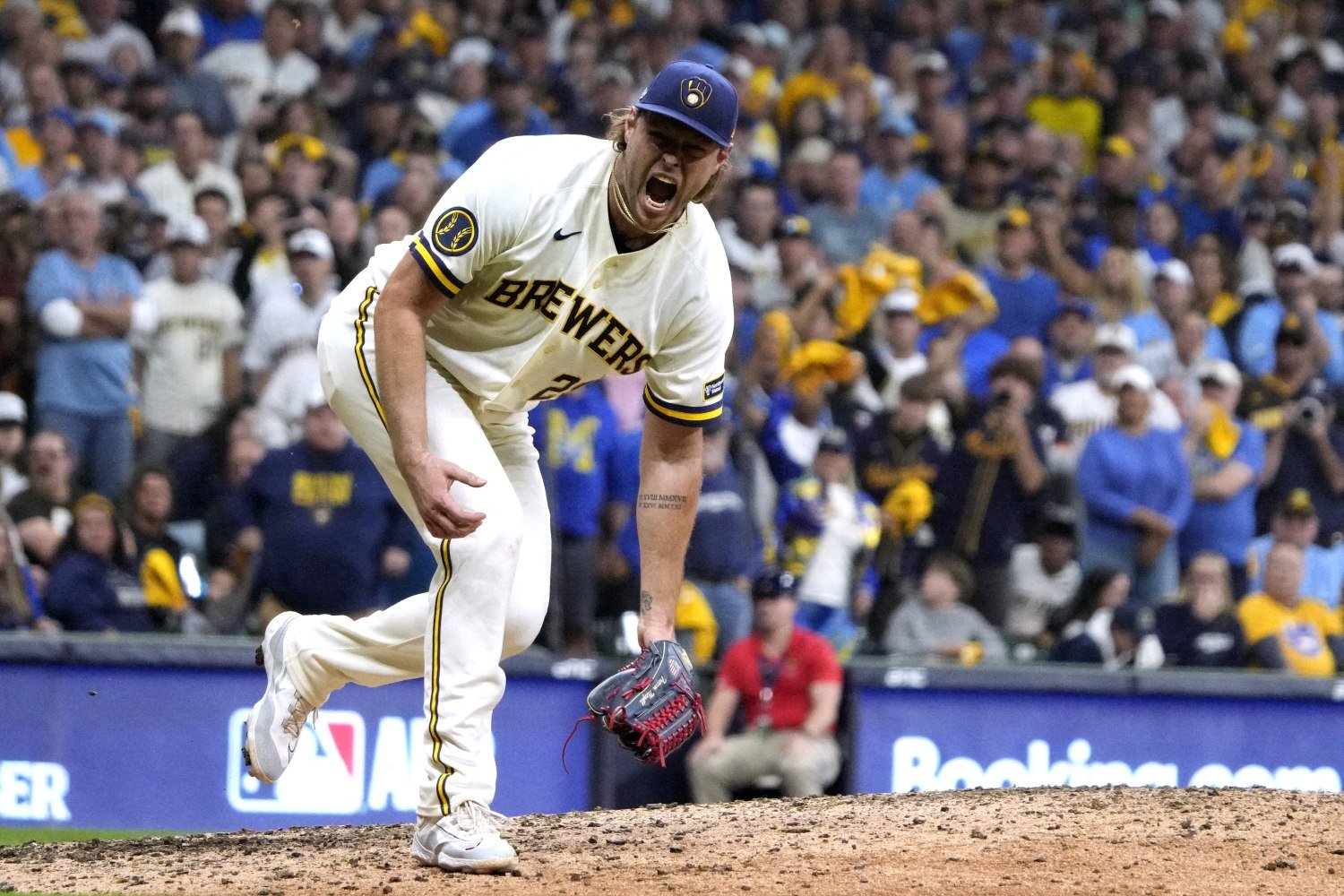
After a mound visit from Chris Hook, Contreras and Misiorowski committed to the fastball, throwing it 77% of the time in the third and fourth innings. He threw one more cutter, but the rest of his secondary pitches were curveballs. Misiorowski faced the minimum over those final two innings before the Brewers went to the bullpen.
"We're trying to battle them, and they were fouling **** off," Misiorowski said. "You've kind of got to make an adjustment and try to go soft, and they're fouling soft off. You kind of just do something until it sticks, and that was the curveball and heater."
Meanwhile, Jackson Chourio resumed his postseason heroics with a game-tying home run off Ray in the bottom of the third. The Brewers loaded the bases with two walks and a bloop single after that, but Christian Yelich and Cooper Pratt failed to drive those runners in. That kicked off a three-inning stretch where Milwaukee had traffic but couldn't score.
It wasn't a lack of effort or poor process. The Brewers had the same strong at-bats they usually do, making sound swing decisions and forcing the Padres to make plays. Murphy said a few hitters were "a little jittery," but the offense chased just 24% of pitches outside the zone and swung at 72% of pitches in the zone, both even better than its season averages.
That approach scored the second-most runs in baseball during the regular season. On Saturday night, it wasn't working. The Brewers just ran into a buzzsaw Padres bullpen and a few loud outs, including six outs with exit velocities of at least 100 MPH.
"You've got to understand who we faced," Murphy said. "That bullpen is recognized as the best in the game, if not one of them."
Like last year, this is the concern shrouding the Brewers' brand of offense in October: does waiting out pitchers and stringing together hits work against the game's best arms in a short series? If not, Milwaukee, who ranked 29th in home runs, must hit for enough power to change games with a couple of swings. Their very first postseason game played out that way.
The Brewers needed another home run, and they got it in the seventh. William Contreras worked Morejon into a 3-1 count, then launched a 3-2 sinker over the outer third of the plate to right-center to give the Brewers a 3-2 lead.
"[The home runs] were helpful," Murphy said. "We'll take them."
"There's a lot of people in the public opinion that think that we're not able to connect with the big hits, with the homers," Contreras said. "I like that today that's how the game shook out, and we were able to win like that. We were able to show that we were able to play that game, as well."
Some of that tough batted-ball luck swung back the Brewers' way in the ninth. With the tying run on first base against Trevor Megill, Ty France's loud fly ball hit one of the cables hanging from American Family Field's roof and deflected down to Chourio, who caught it for the second out. Jackson Merrill then ripped a 109-MPH lineout to Luis Lara to end it.
France's fly ball almost certainly wasn't clearing the fence in fair territory without the deflection. In the Statcast era (since 2015), just one batted ball with a launch angle of at least 49° and exit velocity between 105 and 106 MPH—how France hit his ball—has been a home run. He hit it too high. Both Murphy and Chourio believe it was tailing foul, meaning the cable denied France another swing against Megill.
"A hitter that talented, they would have liked to have that hitter back up there with another strike," Murphy said.
The Brewers' path to their first World Series becomes clearer if they win Misiorowski's starts and hit with timely power. They did both on Saturday night. The Padres took a bite out of Milwaukee in the process, forcing them to use five relievers behind Misiorowski, but that's inconsequential compared to the importance of a Game 1 Brewers win. It wasn't easy, but they gained the series leverage they needed.





Recommended Comments
There are no comments to display.
Create an account or sign in to comment
You need to be a member in order to leave a comment
Create an account
Sign up for a new account in our community. It's easy!
Register a new accountSign in
Already have an account? Sign in here.
Sign In Now