


Brewers Video
On Friday night, against the Boston Red Sox at American Family Field, Freddy Peralta will take the mound in his fourth turn through the rotation, following a West Coast road trip that almost could not have gone better. Thus far, the Brewers have been an extremely balanced team in terms of offense, pitching, and defense picking up one another. Right now, however, the surface stats suggest that the pitching is leading the way. At 95 Runs Scored and 60 Runs Allowed, the Brewers are on a "true" expected pace of 110 to 113 wins (using their Runs Scored / Runs Allowed), certainly enough to satisfy even the most cynical of Brewers fans (myself included!). Against the expected National League and home park environment, according to Baseball Reference multi-year park factors, the Brewers bats are a respectable 11 runs better than average after nineteen games. By contrast, the arms and defense are approximately 24 runs better than average.
What is astonishing about this Brewers rotation is that Aaron Ashby, Adrian Houser, and now Brandon Woodruff are on the injured list for extended periods of time, and offseason depth acquisition Janson Junk has provided nothing more than an emergency start at this point. I say this is astonishing because last year, the Brewers starting rotation was the biggest weakness of the club, impacted by a few injuries and depth issues, as well as backward steps (some admittedly injury-induced) by Corbin Burnes, Woodruff, and Peralta. Given that set of circumstances, the fact that this team is tracking toward triple-digit victories is more than a pleasant surprise.
So far, the Brewers have avoided a disaster scenario, and that's a truly great thing. So, I want to write a semi-regular column throughout the year taking snapshots of the starting pitching rotation exactly where they are. For these purposes, I will be using Runs Prevented, which is a statistic that simply estimates how much better (or worse) a pitcher is against their home park environment and league environment, based on innings pitched. While there are many reliable advanced pitching stats out there, like Baseball Prospectus's Deserved Run Average (DRA, and its indexed cousin DRA-) and Fielding Independent Pitching (FIP), I prefer to use Runs Prevented because it correlates to the numbers that are posted on the scoreboard. There are (and have been) many articles published on why a pitcher might fail to live up to (or exceed) their expected runs production, but at the end of the day, baseball is still decided by Runs Scored and Runs Allowed (although perhaps MLB has an appetite for that rule change, too).
To be clear, one would reasonably expect stats like DRA- to be indicators of expected performance for pitchers in the future--even more so than mere Runs Allowed Per 9 Innings Pitched--but I believe it is still important to look at the actual runs allowed by each pitching staff in order to understand the true shape of how the league is performing and how each team is performing.
So, entering Friday’s game, the Brewers' active rotation core has the following look:
- Wade Miley: 6 runs prevented (3 GS / 18.0 IP)
- Freddy Peralta: 2 runs prevented (3 GS / 17.0 IP)
- Eric Lauer: 0 runs prevented (4 GS, 23.0 IP)
- Corbin Burnes: -1 runs prevented (4 GS, 22.7 IP)
Meanwhile, the current periphery of the rotation looks like this:
- Brandon Woodruff: 4 runs prevented (2 GS / 11.3 IP)
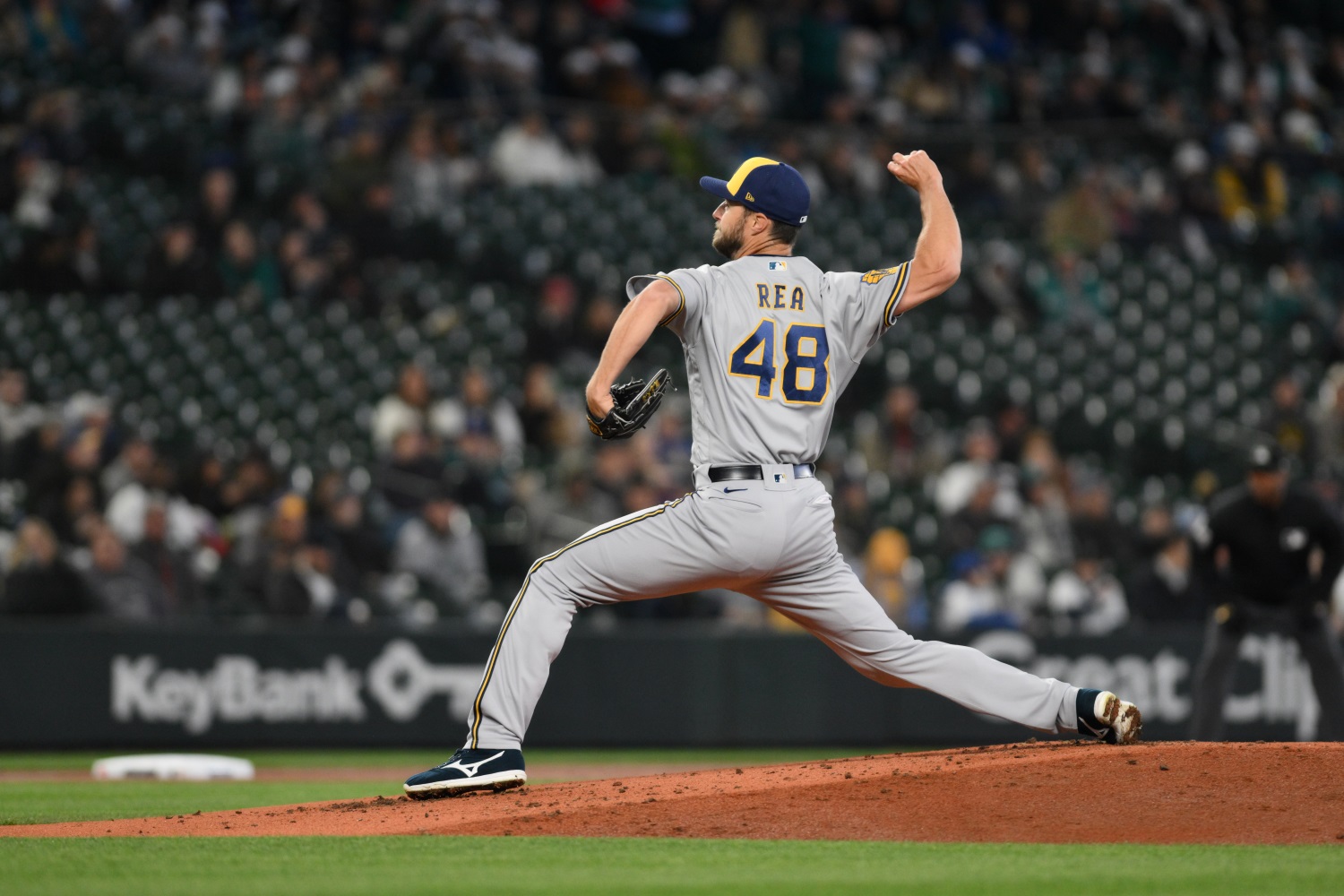
- Colin Rea: -0 runs prevented (2 GS / 10.7 IP)
- Janson Junk: -3 runs prevented (1 GS / 4.7 IP)
It is indisputable, at this point in the season, that the bullpen is driving the pitching staff, with nearly twice as many runs prevented by relievers as by starters thus far. But the pitching group is formidable overall. This rotation core inserted into an average club would put that club on an 88- to 90-win pace, if all else was held equal.
After the next set of 16 games, and the next three turns through the rotation, do you think this list will look similar?






Recommended Comments
There are no comments to display.
Create an account or sign in to comment
You need to be a member in order to leave a comment
Create an account
Sign up for a new account in our community. It's easy!
Register a new accountSign in
Already have an account? Sign in here.
Sign In Now