


Brewers Video
Pat Murphy was eager to discuss Joey Ortiz's fantastic game after Wednesday's Brewers win over the New York Mets, but he was just as excited to talk about another hitter's multi-hit performance after prolonged struggles.
"How about Yelich today?" Murphy asked after praising Ortiz. "Nine-pitch at-bat to lead off the game, which is underrated, RBI, an RBI triple—good at-bats against really good pitching."
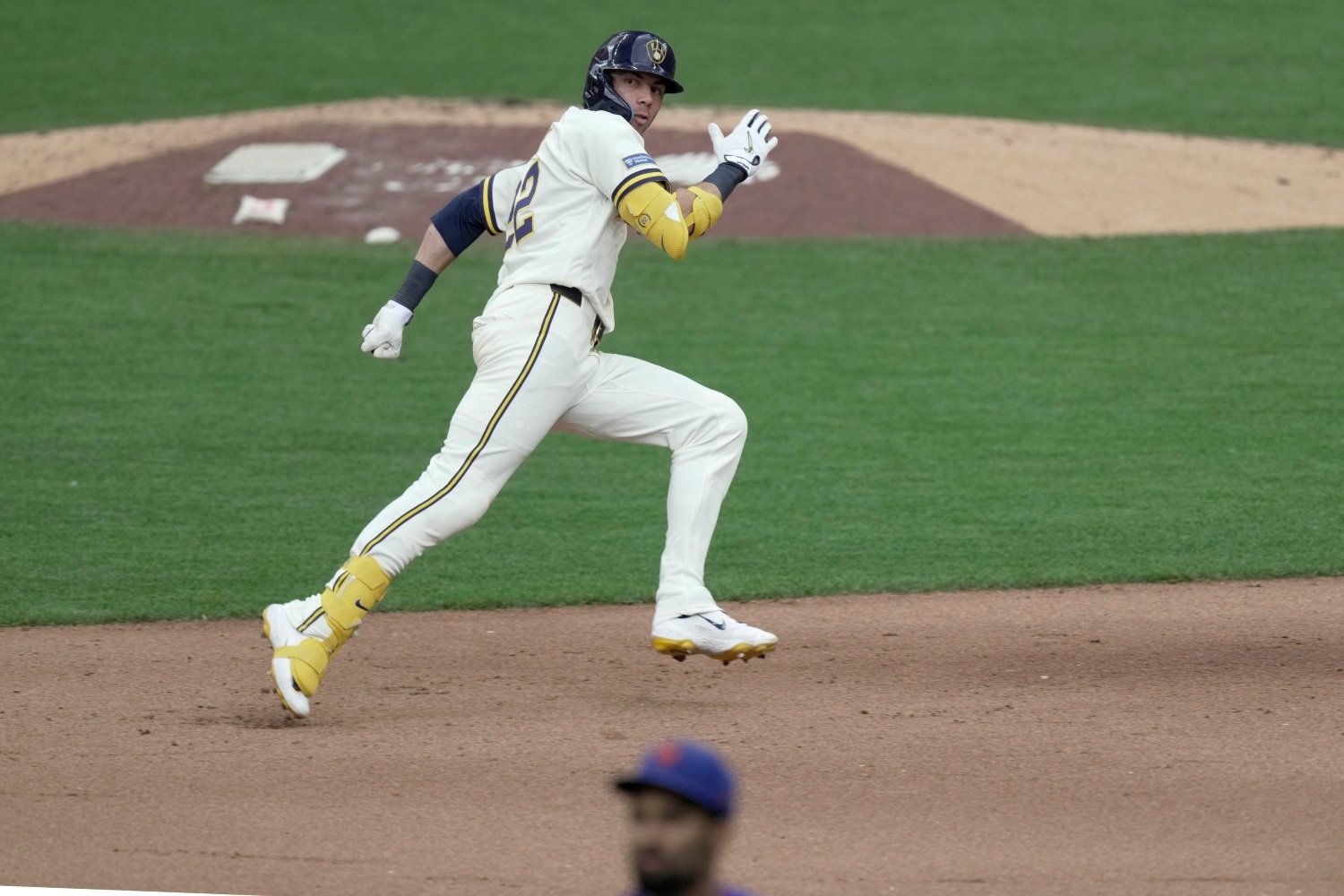
Yelich drove in Ortiz twice: first with a single in the second inning, then with that triple in the sixth. He has four extra-base hits on the current homestand, hitting .250/.375/.500 (a 140 wRC+).
"I'm pumped for 'Yeli,'" Murphy said, deliberately shouting him out a second time in his five-minute press conference.
After a rough first half, Yelich's production and role will be a major storyline down the stretch. If the season ended today, his 99 wRC+ would be the lowest of his career, and the first time he's been a statistically below-average hitter. Lackluster results in a sample of around 300 plate appearances aren't new for Yelich. His overall solid production has experienced more ebbs and flows in recent years. Just last year, Yelich got off to a slow start before doing his best work in the second half.
When things went poorly in the past, Yelich was still hitting the ball hard and usually getting a bit unlucky. That hasn't been the case this year. His .299 xwOBA is lower than his .316 wOBA and is a career low. His hard-hit rate and average exit velocity are also personal worsts. Yelich has never really been a contact hitter, but his whiff rate has jumped to 30.5%, his worst mark outside of the shortened 2020 season.
In the rolling chart below of Yelich's xwOBA over 200 plate appearances, that blip in 2026 below the red average line jumps out. It's still just a blip, but it's a first-time blip. In other words, Yelich has never had a stretch this prolonged in which his quality of contact (not just his results) has been this poor.

Yelich is moving more rigidly. His average sprint speed is down from 28.2 feet per second last season to 27.3. He hasn't looked flexible enough to reach low pitches with his swing path, making it even harder for him to make contact with back-foot breaking balls (the league's whiff rate on those pitches is 40.2%; Yelich's is 63.6%).
Being stiffer has also limited Yelich's skill set and made him less valuable in a few smaller ways. In another pair of unwelcome firsts, he now has below-average speed and has taken fewer extra bases on balls in play than the average runner, according to Statcast.

Yelich's infield hit rate has cratered from 7% of ground balls in each of his previous two seasons to a career-worst 4% in 2026. Earlier this month in Pittsburgh, he laid down a near-perfect bunt for an attempted hit. It took him long enough to get out of the box and run to first that third baseman Nick Gonzales, positioned on the dirt near the traditional shortstop position, had enough time to charge the ball as it rolled down the third-base line and throw out Yelich by half a step.
These could all be symptoms of an underlying injury. Yelich missed time in April and May with an adductor strain and a recurrence of back issues. But with Jackson Chourio, Garrett Mitchell, Jake Bauers, and (until his recent shoulder injury) Sal Frelick all playing well, there's been no need for him to play through pain. When his back has flared up in the past, the Brewers have usually shut him down pretty quickly.
The likelier and more sobering answer is that at 34 years old, Yelich is physically declining and cannot move like he used to. If that's the case, he and the Brewers should not count on a return to form, because that form is gone. Instead, he must make physical adjustments to perform without his past mobility. As a 14-year veteran in tune with his body, Yelich is equipped to make that transition, but it's still challenging to do in-season.
The Brewers are already quietly platooning Yelich; he's started just two of their last eight games against a left-handed starter. But it's too early to relegate him to a part-time player. Not only has he earned a long leash, but Frelick will be sidelined for an undetermined stretch, and Andrew Vaughn's 98 wRC+ against right-handers isn't much better than Yelich's.
If Frelick returns and Yelich doesn't improve, it will be easy to say that the Brewers should reduce the latter's role, but it's not that simple. Yelich is their highest-paid player, their longest-tenured hitter, and a respected clubhouse figure who leads more with his conduct on the field than with his words. To demote him in the lineup—or, even worse, to the bench—is an open acknowledgment that something is wrong, and that it's not immediately fixable. The implications could bleed off the field.
To avoid that dilemma, Yelich must start producing. That's why any signs of life, like those glimpses since the All-Star break, are encouraging.
Do you approve of the job Pat Murphy is doing as Brewers manager?

Follow Brewer Fanatic For Milwaukee Brewers News & Analysis



-
 1
1



Recommended Comments
Create an account or sign in to comment
You need to be a member in order to leave a comment
Create an account
Sign up for a new account in our community. It's easy!
Register a new accountSign in
Already have an account? Sign in here.
Sign In Now