


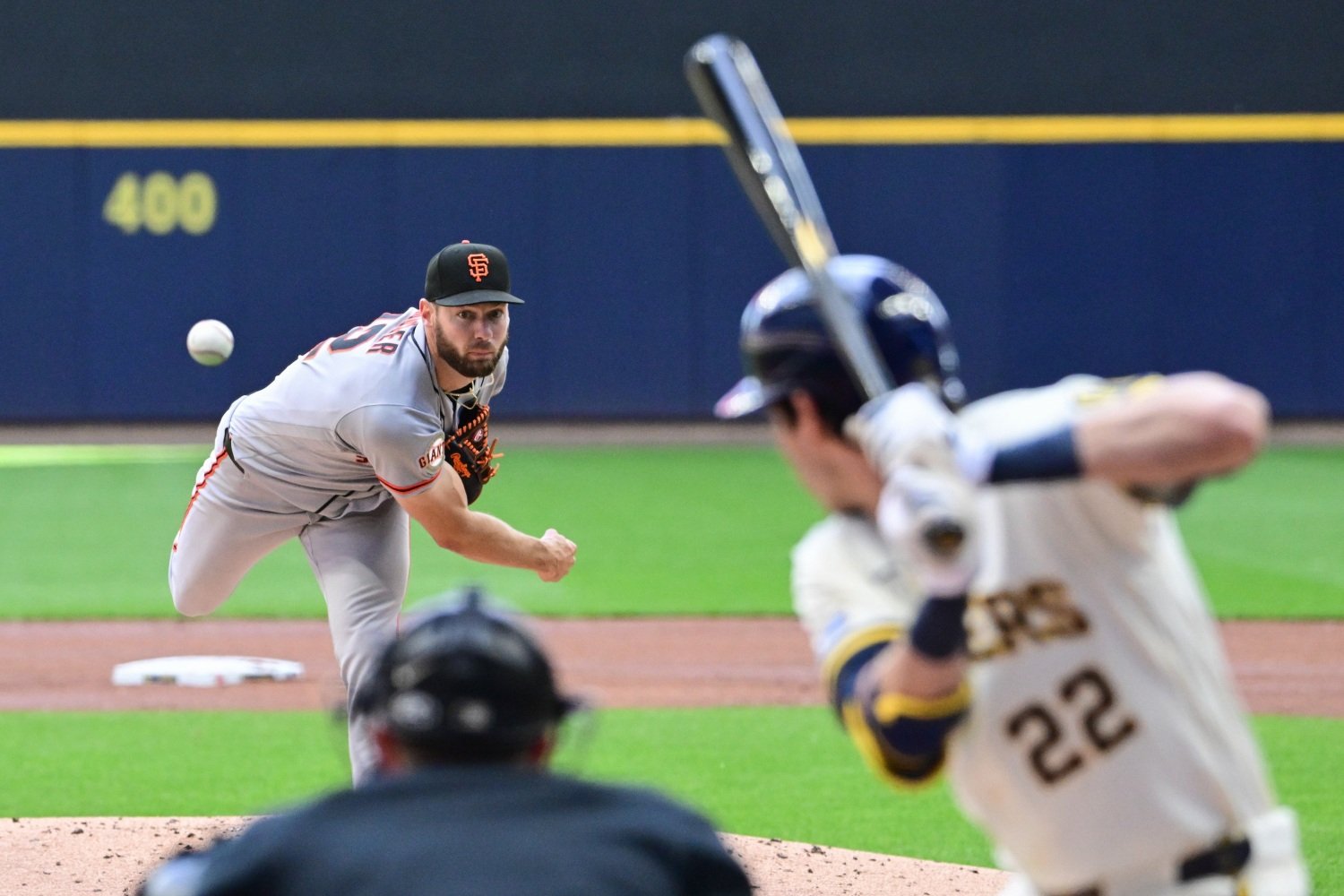
Brewers Video
"Why are you worrying about Christian Yelich?" you might be asking, and you'd have a fair point. David Hamilton is only slowly pulling himself out of a career-threatening cold snap to start the season. Sal Frelick is mired in the same depth of trouble. Blake Perkins, Joey Ortiz and Luis Rengifo are holding onto big-league jobs by their fingernails, and that's especially bad news in their cases, because they only really do well when they're working with their glove. Yelich, meanwhile, is batting .287/.354/.434. It's a normal season. Find a new slant.
Well, no. Sorry. There's real danger lurking behind Yelich's superficially solid numbers, and we had better talk about it a bit. Thankfully, some new data from Statcast sheds plenty of light on the problem. Yelich is running into some concrete problems with clear explanations, even if not all of those problems are solvable. He's over his skis right now, and uisually, when you get over your skis, you end up crashing.
In 158 plate appearances this year, Yelich is striking out 28.5% of the time. Only in the hopelessly bizarre, meaningless 2020 season did he punch out more often. Even that year, he walked at a shockingly high 18.6% rate. This season, that number is less than half as high, at 8.9%. This would be, in short, the worst strikeout rate and the worst walk rate of his career. He's also hitting the ball less hard on average, hitting it hard less often, and hitting it on the ground more. If none of that sounds good, give yourself a gold star; you know ball.
Expected stats don't always tell the whole story, but Yelich's stand in unusually stark contrast to his solid surface-level numbers. He's not controlling the zone well, and he's not making up for that by hitting the ball productively in any sense. He's not going to keep being a good hitter for long, if this keeps up. And here's why.
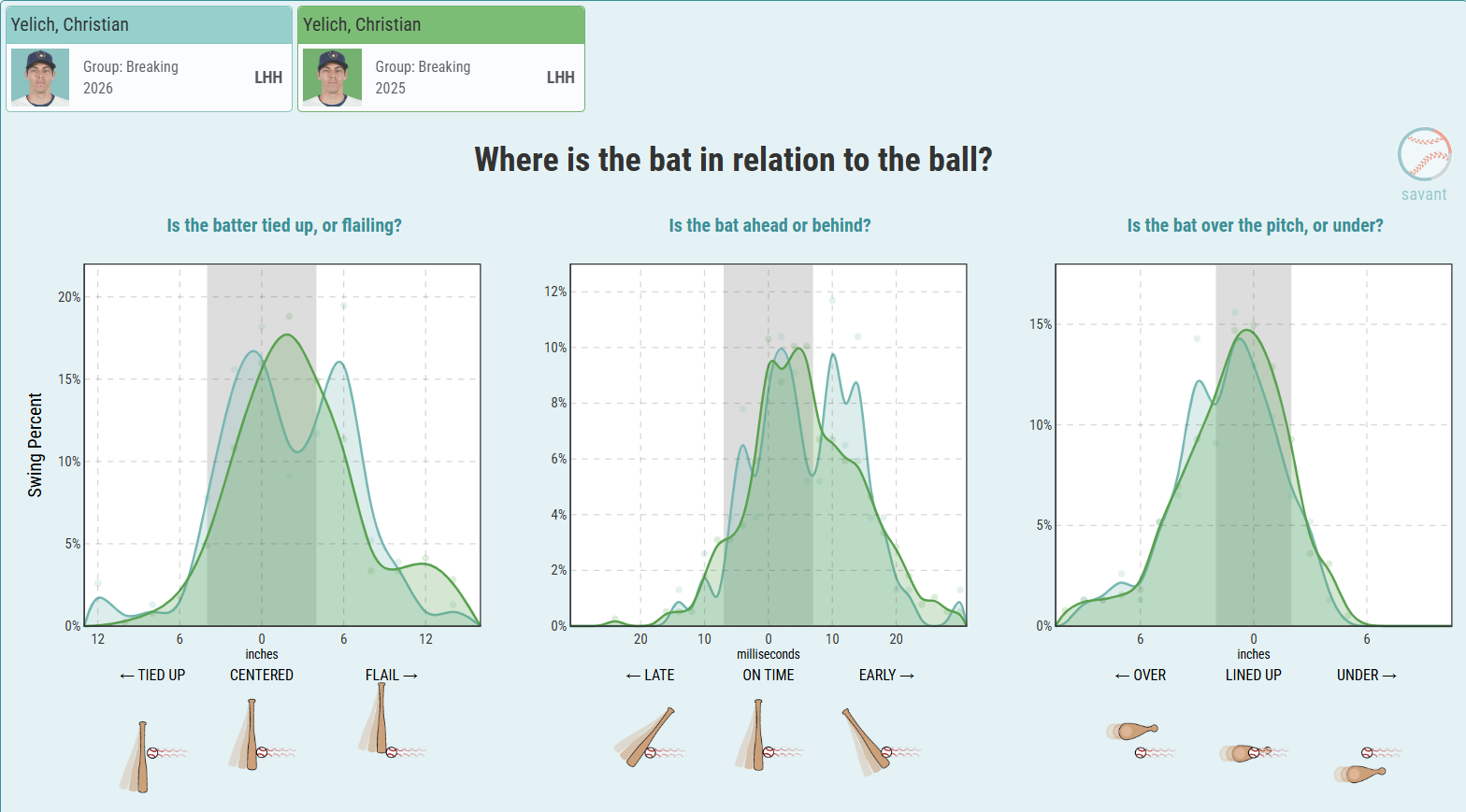
This image comes from Baseball Savant's new leaderboards showing swing timing and miss distance. Initially, they might seem inscrutable, but walk through them with me. Here, we've isolated what Yelich is doing on swings against breaking balls, and we're comparing 2025 to 2026. As you can see, last year, he had a fairly normal distribution in his swings against breaking pitches, in terms of where he met (or would have met) the ball on the bat, horizontally (left); whether he was early, late or on time against them (center); and whether he swung above, below or right through the ball, vertically (right). Those are the slightly forest-hued green curves.
In 2026, something different is happening. As he tries to adapt to what's happening with his body, Yelich is taking a bifurcated approach, which is producing a bimodal distribution. Sometimes, he's sitting on a breaking ball. Other times, he's gearing up for the heat. When it's the former, he's usually on time, and he centers the ball on his barrel laterally pretty well. When it's the latter, he's usually early, which means he either ends up getting the ball with the end of his bat or running out of bat altogether and whiffing. The right-hand image might be the most interesting, though it contains the least obvious difference from one year to the next: he's swinging over the ball (be it very slightly, leading to contact but downward launch angles, or extremely, leading to whiffs) even when he's otherwise lined things up.
This is why Yelich is whiffing on roughly half the breaking balls he sees this year. It's why he's hitting worse against those pitches than he has since he was a pup in Miami:

You could chalk this problem up to Yelich sitting on fastballs, but you'd be wrong. For one thing, he hasn't gotten any extra juice out of his swings against fastballs, really. More importantly, though, look at how well he's hitting offspeed pitches. We already saw that he's sometimes sitting on breaking stuff, putting him on time for them more often than in the past. He's doing the same thing with changeups, but succeeding much more often.
The reason is simple: Yelich has gotten much more grooved, with his swing. This trend began last year, when his contact rate on pitches outside the zone fell to a career-low (except 2020) 44.2%. This season, that figure has plunged all the way to 36.3%, the lowest of his career even if you want to count that husk of a year in the shadow of COVID. He has one swing plane on which he can succeed. He's unable to adapt the way he used to, without presetting his plan to aim higher or lower than usual.
Against changeups, that works. Most (though not all) hitters can spot and intuit the way most changeups will drop en route to the plate. Pitchers with a good combination of ride on the fastball and depth on the change can get whiffs from hitters based on the movement, but most of a changeup's effectiveness comes from the speed differential on it. This is also why flatter swings work best, on average, against offspeed stuff.
Breaking balls are different. Even a great hitter who's an expert at spotting the telltale dot on a slider and/or is hunting a breaking ball can struggle to adapt to their movement, which can be extreme and vary widely even from pitch to pitch for a given hurler. As a result, you have to be able to bend and adjust your swing while the ball is in flight. That sounds impossible, and if you're thinking about it up there, it is. Through enough reps and their extraordinary talent, though, many hitters learn to do it. At some points in his career, Yelich has been able to do it, too.
A lot of that subtle, even subconscious adjustment happens in your lower half, though. A lot of it happens in your spinal column. At this point in his career, on the other side of major back surgery, Yelich simply doesn't have that adaptability. He's gotten stiffer, as virtually everyone does when they enter their mid-30s and as everyone does after they have back surgery. Thus, even when he sits on breaking balls and ends up on time, he can come up completely empty. In fact, he's often doing so.
The league's average whiff rate on breaking pitches for which they're on time is 17.5%. Yelich's mark has hovered just above that all along (as far back as 2023, when bat-tracking data went live), but this year, it's gone through the ceiling. Last year, he whiffed on 22.9% of on-time swings against breaking balls, swinging over the ball 21% of the time and missing by 3.9 inches, on average. This year, he's whiffing on 39.5% of those on-time swings, swinging over it 37% of the time and missing by 4.8 inches. Here's what that often looks like.
"Ok," you might say, "but that's just a bad swing decision. He was sitting on a fastball that time, and chased a pitch down and out of the zone." That's true, to some extent. We'll even ignore the fact that he might be making more of those poor decisions because, as he ages, he's losing bat speed and needs to decide earlier about each pitch. But plenty of his breaking ball whiffs also look like this.
Or like this:
Both of those are cases of pitches nipping the corners of the zone, forcing Yelich to swing. He was on time for them, which tells us he was ready to attack them. Still, he swung right over them. Lots of other left-handed batters—and, importantly, past versions of Yelich, too—would have at least fouled off one of these, and perhaps crushed them. Yelich wasn't even especially close to them, given how tight the movement on each was.
Is this problem fixable? Maybe, and partially. Yelich isn't going to get younger, and it's unlikely that his health baseline will improve much from here. He might eventually need to change his approach a bit and stop chasing certain pitches. That spot down and in might now be a hole in his swing, if a pitcher executes it well. However, Yelich can also put in work to adjust and improve in this regard. Targeted cage and Trajekt machine work can make it easier for him to recognize and lay off pitches that are breaking out of his hitting zone. He can also change the way he presets his swing path a bit, based on situation and opponent. The erosion of his quality of contact and his plate discipline can be stopped, if not reversed. He can continue to outperform his expected stats, because he's strong and uses the whole field and knows how to outguess opposing pitchers at times.
It's not fun to ponder the underlying red flags around Yelich. It's not good that there's a persistent and significant problem causing his problems. However, it's fun to have new insight on the nature of that issue, and since we can be sure the Brewers know everything we do (and then some), it's somewhat comforting. In all likelihood, this is already a project on Daniel Vogelbach's to-do list, and a part of Yelich's routine.
Which team do you dislike the most in the NL Central?

Follow Brewer Fanatic For Milwaukee Brewers News & Analysis



-
 7
7



Recommended Comments
Create an account or sign in to comment
You need to be a member in order to leave a comment
Create an account
Sign up for a new account in our community. It's easy!
Register a new accountSign in
Already have an account? Sign in here.
Sign In Now