Matt Breen
-
Posts
9,122 -
Joined
-
Last visited
-
Days Won
1
Content Type
Profiles
Forums
Blogs
Events
Milwaukee Brewers News, Rumors & Analysis
2026 Milwaukee Brewers Top Prospect Rankings
Milwaukee Brewers Videos
2022 Milwaukee Brewers Draft Picks & Signing Bonuses
Milwaukee Brewers Trade & Free Agent Rumors
Milwaukee Brewers Fan Guides & Resources
2023 Milwaukee Brewers Draft Picks & Signing Bonuses
2024 Milwaukee Brewers Draft Picks & Signing Bonuses
The Milwaukee Brewers Players Project
2025 Milwaukee Brewers Draft Picks & Signing Bonuses
2026 Milwaukee Brewers Draft Picks & Signing Bonuses
Store
Downloads
Gallery
Everything posted by Matt Breen
-
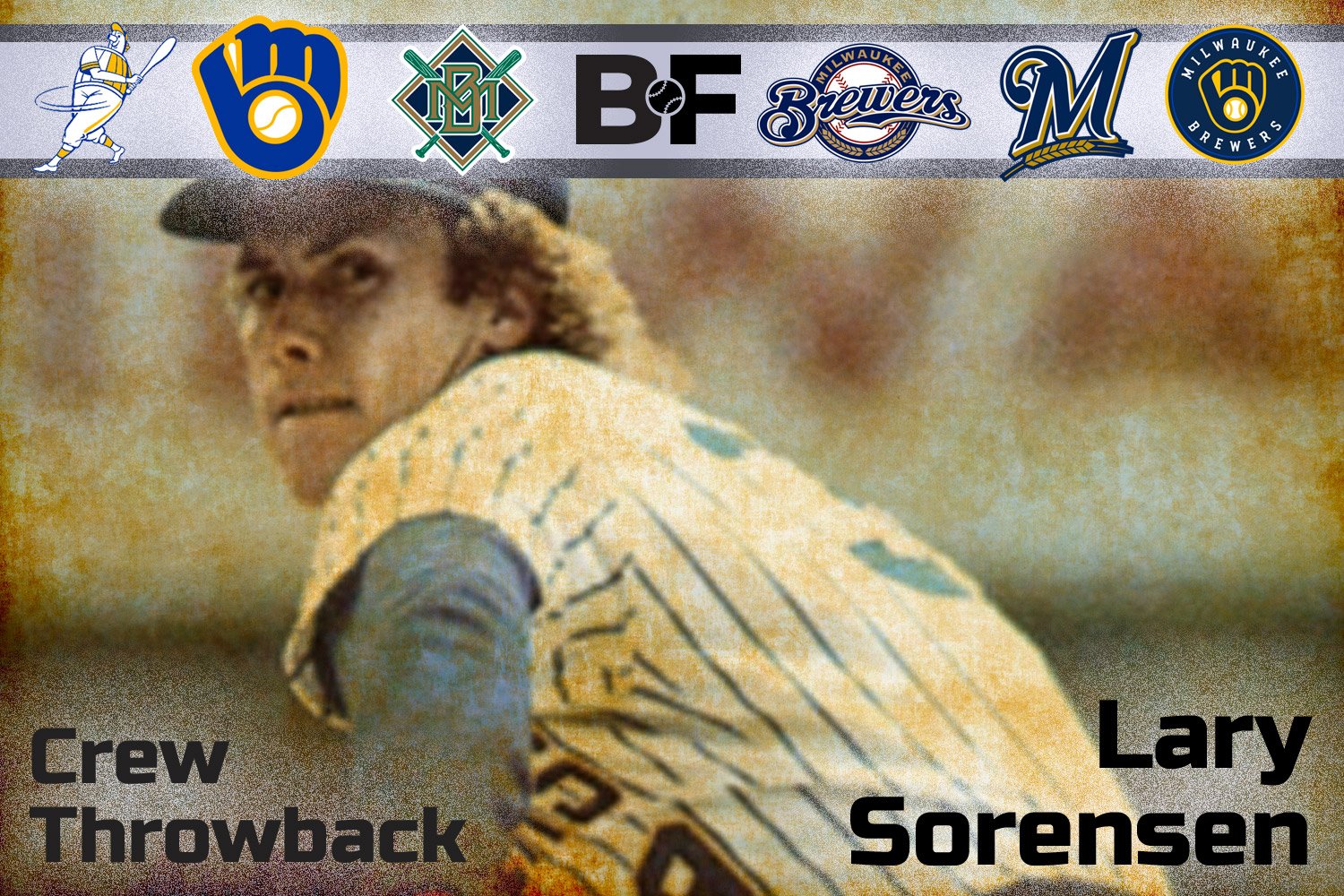 Lary Sorensen was born in Michigan in 1955. He attended the University of Michigan for college and was drafted by the Brewers in the 8th round in the 1975 draft; He rocketed through the Brewers' minor league system, needing only 45 games to reach the majors. From there, he became a rotation mainstay for four seasons. Sorensen was a sinkerball pitcher who rarely walked batters (for his career, his walk rate is an impressive 2.1 walks per 9 innings). He hated walking batters, and he said that walking a batter sometimes made him more upset than giving up a home run. He never struck out many batters either, inducing countless grounders throughout his career. Sorensen's rookie season was promising, but it was his sophomore campaign in 1978 that made people take notice. Sorensen was a workhorse, averaging roughly eight innings per start. Surprisingly, his 17 complete games did not lead the team that year - Mike Caldwell had 23. Named to the all-star team (his only appearance in the mid-season classic), Sorensen worked three shutout innings in the Midsummer Classic. While Sorensen appeared to be a star in the making, the workload would take its toll on his arm. He had decent seasons in 1979 and 1980 but was far less dominant than his 1978 campaign. His innings and effectiveness waned with each season. Sorensen was dealt to the St. Louis Cardinals after the 1980 season in the famed deal that brought Pete Vukovich, Ted Simmons, and Rollie Fingers to Milwaukee. Sorensen would have a solid (but injury-limited) year in St. Louis before being traded to Cleveland. By 1984, his career as a starting pitcher was almost over. He would bounce around the majors and minors until 1988 with limited success. He was done as a player at age 32. During his four years in Milwaukee, Sorensen won 52 games, averaged 213 innings pitched a season, and had a 3.72 ERA. He produced a solid 12.2 bWAR / 11.6 fWAR. After baseball, Sorensen got into broadcasting, working for ESPN and then the Detroit Tigers. He was praised for his quick wit and friendly nature. However, Sorensen won't be best remembered for his time on the diamond or in the booth. Instead, his life has been littered with drug and alcohol-related problems. The first incident occurred while he was still a player when he was one of 11 players fined for admitting to cocaine use during a drug trial in Pittsburgh. In 1992, he received a DUI - the first of seven in his life. In 1998, Sorensen was let go as a Tigers announcer due to substance abuse problems. Things continued to spiral downhill for Sorensen. In the 2000s, he served two prison terms related to his alcohol-related arrests. In 2008, after crashing his auto, his blood-alcohol level was a staggering .480 - a level that would kill most adults. He lost his job, freedom, and marriage to alcohol. In 2014, Sorensen landed a broadcasting job for Wake Forest baseball and then added football in 2017, which he continues to do. But more importantly, he got - and stayed - sober. He credits much of his recovery to his now-wife, Elaine. Before becoming a lawyer, Sorensen's son, Mark, pitched for Michigan State before spending four seasons (2008-12) in the Detroit Tigers minor league system. Please share your memories of former Brewer pitcher Lary Sorensen.
-
Brandin Cooks signed a 2-year extension with Houston. https://www.profootballrumors.com/2022/04/texans-extend-wr-brandin-cooks Odd as you wouldn't think Cooks would be the kind of guy a rebuilding club would need. Of course, perhaps the Texans think they are closer to competing than I do. It takes a potential piece off the WR playing board for Green Bay. Even if we didn't trade for him, it means other teams in need of a WR will be looking to fill that spot via the draft, free agents, or other trades.
-
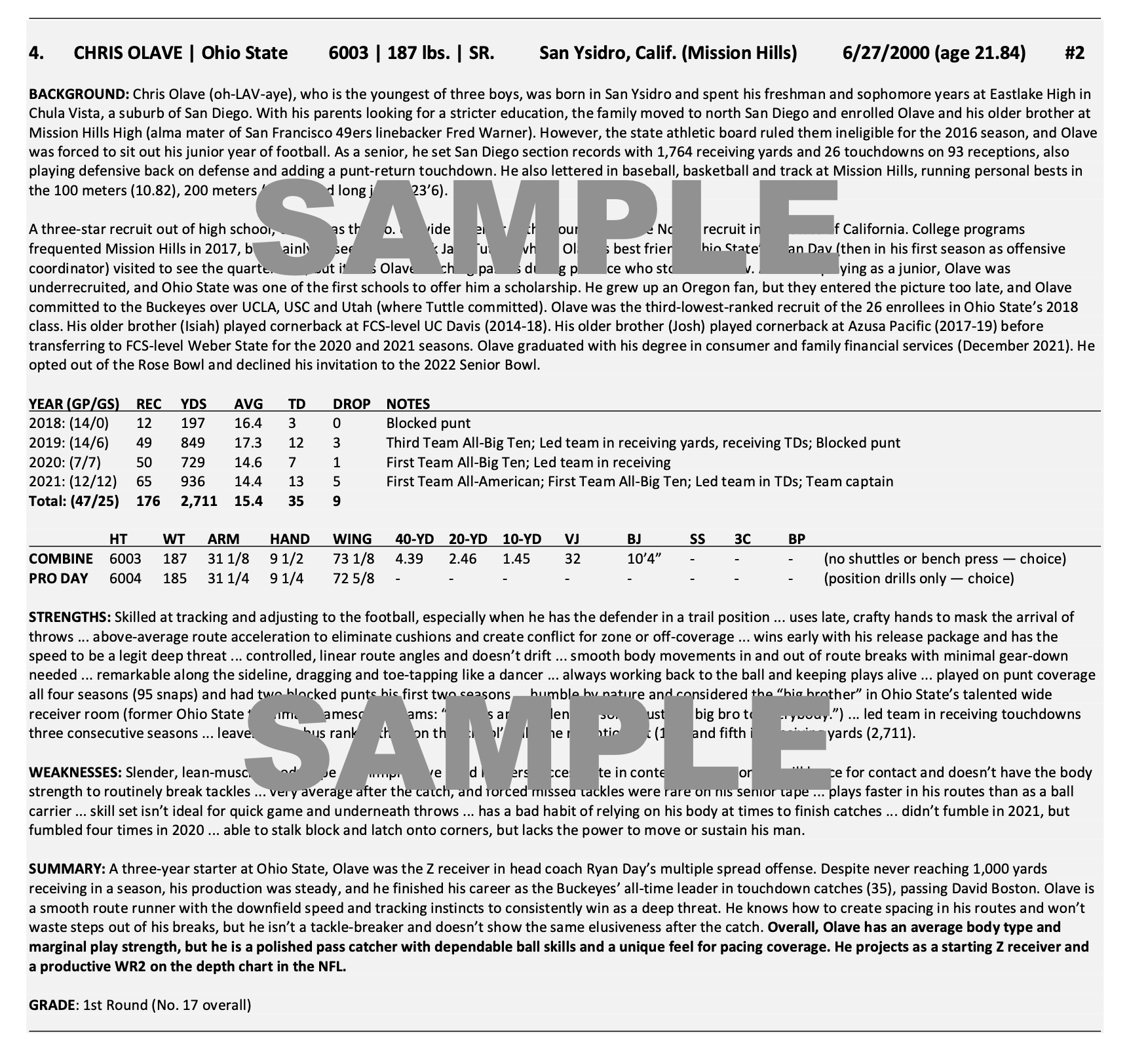
I'm just starting to look at 'the Beast' and it's pretty cool. Obviously, I can't give it to people - but if you are interested in seeing what they do, here's a snippet (Chris Olave's write up). They do this for 400 players. PS - I think you can sign up for a free pass with the Athletic. Or get it cheap for a few months. Or if someone you know has it, they can give you a 30 day pass. They limit the 30 day passes - and I think I've given mine out (but I can check if you have no other options). PS - this is just a snippet of the guide. I think that's cool to post. If not, let me know and I'll remove.
-
I wanted to share that The Athletic has posted their 2022 Draft Guide by Dane Brugler. They call it 'the Beast' - and rightfully so. It's a 288 page guide (a pdf) to hundreds of players. It's really pretty awesome. Of course, the downside is you have to have a subscription to get it. Still, if you do, it's an amazing resource for the draft. https://theathletic.com/3233612/2022/04/07/2022-nfl-draft-guide-the-beast-dane-brugler/
-
Crew Throwback: Mike Felder
Matt Breen replied to Matt Breen's topic in Brewer Fanatic Front Page News
Thank you. -
Crew Throwback: Mike Felder
Matt Breen replied to Matt Breen's topic in Brewer Fanatic Front Page News
Thank you. -
Crew Throwback: Mike Felder
Matt Breen replied to Matt Breen's topic in Brewer Fanatic Front Page News
Thank you. -
Crew Throwback: Mike Felder
Matt Breen replied to Matt Breen's topic in Brewer Fanatic Front Page News
Thank you. -
The Athletic had a short article about the Adams trade. Seems Adams was dead set on getting out of Green Bay. He had told the team he wanted to leave - but the organization thought that was just posturing to get a new contract. But he made it clear it was not. The team even said they would top the Raiders contract offer - but Adams wanted out - hence the deal. They said Adams became 'enamored' with playing for the Raiders and with Carr. Link (subscription required): https://theathletic.com/3232215/2022/04/06/howe-notebook-inside-the-davante-adams-trade-baker-mayfields-status-saints-maneuvering/
-
The Athletic is saying that it's 'widely believed' that the Saints are interested in a QB in the 1st round. The more QBs that go ahead of us - the better as guys we need drop to us (unless we want a QB in the 1st round ? ). The Saints have a lot of needs, but WR and OT is two of their biggest (along with QB). Link (subscription required): https://theathletic.com/3232215/2022/04/06/howe-notebook-inside-the-davante-adams-trade-baker-mayfields-status-saints-maneuvering/
-
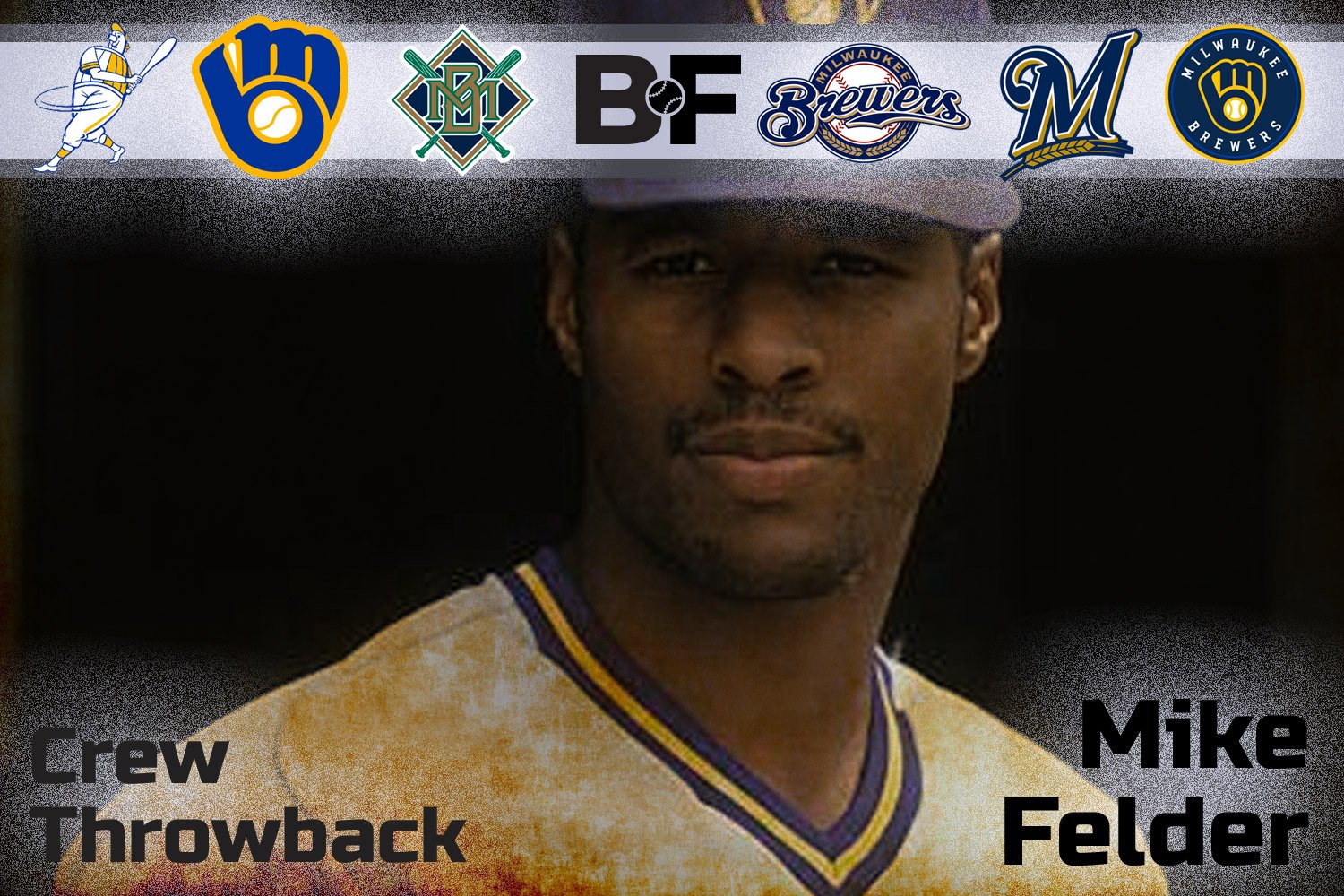 Speed was Mike Felder's game. When the Brewers drafted Felder in the 3rd round of the 1981 draft out of Contra Costa Junior College in California, they were getting one of the most exciting, albeit one dimensional, players in team history. From the moment he arrived in the Brewer organization, the diminutive Bay Area native (nicknamed Tiny) hit the base paths running. Felder led the minors in stolen bases for four straight years from 1982 to 1985 with an astounding 92 stolen bases with Stockton in '82. In addition to stealing truckloads of bases, Felder's hitting improved with each minor league stop. He took his share of walks, and his batting average climbed over .300 in 1985, leading to a cup of coffee with the Brewers. However, what the 5'8" Felder lacked was some thump in his bat. And thus, while Felder's impressive wheels would bring him to the majors, his lack of slugging would limit his upside and playing time; pitchers simply were not afraid of his bat. For parts of six seasons, Felder was an outfielder for the Crew. He appeared in 455 games for the team, hitting .247 and producing a .624 OPS while stealing 108 bases. But Felder never became more than a semi-regular player with Milwaukee (or his subsequent teams). While he didn't strike out often, he simply did not get on base enough, as evidenced by a career OBP of just .301. Felder was a classic one-tool player - all speed. He only hit nine home runs for Milwaukee (in over 1,200 ABs) and only 14 for his entire career. Felder's best season in Milwaukee was his last - 1990 - when he hit .274 and had a .330 OBP in 272 at-bats. But Felder wanted more playing time and at the end of spring training in 1991, he asked for and was granted his release. Felder played another four years with San Francisco, Seattle, and Houston, performing pretty much the same role he had in Milwaukee. He then spent a few more years in independent ball and the Mexican league before retiring after the 1998 season. After retirement, Felder remained in baseball, coaching in the Giants and Expos organizations in 1999 and 2000. He was an assistant baseball coach at the Academy of Art University in San Francisco from 2009-2013. In his career with Milwaukee, Mike Felder was a versatile reserve, playing all of the outfield positions. However, his inability to develop any skills beyond his speed (which was sensational) kept him from being anything more than a part-time player. Still, it allowed him to play 10 years in the majors, a claim few players can make. Please share your remembrances of former Brewer Mike 'Tiny' Felder.
-
Speed kills. You can't teach speed. Everything else in the game can be taught, but speed is a gift from God.” - NFL Owner Al Davis Image courtesy of Brewer Fanatic Speed kills. You can't teach speed. Everything else in the game can be taught, but speed is a gift from God.” - NFL Owner Al Davis Speed was Mike Felder's game. When the Brewers drafted Felder in the 3rd round of the 1981 draft out of Contra Costa Junior College in California, they were getting one of the most exciting, albeit one dimensional, players in team history. From the moment he arrived in the Brewer organization, the diminutive Bay Area native (nicknamed Tiny) hit the base paths running. Felder led the minors in stolen bases for four straight years from 1982 to 1985 with an astounding 92 stolen bases with Stockton in '82. In addition to stealing truckloads of bases, Felder's hitting improved with each minor league stop. He took his share of walks, and his batting average climbed over .300 in 1985, leading to a cup of coffee with the Brewers. However, what the 5'8" Felder lacked was some thump in his bat. And thus, while Felder's impressive wheels would bring him to the majors, his lack of slugging would limit his upside and playing time; pitchers simply were not afraid of his bat. For parts of six seasons, Felder was an outfielder for the Crew. He appeared in 455 games for the team, hitting .247 and producing a .624 OPS while stealing 108 bases. But Felder never became more than a semi-regular player with Milwaukee (or his subsequent teams). While he didn't strike out often, he simply did not get on base enough, as evidenced by a career OBP of just .301. Felder was a classic one-tool player - all speed. He only hit nine home runs for Milwaukee (in over 1,200 ABs) and only 14 for his entire career. Felder's best season in Milwaukee was his last - 1990 - when he hit .274 and had a .330 OBP in 272 at-bats. But Felder wanted more playing time and at the end of spring training in 1991, he asked for and was granted his release. Felder played another four years with San Francisco, Seattle, and Houston, performing pretty much the same role he had in Milwaukee. He then spent a few more years in independent ball and the Mexican league before retiring after the 1998 season. After retirement, Felder remained in baseball, coaching in the Giants and Expos organizations in 1999 and 2000. He was an assistant baseball coach at the Academy of Art University in San Francisco from 2009-2013. In his career with Milwaukee, Mike Felder was a versatile reserve, playing all of the outfield positions. However, his inability to develop any skills beyond his speed (which was sensational) kept him from being anything more than a part-time player. Still, it allowed him to play 10 years in the majors, a claim few players can make. Please share your remembrances of former Brewer Mike 'Tiny' Felder. View full article
-
Question - in the NFL - can teams include money in a trade to cover salary? I was wondering where Baker Mayfield would end up. He's got a guaranteed salary of $18M or so. Reportedly teams are interested in him - but not at that price. Could the Browns work out a deal - and pay down some of that salary as a way to facilitate a trade? I'm just not sure of the NFL rules. Thanks.
-
I read Landry was looking for some pretty serious money. Which makes sense. He's 29. This is probably his last big payday. And as madbad2000 noted, I read he's interested in a reunion with the Browns. Probably won't happen until the Mayfield situation is figured out.
-
Sweat. So nice to be back.
-
Thanks to everyone who voted. We'll put together numbers have the results online in the next week. Thanks again.
-
Saints reportedly are interested in WR and OT. The extra pick certainly gives them the ammunition to get someone - such as Olave - and fill the OL need. They have lots of other needs as well - but those two are big areas of weakness. They supposedly like Olave a lot.
-
If you can get Cooks for a decent price he makes sense. Deep threat, productive. I don't know about the reasons he has been traded so much - perhaps there's issues there. But even just a one year rental would be great. Add in a WR in the first couple of rounds - and you have a a receiving corps that we can work with.
-
Hamilton is the exact kind of guy that you don't expect to be there - but if he is - is huge value. I think there are so many options for us at #22 and #28 - I'm pretty happy just letting the best players come to us (although I wouldn't take a QB or RB). We have to address WR at some point. And probably DL, but if the a top 10 player like Hamilton drops - he still fills an area of need (although maybe not as desperately as WR). Gonna be a fun draft.
-
I love all the notes about prospects people provide. Thanks.
-
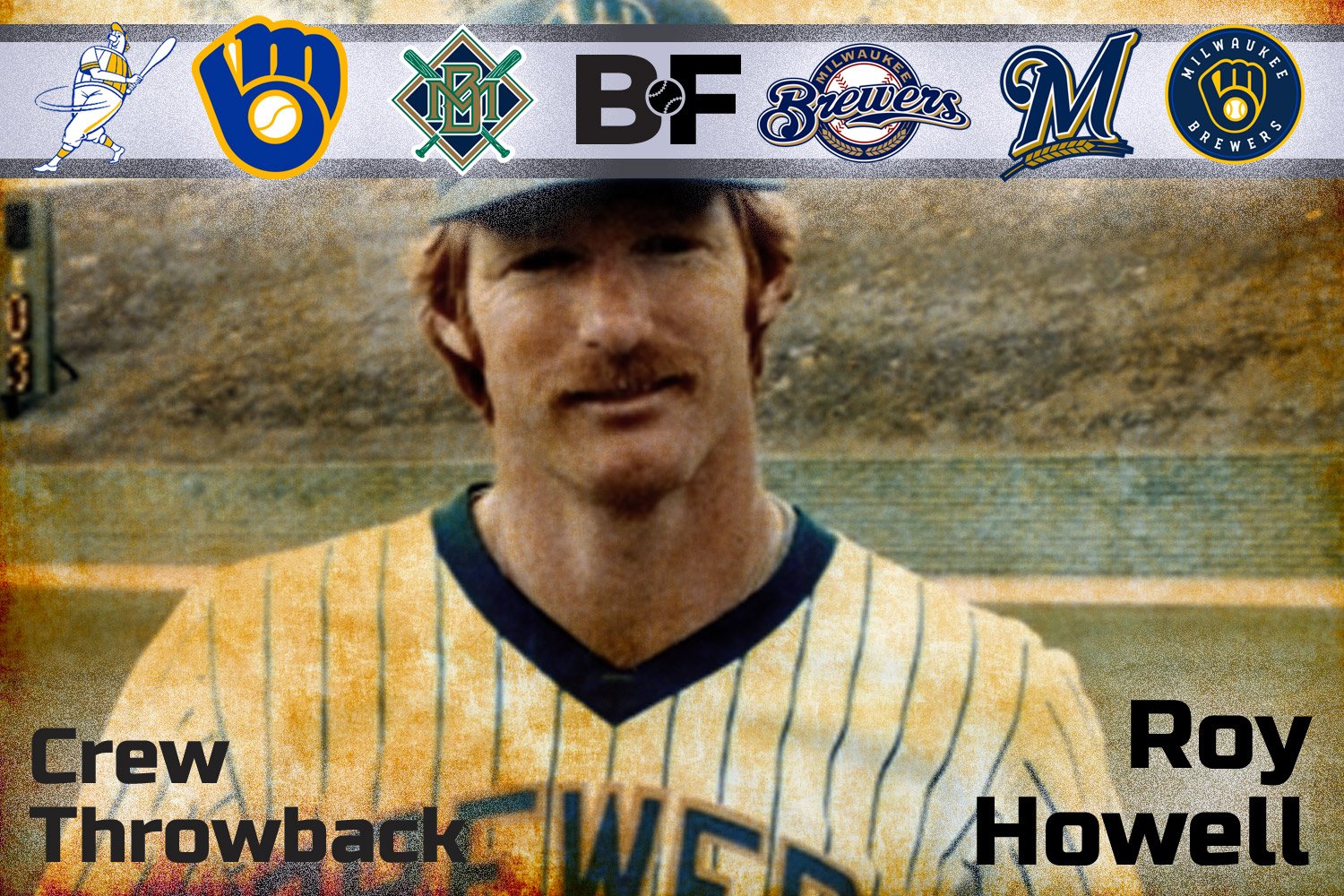 One of those players was the hard-nosed 3B Roy Howell - who would spend four seasons with the Crew (1981-84). Roy Lee Howell was born in California in 1953. A left-handed hitter, he was selected in the first round, fourth overall, by the Texas Rangers in the 1972 MLB Draft. Howell quickly moved up the minor league ladder, displaying a combination of impressive physical tools, good power, and on-base skills. He would reach the majors at the age of 20, getting a cup of coffee with the Rangers. Howell would spend the next six seasons in Texas and Toronto. His bat never quite emerged as the force many had thought it would, but he had some solid seasons, hitting over .300 twice. He was selected for the all-star team in 1978. A free agent after the 1980 season, Howell signed a five-year deal with Milwaukee. The idea was to have him take over for the aging Sal Bando and Don Money. Unfortunately for Howell, his fielding skills - never great to begin with - were eroding due to a variety of injuries. And after another injury in 1981, he was never the same and was reduced to a part-time player. Howell spent four seasons with Milwaukee, playing first base, third base, and DH during that time. His teams made two postseason appearances, reaching the World Series in 1982 (he went 0-14 in the postseason that year). He hit .253 as a Brewer and produced an OPS of .684, unspectacular numbers for the corner infielder. Milwaukee released Howell after the 1984 season. He spent 1985 in the minors before retiring. During his career, Howell produced 9.3 fWAR / 10.9 bWAR while hitting .261 with an OPS of .710 which included nearly 1,000 hits and 80 home runs. Howell was recognizable during his playing days for his red hair and thick mustache and beard (although he was much better groomed during his stint in Milwaukee than in Texas and Toronto). He played the game hard and endeared himself to his teammates and the fans. Sadly, injuries sapped Howell's abilities at an early age. Instead of being a core member of the great Brewer lineups of the early 1980s, he was a minor figure, still contributing, but not in the manner the organization had hoped when he had signed with them. After baseball, Howell stayed in the game as a coach and manager, working for the Padres and Mariners and in independent ball. Please share your memories of former Brewer Roy Howell in the comments below!
-
The early 1980s featured one of the most explosive lineups in team history - the famed Harvey's Wallbangers. Yount, Molitor, Cooper, Oglivie, Thomas, Money, Simmons, and others headlined a lineup that was one of the most feared in baseball. But there were other guys on the Brewer roster that contributed to the success of that era - which included the team's only World Series appearance. Image courtesy of Brewer Fanatic The early 1980s featured one of the most explosive lineups in team history - the famed Harvey's Wallbangers. Yount, Molitor, Cooper, Oglivie, Thomas, Money, Simmons, and others headlined a lineup that was one of the most feared in baseball. But there were other guys on the Brewer roster that contributed to the success of that era - which included the team's only World Series appearance. One of those players was the hard-nosed 3B Roy Howell - who would spend four seasons with the Crew (1981-84). Roy Lee Howell was born in California in 1953. A left-handed hitter, he was selected in the first round, fourth overall, by the Texas Rangers in the 1972 MLB Draft. Howell quickly moved up the minor league ladder, displaying a combination of impressive physical tools, good power, and on-base skills. He would reach the majors at the age of 20, getting a cup of coffee with the Rangers. Howell would spend the next six seasons in Texas and Toronto. His bat never quite emerged as the force many had thought it would, but he had some solid seasons, hitting over .300 twice. He was selected for the all-star team in 1978. A free agent after the 1980 season, Howell signed a five-year deal with Milwaukee. The idea was to have him take over for the aging Sal Bando and Don Money. Unfortunately for Howell, his fielding skills - never great to begin with - were eroding due to a variety of injuries. And after another injury in 1981, he was never the same and was reduced to a part-time player. Howell spent four seasons with Milwaukee, playing first base, third base, and DH during that time. His teams made two postseason appearances, reaching the World Series in 1982 (he went 0-14 in the postseason that year). He hit .253 as a Brewer and produced an OPS of .684, unspectacular numbers for the corner infielder. Milwaukee released Howell after the 1984 season. He spent 1985 in the minors before retiring. During his career, Howell produced 9.3 fWAR / 10.9 bWAR while hitting .261 with an OPS of .710 which included nearly 1,000 hits and 80 home runs. Howell was recognizable during his playing days for his red hair and thick mustache and beard (although he was much better groomed during his stint in Milwaukee than in Texas and Toronto). He played the game hard and endeared himself to his teammates and the fans. Sadly, injuries sapped Howell's abilities at an early age. Instead of being a core member of the great Brewer lineups of the early 1980s, he was a minor figure, still contributing, but not in the manner the organization had hoped when he had signed with them. After baseball, Howell stayed in the game as a coach and manager, working for the Padres and Mariners and in independent ball. Please share your memories of former Brewer Roy Howell in the comments below! View full article
-
For my 94 person draft, I ended up with 6 QBs. I automatically picked the highest ranked player on the PFF board when there were no trade offers on the table. My third pick was Carson Strong of Nevada (3rd round, 90th overall). And then four of the last six picks were QBs. I should have traded Rodgers for a bunch of picks. I probably could have gotten 150 players if I had done that.
-
On the PFF draft simulator, I traded down repeatedly - made 34 trades - and drafted 94 players. I simply took the top player on the board the time I picked. It was kind of fun, if silly. I ended up with the following: 2nd Round picks x 2 3rd round picks x 1 4th round picks x 10 5th round picks x 21 6th round picks x 29 7th round picks x 32 I tried to upload the image they provide, but it was too big. I got some Badgers, including Sunburn, Ferguson and Bruss. Plus former Badger Jack Coan (fourth to last pick in the draft).
-
One thing nice about Watson is that he is cold weather tested. Not a huge thing - but nice to know.