


Brewers Video
While most known for his time in sunny San Diego, his stint in Milwaukee was a fitting end to a historic career.
In 2025, the song Hells Bells by AC/DC might be best-known among your average person for being on the Deadpool & Wolverine soundtrack. To others, it’s one of two songs (the other being Enter Sandman by Metallica) that evoke memories of the greatest closers of all time. While Mariano Rivera undoubtedly holds the top spot, Trevor Hoffman is a pretty close second. At 601 career saves, he has 123 more than third-place Lee Smith. Kenley Jansen could take the third spot, but unless he pays several visits to the Fountain of Youth, Hoffman’s place on the statistical podium is safe and sound.
After a brief debut with the Marlins, he spent the next 16 years coming out of the bullpen for the Padres where he established his stellar reputation and earned 552 of his saves. By 2009, he was a 41-year-old free agent watching the ownership of his beloved team cut the payroll in half to facilitate a sale. Despite wanting to retire a Friar, Hoffman had to move along. The club offered him just a $4-million contract before withdrawing their offer, forcing him to test the waters elsewhere. Instead, he signed a one-year, $6-million contract with the Brewers.
The 2008 campaign had been a down year by his standards, resulting in a 3.77 ERA and just 30 saves. With little reason to believe that he could turn back the clock in his 40s, it was immensely surprising to watch him put up one of his best performances yet, recording a 1.83 ERA (second-lowest for a full season in his career) with 37 saves. He earned his seventh and final All-Star selection for his efforts and at the end of 2009, he signed another one-year, $8-million deal with a mutual option.
At this point, Hoffman needed just nine more saves to reach the elusive 600 mark. His status as an all-time great reliever was already settled, and any further accomplishments were just gravy. In fact, since he had just thrown the ball as well as ever, the possibilities seemed endless for a man seemingly unaffected by the march of time.
Unfortunately, reality is often disappointing. He struggled immensely in 2010, posting a 5.89 ERA and -0.9 rWAR, the worst single-season numbers he had ever put up. After the first two months, he had accumulated just five saves. Still four saves away from 600, Ken Macha, the manager at the time, decided to move Hoffman to lower-leverage relief innings to try and get his mechanics back on track. After he spent June and July avoiding save situations, he returned to his natural habitat in August. He still struggled but managed to acquire three more saves, bringing him to 599. With just a month of regular season left to play, it really seemed like a dice-toss as to whether he’d be able to drag himself across the finish line.
He entered September with a 6.23 ERA and a FIP of 5.40, numbers that would’ve led anyone else to being removed from the roster entirely—let alone taking the ball in save situations. But Trevor Hoffman isn’t anyone else. Furthermore, the Brewers weren’t even close to a playoff spot, so why not aim for history instead?
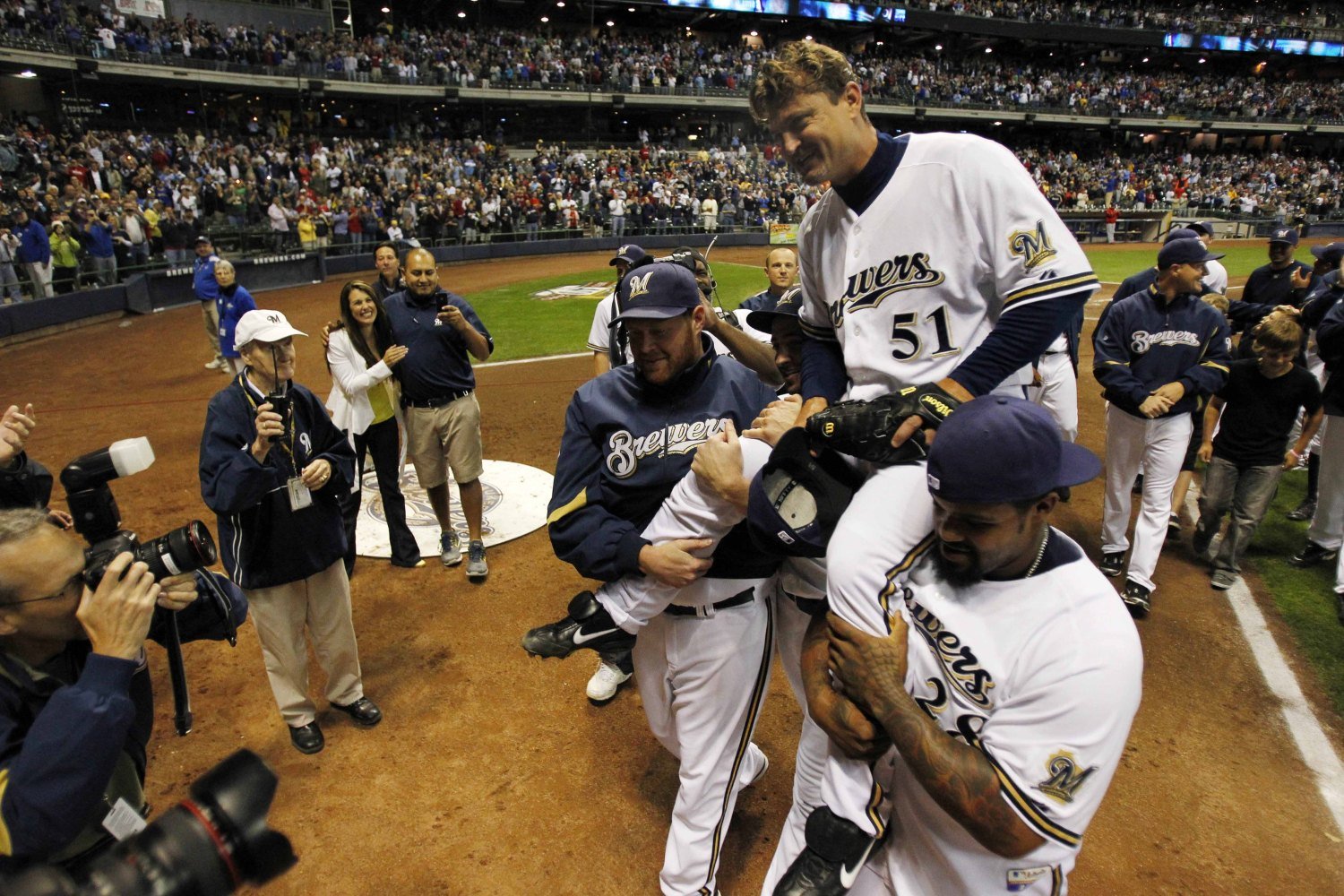
On Sept. 7, he finally got the chance he had been waiting for, entering the game against the Cardinals while up 4-2. Facing the bottom of the St. Louis lineup, he did what he had done best for the past 18 years: dice up major-league hitters.
To put a cherry on top, he earned another save against the Mets in his last-ever major-league game, bringing him to a nice prime number in 601.
Brewer Fanatic readers know better than most that baseball is a game of statistical obsession. Whether it’s swing adaptability metrics or some nuanced defensive figure made up by some computer program, fans love numbers. Players are no different, and many often chase round-number milestones even if it’s probably not conducive to team success. The most recent example of this was Adam Wainwright’s painstaking chase of his 200th win in his final big-league season, which saw him limp to the end with a 7.40 ERA over 21 starts.
With Hoffman, his competitive nature and dogged determination to reach some arbitrary threshold may not have been the best for his overall career numbers, but it gave fans something to cheer for, and it demonstrated one of the subtle aspects of his greatness: that improbable consistency and longevity. He may forever be remembered as a Padre, but his crowning achievement came as a Brewer.
Do you approve of Brewers' ownership?

Are you interested in Brewers history? Then check out the Milwaukee Brewers Players Project, a community-driven project to discover and collect great information on every player to wear a Brewers uniform!
View The Players Project



Recommended Comments
There are no comments to display.
Create an account or sign in to comment
You need to be a member in order to leave a comment
Create an account
Sign up for a new account in our community. It's easy!
Register a new accountSign in
Already have an account? Sign in here.
Sign In Now