


Brewers Video
The Milwaukee Brewers collected their third win of the Cactus League season Sunday, beating up on the Diamondbacks at Salt River Fields in Scottsdale. That park is the only one in the Arizona spring training circuit that features public Statcast data, so let's dig in on our glimpse of the goods.
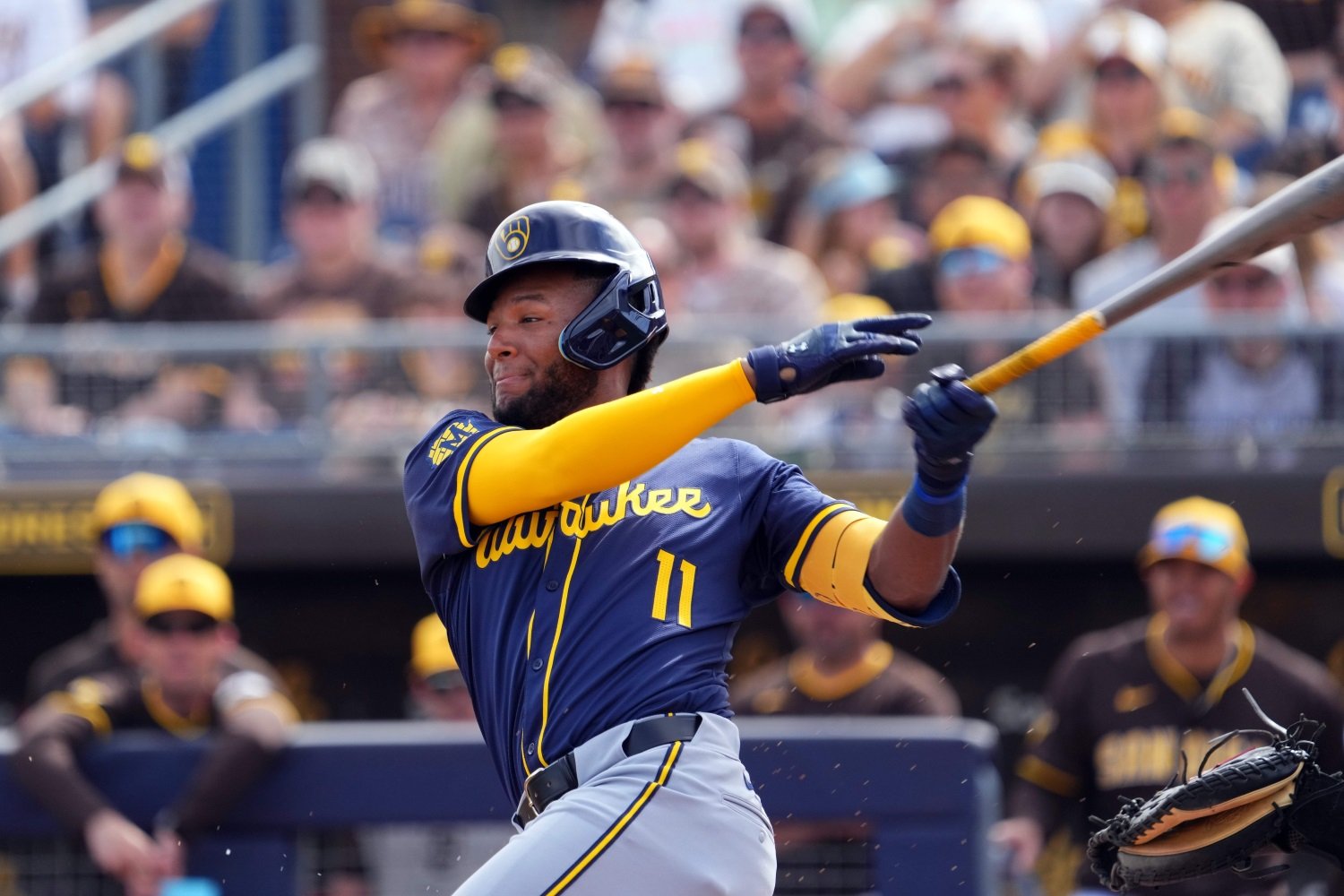
In what has been a less than stellar first week of the spring, Jackson Chourio busted out a bit on Sunday, with a double that showcased both his hit tool and his terrific speed and a walk in four plate appearances. Chourio looked overmatched on Saturday in Maryvale, against the Dodgers' second-tier traveling roster pitchers, so we shouldn't massively overreact to either sample, but it was great to see him hitting the ball hard.
Thanks to Statcast, we can say precisely how hard. On a 2-1 changeup in his first trip to the plate, Chourio lobbed a line drive over the head of the third baseman and into left field, and got to second thanks to good placement and even better speed. The ball left his bat at 99.6 miles per hour, which is very strong for a hitter who was geared up for the fastball but still found a way to deliver the barrel to the ball and keep it fair.
Chourio's other two batted balls on the day were grounders hit basically right into the ground, but one nearly had enough pace to get into center field for a second hit. That one was hit at 102.6 miles per hour, so we're seeing the easy jolt the 19-year-old already puts into the baseball. As he makes his case for a place in the Opening Day outfield, this was a great game, and a possible turning point. Let's take a quick look at five other small takeaways from the data mine that each contest yields, since it's March 3 and we're all thirsty for it.
A Great Sign for Willy Adames
The Brewers' slugging shortstop didn't slug enough to make up for some of his other shortcomings at times in 2023, leading to long slumps and a brief demotion to the bottom half of the batting order. Pat Murphy hopes to be able to rely on Adames in the heart of his lineup this season, so he had to be pleased to see Adames thwack a first-inning, 92-MPH fastball from Eduardo Rodríguez 108.2 miles per hour for a home run.
In all of 2023, Adames only hit four balls that hard. He hasn't sent a pitch coming in at 92 back out at 108 or better since 2022. It's just spring training, and Rodríguez belongs to the class of veteran pitchers who are happy to get knocked around a bit in March to ensure that they're fully ready for April and beyond, but this was exciting.
Abner Uribe, New Cutter Guy?
The Brewers still love cutters, even if trading away Corbin Burnes makes them a bit less readily identifiable as the team who throws cutters the most. The latest evidence that that affection lingers even after the departure of their very cutter-y ace showed up in Uribe's pitch data for the day. Mapping out the movement on all his stuff, there were a few pitches that didn't behave like anything he threw last year.
We'll have to try to confirm it, but it sure looks like #Brewers flamethrower Abner Uribe was playing with a little bit of a cutter today. That cluster in the middle (though marked as four-seamers and sliders) doesn't look like his four-seamer from last year. pic.twitter.com/S9V9mkcZe5
— Matthew Trueblood (@MATrueblood) March 3, 2024
This is far from definitive, and maybe Uribe just didn't have the usual feel for his four-seamer today. It also looked like a slightly different pitch in live action, though. This will bear watching, because if Uribe can start firing in a 95-MPH cutter without cannibalizing his other offerings, it gets downright unfair to opposing hitters in a hurry.
DL Hall's Delightfully Dominant, Slightly Inexplicable Fastball
I don't like to default to Stuff+ or PitchingBot, a pair of models designed to boil down the quality of a given offering to a single number using data about release point and movement. I think pitching is much more nuanced and interesting than that. I do find it fascinating, though, that those two models disagree sharply about Hall's fastball. Somewhat famously, multiple outlets who put scouting (non-quantitative) grades on players gave Hall an 80 (the very top of the scale) to the lefty's heater.
PitchingBot, which is on the scouting scale (20-80), comes fairly close to affirming that, at 68. It ranked Hall's as the 20th-best fastball in baseball last year, of 727 qualifying pitchers. Stuff+, though, is much less impressed. That number is scaled to 100, where that figure is average and higher is better. Hall comes in at just 101, above average but far below any standard for excellence. He ranks 232nd in fastball Stuff+.
I bring this up because, when you watch Hall, it's not hard to see what the scouts saw when they slapped that high grade on him. The fastball explodes on the hitter. It's just not easy to put a finger on why that is.
I looked up Hall's percentile ranks in many categories, among lefties who threw at least 200 four-seamers, for 2023. As it turns out, while he doesn't excel in terms of sheer movement or sheer velocity, he's extraordinary in many other regards.

We're certainly used to elite fastballs grades being given to fastballs with elite velocity, and failing that, we at least expect something weird to be going on in terms of horizontal or vertical movement. Hall is more subtle than that. It's a weird horizontal angle, but also a low release point, which gives him an extreme vertical approach angle, too. His very good extension lets the raw velocity play up, and he changes speeds on the heat much more than most pitchers do. That's an especially intriguing tidbit, for such a young pitcher.
In the context of a short Cactus League outing, it's impossible to distinguish adding and subtracting on the fastball from tiring in a second inning of work, but I thought he seemed to be doing the former, not the latter, on Sunday. Changing speeds and giving hitters such a tricky look makes up for a lot of other things, and with Hall's good (though not dominant) power, it becomes a deadly cocktail in a hurry. In a short outing Sunday, he showed everything from 93.7 MPH to 96.9 on the fastball, with accompanying changes in spin rate. That touch might be what sets the pitch apart.
Joey Wiemer Has Not Looked Good So Far
We can discuss this more in a separate post later this week, but WIemer was one of the players I watched most closely this week. I wish I felt more encouraged by what I saw. He has talked at length about the benefits of a quieter swing since arriving at camp, but in games, he looks (if anything) less comfortable. He did manage a single Sunday, but his exit velocities on three batted balls were 69.5 miles per hour, 76.3, and 66.3, and the contact was no more impressive than that makes it sound.
"Everything is just a little more quiet," Wiemer told me this week. "That’s been one of my focuses right now, is that my takes are a lot better. I’m not feeling like I’m falling forward as much."
He did draw a walk Sunday, and a little more plate discipline is one highly plausible and valuable potential benefit of the changes he's made this offseason. I wrote as much last week. Throughout the early games of spring ball, though, he's looked as imbalanced as ever.

Wiemer's the kind of player you assiduously avoid giving up on too soon, but barring a fast turn of the corner from here, I'd be surprised to see him break camp with the Brewers. He isn't doing enough to assert himself as a more valuable option than defensive specialist Blake Perkins or more versatile bench piece Owen Miller. If it comes down to Wiemer against either of the team's out-of-options position players (Eric Haase and Jake Bauers), I think the Crew should keep them and let Wiemer get more plate appearances in Nashville.
Four More Whiffs on the Slider for J.B. Bukauskas
No player is harder to evaluate in early spring training games than the reliever who comes on to finish games. They're hardly ever facing big league-caliber hitters, and those who do stick around that long could be forgiven for having mentally checked out. By and large, the fans have done so by that stage.
Still, Bukauskas has impressed Murphy already this spring, and his nasty breaking ball catches both the human and the digital eye, too. The devastating thing about him is that his slider doesn't have crazy movement, in and of itself. It's his sinker that has exceptional run, and from his setup way over on the first-base side of the rubber, he can find the zone with that pitch.

Then, when the slider does come, it's much too long before most hitters can see it for what it is, and they end up flailing foolishly. The Diamondbacks did plenty of that in a single inning Sunday.

Again, it's silly to assume that these results will port right to real MLB games--the kind that count, where minor leaguers don't enter in a shift change at the seventh-inning stretch and pitchers who got knocked out of the box in one inning can't come back the next inning to finish their daily work, as the Diamondbacks did at one point Sunday. Nonetheless, as Murphy rightly notes, Bukauskas will pitch in the majors at some point this year. He's on the 40-man roster and can still be optioned for one more season. The next step should be to get him in while the bigger bats are still swinging, and see whether they cast a colder eye on his go-fish offerings.
Research assistance provided by TruMedia.
Do you approve of the job the Brewers' front office is doing?

Follow Brewer Fanatic For Milwaukee Brewers News & Analysis



-
 2
2


Recommended Comments
There are no comments to display.
Create an account or sign in to comment
You need to be a member in order to leave a comment
Create an account
Sign up for a new account in our community. It's easy!
Register a new accountSign in
Already have an account? Sign in here.
Sign In Now