


Brewers Video
Many despise batting order discourse and contend that lineup construction has almost no impact on run scoring. The problem is that one can only theorize that its minimal effect is true because you can't see what would happen with humans hitting various spots in the lineup for multiple iterations of the same season. So, people like myself see things differently. For a team like the Brewers, who have a blend of ages, experience, and hitting styles, optimizing the lineup to create more opportunities to score consistently becomes essential.
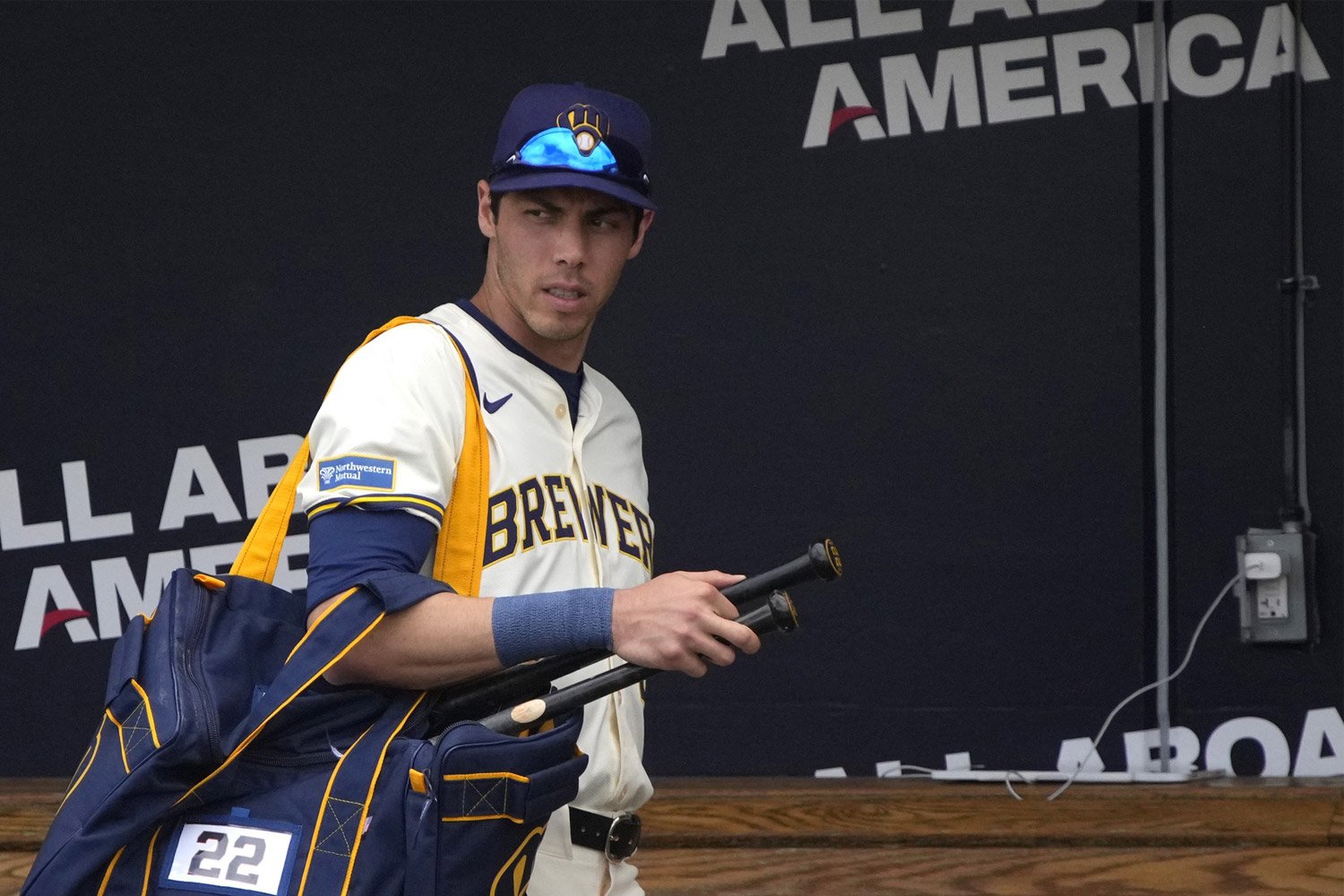
It starts with the leadoff man and the ultimate goal of being on base frequently and scoring runs. He will get the most plate appearances all season, by a sizable margin compared to the third hitter, and his presence on base for the middle of the order sets up the offense for regular success. Christian Yelich owns a .376 career OBP and finished at .370 last season. In his 11 MLB seasons, Yelich has had an OBP under .360 only twice: .356 in 2020 and .355 in 2022. That level of reliable consistency is extremely valuable. How much did his OBP and elite base running help the 2023 offense? Yelich scored the most runs (106) for any player with fewer than 25 home runs, finishing 11th in runs overall on a team that ranked 17th in offense. In the past three seasons, Yelich has been a top-eight leadoff hitter in competition with a ton of talent like Ronald Acuna Jr., Mookie Betts, and Marcus Semien.

Sal Frelick posted a .393 OBP in 197 minor-league games and projects to be a quality leadoff man in the big leagues. It was encouraging to see his .341 OBP last season, but he only has 223 MLB plate appearances, making it difficult to trust he would find a 30-point bump in 2024 to match Yelich. It could happen, though it's just as likely the league makes adjustments to keep Frelick off the bags more often. And while Frelick is faster than Yelich, the 32-year-old is the better overall base runner, making his times on the sacks more valuable.
Part of the decision to put Yelich first or third in the lineup is based on how you value each of those spots. Traditionally, the three-hole was reserved for your best or second-best hitter as the ideal location for production. That still can be true for clubs with deep, proven, high-quality lineups, but modern analysis often tells a divergent story. Many baseball analytics indicate the number three hitter is only the fifth most important guy in the order. The belief is that the second hitter is most valuable, followed by the cleanup man, and then the first and fifth spots, emphasizing OBP at leadoff.
The Brewers' projected lineup gets most of those right, with William Contreras hitting second (best overall hitter), Rhys Hoskins batting fourth (power as the X-factor), and Willy Adames hitting fifth as his OBP is low, but his slugging potential is high. Thus, if you believe in this hitter hierarchy, it's clear Yelich should take hold of the opening slot while Frelick nestles into number three - unless you think another hitter is better. So, depending on how one assesses the role of varying lineup spots, opinions can change quickly.
A significant concern with Yelich batting third is his propensity to hit ground balls, which could result in double plays. Among qualified hitters in 2023, Yelich had the second-highest ground ball percentage (GB%) at 57.4%. He ended up hitting into 15 twin killings, tied for 34th in MLB. Few things take the air out of the stadium like a double play, especially with multiple runners on base. Even when he doesn't fall victim to the double play, there was often a sense of potential dread with him up in those spots because of the extreme ground ball threat. Yelich will typically be in fewer of those situations hitting leadoff than he would be batting behind Contreras and whoever would bat first.
Frelick hits his fair share of ground balls, too. His small sample in 2023 put him at a 52.6 GB%. However, he mostly stayed below 50% in the minors. Even if he does put the ball on the ground, it stands to believe he's less likely to hit into a double play than Yelich for two reasons: hard-hit balls and home-to-first speed.
Ironically, part of the frustration with Yelich's high groundball rate is that he usually scalds the ball. You saw what happens when he gets more balls in the air in 2018 and 2019. But rockets on the turf are still often outs and easier to turn two on. Yelich's average exit velocity in 2023 was 91.7 MPH, while Frelick sat at a measly 83.3 MPH. Among the 343 players with at least 150 batted ball events, that ranked 342nd. He's far too good of a hitter to live in that zip code, but he isn't going to reach Yelich levels. To complement Frelick's weaker contact, he has the better home-to-first speed between the two. Frelick clocked in at 4.18 seconds (23rd) in 2023, while Yelich reached first in 4.35 seconds (149th). In theory, this combo means it's less likely that Frelick creates multiple outs on one swing, and, at worst, his contact results in a defacto sacrifice to advance runners. Of course, you'd also be more likely to have Frelick drop down a bunt than Yelich since Frelick doesn't have the same power potential as Yelich. That's not to say Frelick couldn't have a fantastic opening weekend with the Brewers like he did last year in Nashville.
Speaking of contact, the ability to put the ball in play has often been a traditional value of the leadoff hitter. While you don't want a player to whiff a ton, striking out at the top of the order is less harmful than in the middle. Again, there will be many times the leadoff man is up without a runner on base - guaranteed at least once. And with the level of defensive skill in MLB, simply putting the ball in play with the bases empty has limited upside. There can be a benefit, but not as much as a middle-of-the-order bat. Since they will have more opportunities with men on base, avoiding strikeouts in the third spot can lead to productive outs, runs scored, and additional defensive chaos. To that end, Yelich has a 21.8 strikeout percentage (K%) in his career (22.2 K% in 2023). Frelick mostly hung in the 12-16% range in the minors and owned a 16.6 K% in his debut season with the Brewers. So again, by this measure, Yelich fits the leadoff role better.
I recall writing a piece for a different site in 2018 that noted the difference in the offense when Lorenzo Cain hit leadoff with Yelich second versus when their spots were flipped. Up to that point (Aug. 21), the Brewers averaged 4.7 runs per game, with Cain leading off and 3.5 per game if Yelich led off. Yes, people discussed sample sizes and other factors, but why change it if something appears to be working with a particular order?
So, for the 2024 Brewers campaign, Yelich in the leadoff role still makes more sense for this particular offense. Things can change during the season depending on the offense's production, Jackson Chourio's emergence, or the failures of any number of players. But for the first portion of the year, when there is already so much uncertainty, having a reliable hitter with a track record of success at the top is an ideal course of action. If it isn't broken, don't fix it.
Do you approve of Brewers' ownership?

Follow Brewer Fanatic For Milwaukee Brewers News & Analysis



-
 1
1


Recommended Comments
Create an account or sign in to comment
You need to be a member in order to leave a comment
Create an account
Sign up for a new account in our community. It's easy!
Register a new accountSign in
Already have an account? Sign in here.
Sign In Now