


Brewers Video
This month, Baseball Savant released its latest new feature—a Batted Ball Profile leaderboard, which breaks down all of each hitter's batted balls into ground balls and Air Balls (line drives, fly balls, and pop-ups), and into pulled, straight, or opposite-field directions. The fascinating added wrinkle is that the leaderboard also has columns showing what percentage of all a player's batted balls have been hit in each direction within each trajectory category.
Obviously, the page centers on showing which hitters pull the ball in the air most often, because there's no more valuable type of batted ball (without knowing exact launch angle, exit velocity, or defensive positioning) than a pulled ball in the air. That's where almost every batter finds almost all of their power, so naturally, the best hitters tend to hit lots of pulled flies. The 2024 Brewers did have two representatives high on the leaderboard when it's sorted by that column: Rhys Hoskins and Jake Bauers. That makes sense, but it's also a bit revealing. Hoskins and Bauers, despite their proclivity for pulling it in the air, had tough seasons last year, mostly because the hunt for pitches to drive to the pull field led to too many strikeouts and too few walks, and because hitting a lot of pulled Air Balls doesn't generally correlate well with hitting for average even on your balls in play.
If you sort by another column, though, the Brewers are even more prominent at the top of the board. Again, it's not an unmitigated positive—but it's fascinating, and illuminating.

In general, pulled ground balls are bad. They're especially bad for left-handed batters, because that means a short throw when any fielder gets a handle on the ball, but even right-handed hitters don't want to hit many pulled ground balls. Shift or no shift, teams are good at positioning defenders, and if a hitter hits lots of their ground balls to their pull side, the defense will usually be in position to collect a high percentage of them. The league, as a whole, had a .208 batting average on pulled grounders in 2024, against a .247 expected batting average, based on the launch angle and exit velocity of those grounders.
Up the middle is better. Hitters had a .252 batting average on grounders to the middle of the field, virtually identical to their expected mark. The bad news, of course, is that a grounder up the middle lacks even the smallish chance of being a double that grounders down either line have, but on balance, better to hit straightaway grounders than pulled ones.
Go the other way on the ground, though, and everything opens up. The league hit .405 on those batted balls last year, which is a wild-sounding number—until you remember that most of those balls are mishit, the defense is naturally anticipating the pulled grounder, and the fielders are out of position to make plays on those balls. If you could do it, intentionally hitting just enough grounders the other way to collect your hits without the defense wheeling around to shut down your plan would be as good a way as any to hit .300 in the modern game. Tony Gwynn is in the Hall of Fame because of opposite-way ground balls.
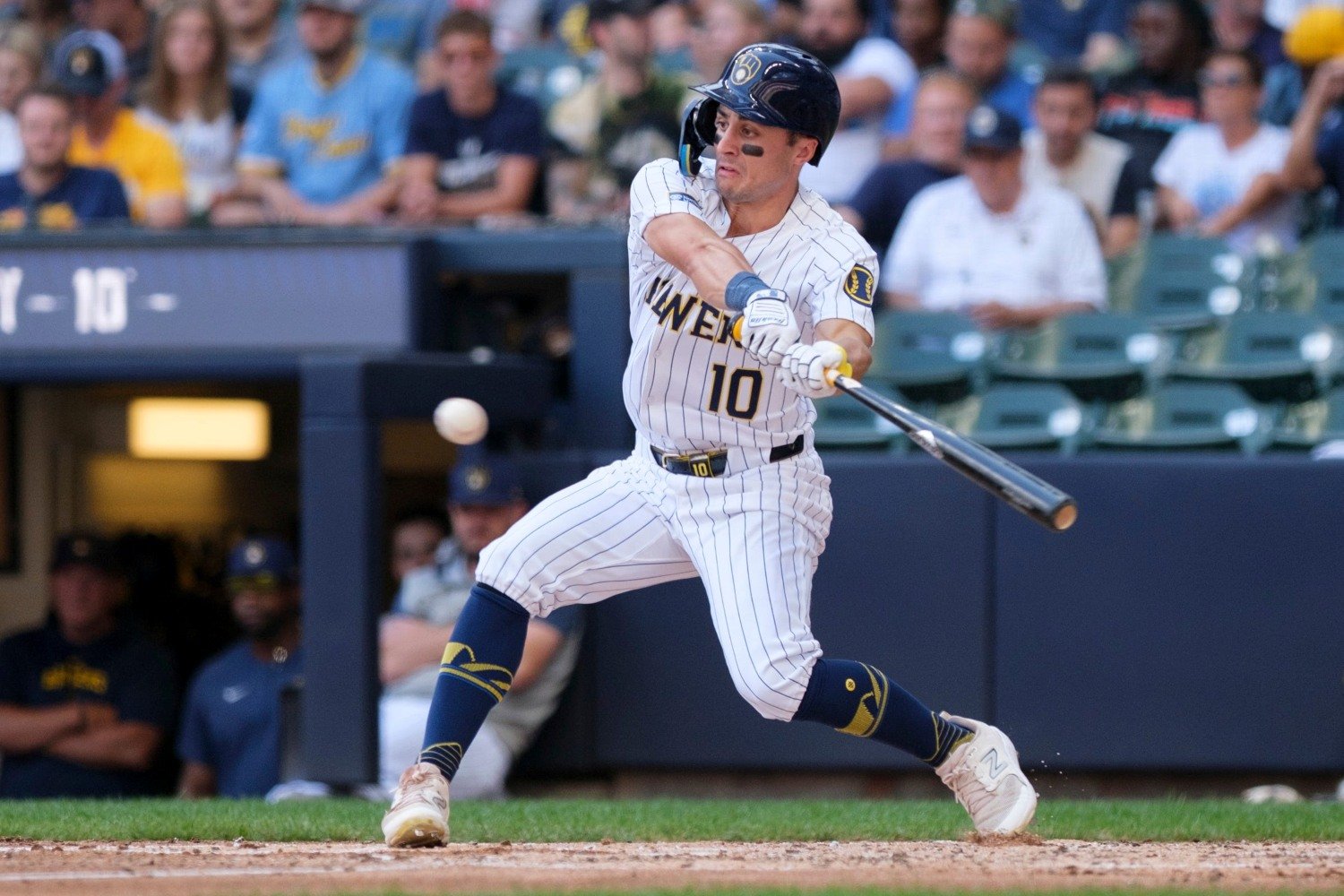
Of the eight hitters who generated the most wrong-way grounders in MLB last year, three are Brewers: Brice Turang, Sal Frelick, and Joey Ortiz. Each of them hit lots of grounders overall, of course, but notice that both Turang and Frelick—the lefties in the group—had an exceptionally unusual directional profile with their worm-burners. They not only hit against the alignment of the defense, but forced fielders to make long throws across the diamond to get them.
Rolling the ball that direction on a quasi-bunt, like that Turang hit, is just one way to put lots of pressure on a defense with opposite-field grounders. If they have to run a long way to make a play like that, the athletic demands of the play (a bare-handed pickup, in most cases; a fluid, single-motion throw; accuracy and power on it) are a good bet to exceed the capacity of the fielder. Then, if they're playing in to cut down the risk of a long run to field it before a long throw, you've taken away their margin for error, and shortened their reaction time.
Ortiz, meanwhile, pulled a lot more grounders than the two lefties did—but again, a righty batter can put plenty of pressure on the defense even with pulled grounders, especially if they have some speed.
Jackson Chourio and William Contreras actually led the team in times reaching on singles, errors, or fielder's choices without outs recorded on ground balls hit to the third baseman or shortstop. They were less likely to go the other way with grounders, but because of how hard Contreras hits the ball and how fast Chourio runs, they got plenty of value from the grounders they pulled.
On balance, the hope should be that the Brewers will hit fewer grounders in 2025. Lifting the ball is crucial to modern offense. That's why the league's average launch angle has risen steadily even within the decade-long Statcast Era, from 10.9° in 2015 to 13.3° in 2024. There's no slug on the ground, except that which you find through batting average, and that's not enough. Still, it's fun to see this breakdown, because it highlights the way Frelick, Turang and Ortiz—the quirky trio of young hitters on whom the team depends so heavily, even if they're not the true pillars of the lineup—find value by making unusual, sneakily high-value contact, whether they hit it hard or not.
Do you approve of Brewers' ownership?

Follow Brewer Fanatic For Milwaukee Brewers News & Analysis



-
 1
1


Recommended Comments
There are no comments to display.
Create an account or sign in to comment
You need to be a member in order to leave a comment
Create an account
Sign up for a new account in our community. It's easy!
Register a new accountSign in
Already have an account? Sign in here.
Sign In Now