


Brewers Video
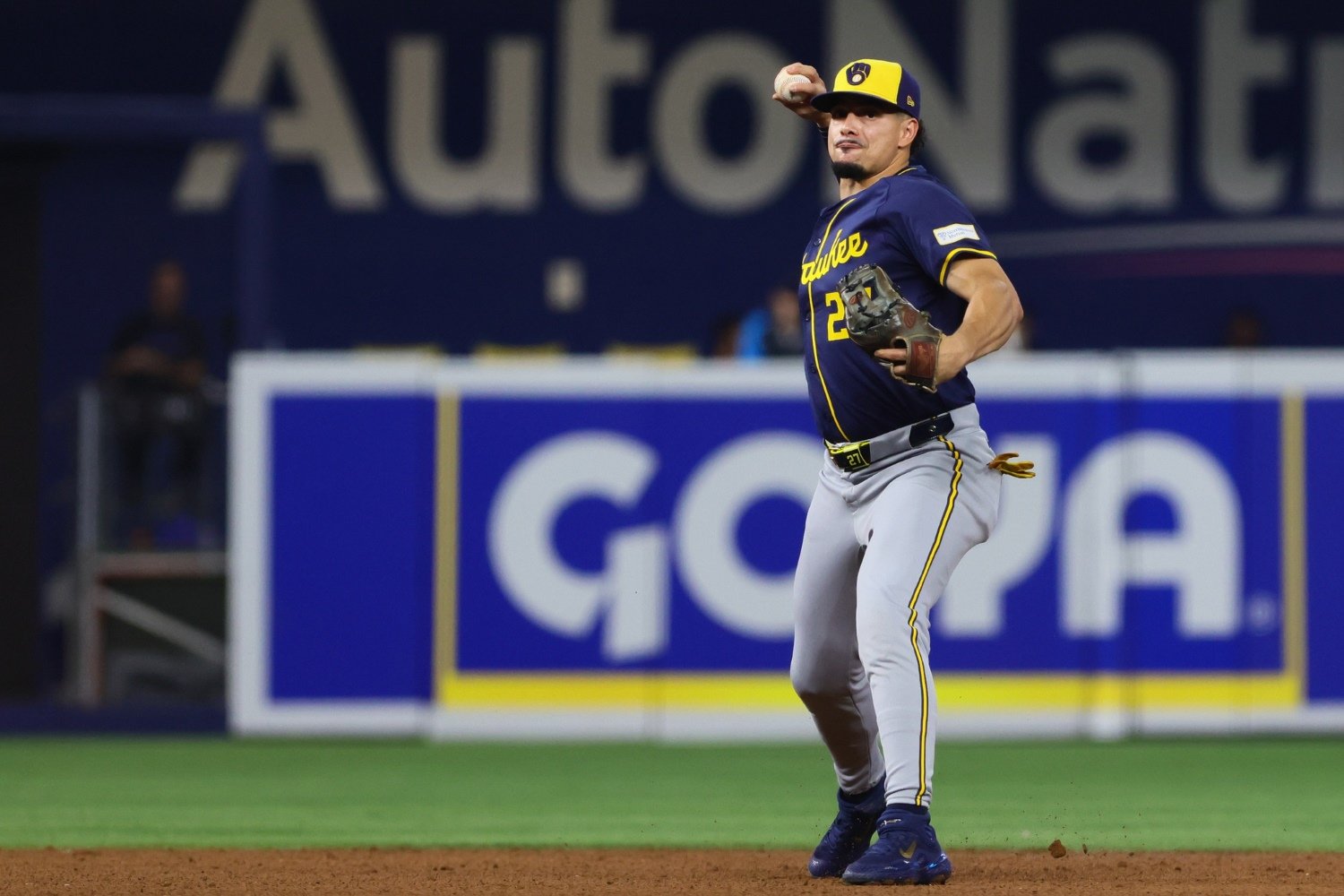
Numbers define baseball players. They determine their salaries, and often, they reflect their value pretty accurately. When it comes to the tenacity with which Willy Adames pursues outs as the Brewers' shortstop, though, numbers can't quite tell the story. We need to make sure we tell it, with words and pictures.
Not long ago, in response to an email from one of the readers of his superb newsletter Pebble Hunting, baseball writer Sam Miller broke down some of the ways in which Carlos Correa stands out from other shortstops when it comes to getting his hands on the ball. As the reader noticed and Sam attempted to confirm, Correa is the rare shortstop who will cross from his position on the left side of the field to act as the relay man when a ball is hit into the right-field corner. In his efforts to find another guy who does that with any regularity, in face, Sam came up empty.
In my opinion, Miller (who, it seems only right to disclose, hired me at Baseball Prospectus nearly a decade ago and was my editor for a couple of years there) is the greatest living baseball writer. There's no better value in sports media than his newsletter. The piece on Correa was excellent, too, but when reading it, I had the rare thrill of digesting a Sam piece and not despairing of my own ability ever to add anything further on the subject. If you're reading this, you're probably a Brewers fan, which means you probably know why. When it comes to going outs-hunting, from foul line to foul line, Willy Adames is Correa, plus an extra cup of coffee or two.
In basketball, it's easy to manipulate the relative impact of each player on the court on the outcome of the game, or at least of a given possession. Teams can make choices about which player should guard whom, and against which stars to use double-teams. Players themselves can choose whether to shoot or pass, and how to move without the ball to either create isolation opportunities for teammates or get open for their own shot. In football, you can move your best corner to stay on the opponent's best receiver, or not; run chip blocks at an elite pass-rusher, or not; and distribute the ball within the offense based on the relative quality and matchup utility of players.
Baseball is different. For the most part, players have to take opportunities as they come. If you want a batter to hit more than another, it's easy: you just slot them higher in the lineup. You can't control in which situations starting players come to bat, though, and surprisingly often, the game comes down to whether your No. 7 hitter can drive home a runner from second base with two outs. If you want a player to touch the ball more on defense than others, you can put them in center field or at shortstop, but by and large, their actual opportunities to affect the other team's production on batted balls is beyond your control. Short of having a rover in whom the team has such exceptional trust that they're placed wherever the ball is most likely to go most often based on the pitcher on the mound at the time, you're at the mercy of the chaos that happens every time a round bat tries to square up a round ball at 100 miles per hour.
For the latter set of reasons, defensive metrics have always been pretty much about what happens when the ball comes and finds you. Throughout baseball history, errors have been the easiest measuring stick for fielders, but beyond the folly of such a subjective judgment, errors are limited by the fact that a fielder has to reach the ball pretty easily in order to be charged with one. Even once range-based defensive stats came into vogue, beginning in the early 21st century, they were only attempting to answer the question: "How well does this player cover the ground their team assigned them to cover by putting them at the position they chose?"
There probably isn't a better way to measure defense on a holistic basis, but every now and then, a really smart and aggressive middle infielder makes those stats look hopelessly blinkered. Jackie Robinson was such a player. Javier Báez, with his tagging genius and baseball IQ paired up with supernal physical gifts, is one modern exemplar. Another, and the best one of the moment, is the man whom the Brewers acquired just over three years ago.
Wherever there might be an out available, look for Willy Adames. Whenever the ball finds a gap or a corner against the Brewers defense, look for him going out to take the throw from the outfielder--regardless of which gap or corner it is.
Not long after Adames arrived, he started showing his ability to be a playmaker on balls that didn't feel like plays waiting to be made. Here's a perfect example, from late May 2021.
Adames was the second cutoff man on this play, and the angle of Jackie Bradley Jr.'s throw tells you what he was thinking, firing it in: try to cut down the runner at third base. Adames, with a combination of instinct and extraordinarily quick, sagacious baseball-time calculation, decided to take down the run at home anyway--and his throw was a seed.
That's a terrific play, but it's also a little bit normal. The Brewers ran that play the way you'd expect: Kolten Wong went out as the first cutoff man, with Adames backing him up. On two similar plays in 2022, they did the same thing. With a runner in motion on a 3-2 pitch in the ninth inning against the Pirates that July, the tying run nearly came around to score from first on a single. Andrew McCutchen's throw back to the infield was a "get it in" throw, not a "get an out" throw. Adames changed that in a hurry.
Then, in August, another ball split the gap in right-center, but when José Siri tried to stretch it into a triple, Adames nailed him.
After that, the team figured something out: it made more sense to have Adames just go out and be the primary cut man any time the ball made its way to the gaps, even if it was to the right side of second base. Here's one example from early this season.
Adames isn't the second option here. He runs out beyond Brice Turang, who stays at home, nearer second base. Turang's arm isn't bad, for a second baseman, but because Adames's is so strong (and is matched by such a sharp nose for the big play), he's the priority place to put the ball whenever trouble is brewing.
Here's another occasion on which Adames went out to take a throw from right-center, in Chicago this month.
Blake Perkins's bobble cost them the chance to get an out on this one, but Adames was the man going way out into center field to collect the throw and attempt the relay. Unlike Correa, he rarely goes to the right-field line on those relays, largely because Miller Park (with the inward jut of the sidewall) often begets tricky bounces out into right field on balls hit down the line, so it makes more sense for Turang to head out there, anyway. Here's one play where Turang had to collect the ball on a double down the line, from a place not even rightly called "down the line", anymore.
That just means Adames is more available in the middle of the field, though, and he's extremely aggressive about going down his own foul line to make plays. Last year, as the Brewers endeavored to seal up a playoff spot in Miami, he did just that. Initially, the runner was called safe, but on replay, the Brewers got a big out.
Adames never views a play as over, or hopeless. At times, this leads to errors, throwing behind runners or trying to prevent a triple and overthrowing, but sometimes, it nets the team outs that other, even slightly less aggressive shortstops wouldn't get. The play in Houston this month was a good embodiment of that.
His exchange had to be perfect to get Kyle Tucker on this play. The throw also had to be on a dime. No problem; Adames was ready long before the ball reached him, and never doubted he'd get his man.
So often, players get slightly flustered in multiple-baserunner, run-possible situations, even after they possess the ball. Not Adames. Like Báez, he always knows not only where the ball needs to go, but how it needs to get there, in order to minimize the risk of a mistake or the needless loss of 90 feet somewhere.
Finally, there's one of the most delightful things about Adames's peculiar style of defensive aggressiveness: he always wants the lead runner. He'll risk sure outs to cut down a runner at third or home instead, and plenty often enough to justify that approach, he succeeds. In the earliest days of the automatic runner rule in extra innings, runners frequently tested shortstops by taking off for third on balls to the left side, figuring the defense might be desperate enough for an out to let them advance, or that they might rush and make an error in trying to take the lead man.
It didn't work on Adames, at all. On the contrary, his eyes seem to light up every time a ball comes his way in extra innings, especially with that runner thinking about trying it. Again, the accuracy of his throw is paramount, and he's a deadeye.
I mentioned that, in American football and in basketball, it's easy to direct the action toward one's best players, and that it's much more difficult to do so in baseball. Somewhere in the middle of that spectrum lies international football, or soccer, and it's there that the best comparison for Adames's style might rest. He's reminiscent of a great central midfielder, like the Croatian Luka Modrić. He understands his responsibilities and has to let the game flow around him, but he's special because of his ability to roam widely and involve himself organically--to make more plays within the run of things than others do, without forcing things.
The Brewers have to overachieve to thrive. They have to win more games than their raw, individual talent would imply. Adames facilitates that. He creates extra outs and prevents advancements, in ways that don't show up even on the ledgers of most modern defensive metrics. He also (and this matters, just as much as the wins and losses) makes baseball a more beautiful game. He's the heartbeat of the Brewers' strong defense, and if they win another NL Central crown this year, they'll owe a great deal to their opportunistic, brilliant veteran shortstop.





Recommended Comments
There are no comments to display.
Create an account or sign in to comment
You need to be a member in order to leave a comment
Create an account
Sign up for a new account in our community. It's easy!
Register a new accountSign in
Already have an account? Sign in here.
Sign In Now