


Brewers Video
You almost can't beat this 2025 Brewers defense. Only three teams have a better Defensive Efficiency than Milwaukee's. Only four teams have more Defensive Runs Saved. The Brewers' formula for wins is total team baseball, which means getting outs as a team as well as scoring runs as a team. They strive not to have weaknesses anywhere on the diamond. It's a defense designed to give an opposing offense no quarter.
If you can manage to catch hold of a pitch from the Brewers pitching staff and drive it well to left or left-center, though, you might just have a chance. On balls in play hit at least 340 feet in that direction, the Brewers are just 18th-best in baseball at getting outs. You don't have to clear the fence to beat them; you just have to get the ball close to it.
The Brewers have three main options in left field, depending on the configuration of the rest of the lineup. Superb rookie Isaac Collins has played there most this year, with Jackson Chourio in center field. When the team's outfield is fully healthy, though, Blake Perkins earns some starts in center, which pushes Chourio over to left. Meanwhile, on days when Danny Jansen catches but the team still wants William Contreras in the lineup, Contreras serves as the designated hitter and Christian Yelich swings out to left field. Collins, Chourio and Yelich figure to be the solution for the balance of the year.
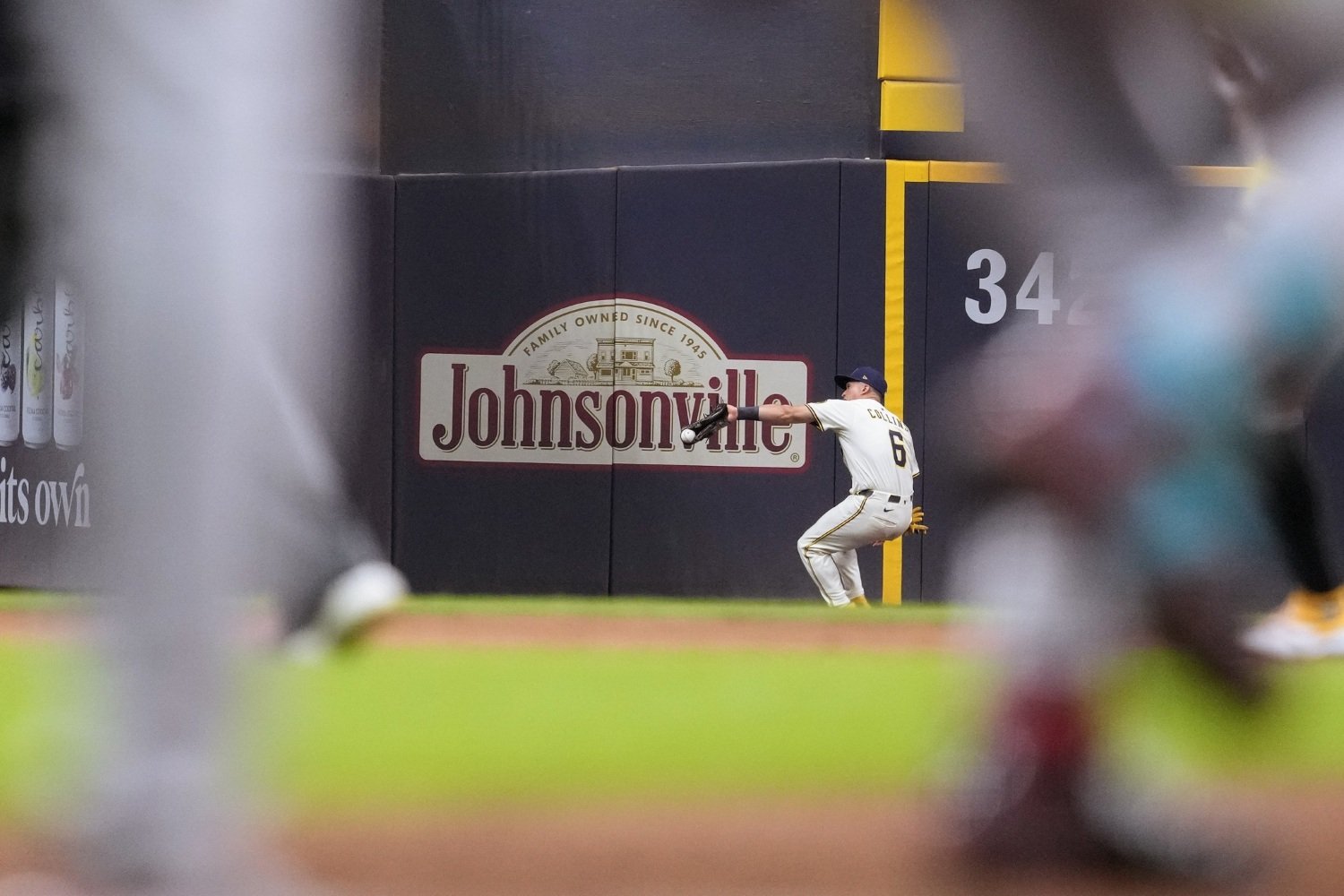
Of them, Collins is easily the defensive ace—but he struggles more than either of the others when going back on the baseball. Sports Info Solutions breaks down players' Defensive Runs Saved (DRS) based on the relative depth of the plays they're attempting. Here's what that looks like for the Crew's three left fielders.
- Collins: Shallow +3, Medium +7, Deep -1
- Chourio: Shallow 0, Medium +2, Deep 0
- Yelich: Shallow 0, Medium -2, Deep +1
A former infielder, Collins readily admits that going to the wall is a point of emphasis for him, and still not a play with which he's comfortable. You can see that on plays like this one.
The extra glance to find the wall cost him time and certainty about the ball's position. This has been a frequent issue for Collins this year. Yelich, by contrast, simply doesn't get that far back on well-hit balls; he quickly takes up whatever angle allows him to play the carom best. Chourio is fearless, but his willingness to crash into the wall is impossinle to mistake for a skill at doing so well. When he gets to long drives over his head, it's not under control. Other times, he struggles even to read the ball, and meanders back too late to make a play.
Collins has also been guilty of taking too flat a route to balls in the gap, at times, which pays off when he's able to spear liners but shows up on the other side of the ledger when a ball needlessly goes to the wall untouched.
On balance, this is no huge deal. Collins makes so many good plays on line drives and flares in front of him or to either side that he more than makes up for letting up a few extra doubles or triples in the course of a year. Chourio playing left makes the defense better because it means Perkins is in center. Yelich playing left means it's a day when the team has Contreras in the lineup but are getting him some rest from the grind of catching. The tradeoffs are all acceptable.
When the Brewers take the field for the National League Division Series, though, tradeoffs will come with higher stakes. Every play matters more when the season rides on a week's worth of action between the same two teams. The tendency to let a long hit get over your head, even if it's just once a week, could be the difference between a pennant and another maddening early exit.
Happily, Collins is already making an important adjustment. When he played left field in April, his average starting depth was 301 feet. That's not unusual for a corner outfielder. Since then, though, he's steadily drifted deeper.
- May: 305 ft.
- June: 307 ft.
- July: 307 ft.
- August: 308 ft.
Last month, Collins was not only seven feet deeper on the average pitch when he was stationed in left than he had been in the spring, but deeper than any other semi-regular left fielder has played in any month all year. He tends to play well off the foul line, so he needs to play fairly deep, trying to give himself time and an angle on balls hit deep into the long corner at Uecker Field, but he's playing deeper than any other consideration demands. This is a clear attempt to better allow him to get to balls hit over his head—by leaving less room between him and the outfield wall, reducing the amount of speed he needs to get to those balls and giving him more time to measure his progress toward that wall.
Pat Murphy might well make moves within games, even come the playoffs. It's unlikely that Jansen will start any games at that stage, so Yelich shouldn't be needed in left, but we could see plenty of Perkins in center and Chourio in left. For most contests, though, getting the bats of both Chourio and Collins into the order will feel urgently necessary, so Collins's work to get more comfortable going back and preventing extra-base hits near the wall is very important. It's not an exaggeration to say that the most promising Brewers run toward the World Series in over a decade could depend on the rookie being ready to catch everything.
Do you approve of the job the Brewers' front office is doing?

Follow Brewer Fanatic For Milwaukee Brewers News & Analysis



-
 1
1


Recommended Comments
There are no comments to display.
Create an account or sign in to comment
You need to be a member in order to leave a comment
Create an account
Sign up for a new account in our community. It's easy!
Register a new accountSign in
Already have an account? Sign in here.
Sign In Now