


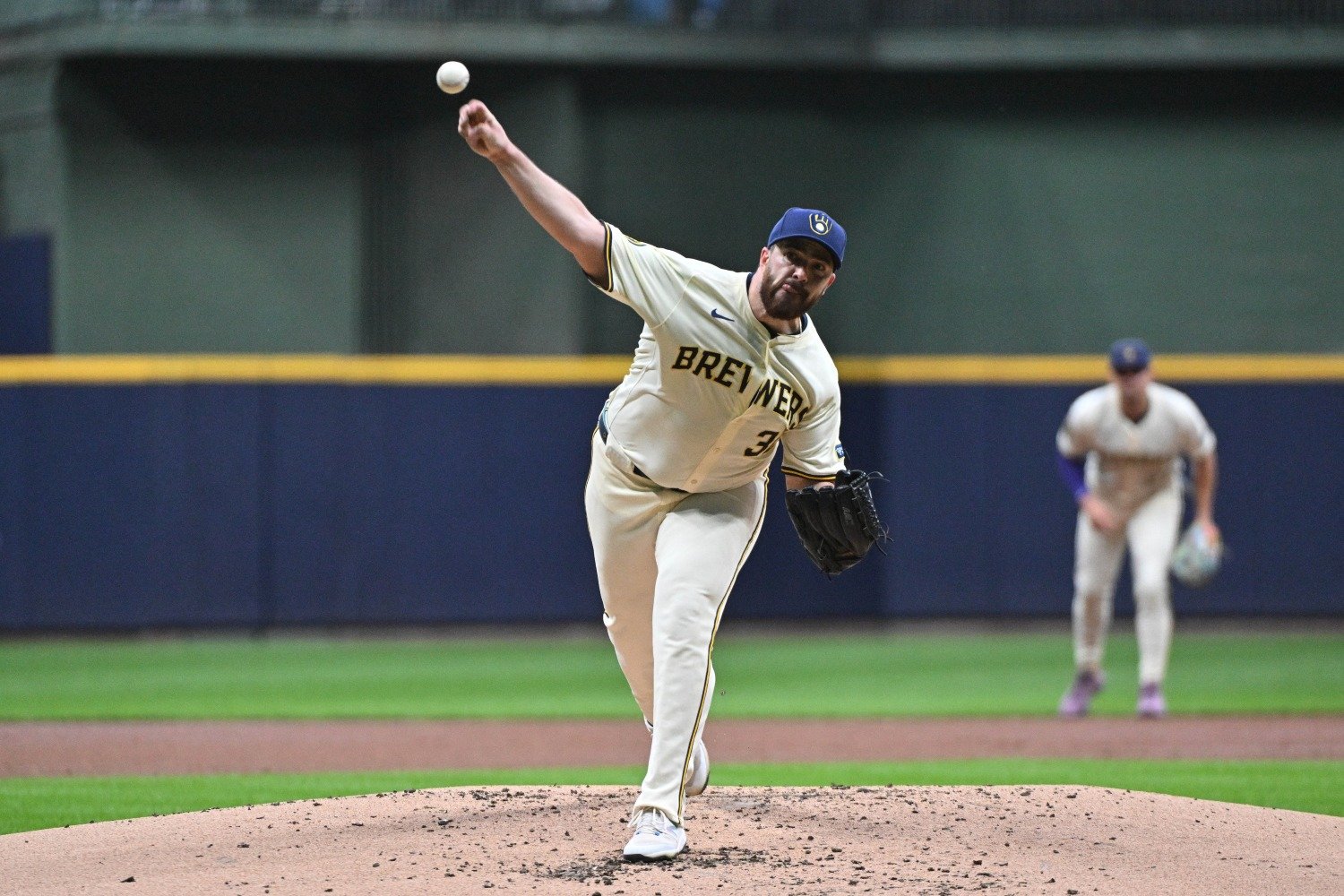
Brewers Video
The Brewers have some of the best pitchers in the sport, but you might not know that from their advanced pitch-modeling metrics.
Baseball is a numbers game. For hitters, most figures are pretty self-explanatory. Batting average, on-base-plus-slugging, chase rate, and strikeout rate have names that paint a pretty clear picture as to what they measure and how they’re calculated. Pitchers, on the other hand, are a little more difficult to assess. Sure, you can measure objective numbers like velocity, spin rate, and movement, but two pitches with similar numbers can have extremely different results. For example, let’s compare the four-seam fastballs of Tobias Myers and Chris Flexen:
|
Fastball Velocity |
Fastball Spin |
Fastball Whiff Rate |
Fastball Run Value |
|
|
MIL Tobias Myers |
92.9 mph |
2,223 RPM |
19.4% |
6 |
|
CHW Chris Flexen |
91.3 mph |
2,144 RPM |
13.2% |
-6 |
Despite being pretty close in velocity and spin, Myers was able to generate significantly more run value with his four-seam fastball than Flexen. This is a bit of an unfair comparison, and I’m conveniently glossing over several other important factors, but this should be sufficient to show you that just looking at surface-level numbers—even the kind we drooled over as recently as 10 years ago—isn’t nearly enough to tell the whole story.
To try and fix this problem, the best minds in baseball came up with a very specific, crystal-clear term that left nothing up to the imagination: Stuff. You’ve likely heard this term tossed around before, and maybe you just assumed it was a general term for a pitcher having impressive velocity and movement on his pitches. Sometimes, of course, it is, but there’s actually a more specific definition. In essence, it’s a catch-all word for a pitcher being good at his job.
This brings us back to the Brewers. After having a collective 3.65 ERA in 2024, fifth-best in MLB, one might assume the team’s “Stuff” is off the charts, since the pitchers were all pretty good at their jobs. The opposite is a little closer to reality. Here is a quick primer on how Stuff+ is measured, and the table below displays the 2024 Stuff+ numbers of the potential arms in Milwaukee’s 2025 rotation:
|
113 |
|
|
106* |
|
|
105 |
|
|
104 |
|
|
99 |
|
|
Tobias Myers |
97 |
|
87 |
*Data from 2023 since Brandon Woodruff did not pitch in 2024
There are a couple of key takeaways here. First, Ashby leads the pack by a decent margin, but his lack of arsenal depth means he’ll probably be better in the bullpen, especially given how well he did as a reliever last season. Second, Nestor Cortes may be a surprising appearance, but his sinker had a Stuff+ figure of 119 last year. He primarily depends on a four-seam/cutter combination, but Milwaukee could have him increase his usage of his sinker and his slider, which had a Stuff+ of 109. Third, this set of numbers seems to sell the pitching staff pretty short. In fact, as a team, Brewers starters had a cumulative Stuff+ of just 97, placing them 17th in MLB.
Upon further consideration, this actually makes sense. Without Corbin Burnes or Woodruff and with plenty of injuries to go around, Milwaukee’s starters relied more on clever tricks than they did on intrinsic pitch quality. Furthermore, Stuff+ doesn’t always translate to on-field success. Nick Mears had a Stuff+ of 119 while pitching for the Brewers, but only managed a 7.30 ERA and 6.25 FIP for the team.
Will the Brewers be getting access to more of this so-called “Stuff” anytime soon? Well, the return of Woodruff should help their case, assuming he isn’t dragged down by any long-term side effects from injury. If Jacob Misiorowski debuts, his 70-grade fastball/slider combo should also measure well, but he has some work to do in rounding out the rest of his arsenal before he’s ready to be a big-league starter. Last but not least, we have Robert Gasser. He probably won’t be back until the back half of 2025 at the absolute earliest, but the lefty had an impressive 118 Stuff+ on his slider and is one of the team’s top pitching prospects for a reason.
All in all, what the Brewers have done best with their arm talent is to get value for money. Any (rich team's) front office can cough up nine figures for pitchers who are essentially finished products, but it takes a really savvy organization to maximize the potential of what they’ve already got. Whether this ability to outperform their statistical expectations is anything more than a temporary trend is yet to be seen, but for now, if it ain’t broke, don’t fix it.
Are you optimistic about the Brewers right now?

Follow Brewer Fanatic For Milwaukee Brewers News & Analysis



-
 1
1



Recommended Comments
There are no comments to display.
Create an account or sign in to comment
You need to be a member in order to leave a comment
Create an account
Sign up for a new account in our community. It's easy!
Register a new accountSign in
Already have an account? Sign in here.
Sign In Now