


Brewers Video
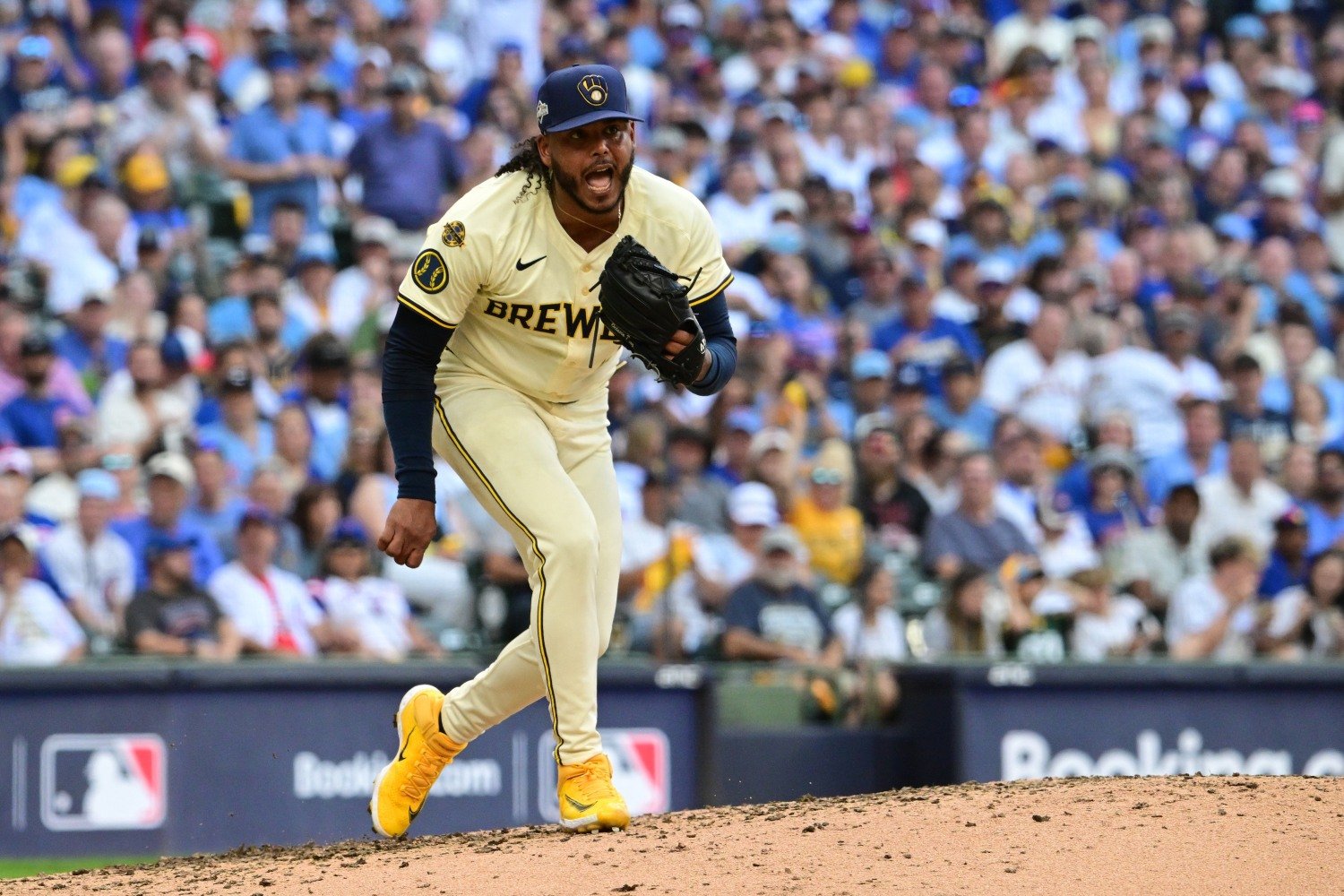
Michael Busch got the better of Freddy Peralta at the very beginning of his day. Ian Happ and Carson Kelly put good wood on him at the very end of it. In between, though, Peralta utterly dominated, securing a win in the first game of what should be one of the most hard-fought Division Series rounds in baseball history. The Brewers' ace got 17 outs and left with a comfortable 9-2 lead, having struck out nine batters and walked three. In a 95-pitch effort, Peralta induced 14 swings and misses, but he also controlled the quality of the Cubs' contact well when they did put it in play. He used his whole arsenal, and seemed to be one thought ahead of Chicago all afternoon.
Between Busch's leadoff home run and Happ's solo shot in the sixth, Peralta only allowed four baserunners, and he seemed to slice through the vaunted Chicago lineup with relative ease. His velocity and movement were right where they usually are, and his command came and went, but his plan—the gameplan he and William Contreras constructed and then adapted to frustrate Cubs hitters—was as good as it's ever been.
Almost immediately, it became clear that the Cubs were trying to pin Peralta down to two pitches from each side of the plate: the fastball, and then the changeup to lefties and the slider to righties. They expected something akin to his season-long approach, which still includes throwing the heater over half the time, even in the post-Fastball Freddy Era. They had some reason for that expectation, although the case was not airtight. Peralta faced the Cubs four times this regular season—once in each series in which the two teams met—and had a mixed bag of results, drawn from a widely varying set of approaches and looks.

The background colors here aren't just for looks. In his first (May 4) and last (August 18) start of the regular season against Chicago, Peralta was excellent. In those two starts (one each at Uecker Field and Wrigley Field), he pitched a combined 12 innings of scoreless ball, allowing just seven hits and four walks while striking out 13. On the other hand, in starts on June 19 at Wrigley and on July 30 in Milwaukee, Peralta pitched just nine combined innings, allowing seven hits, walking six, and striking out just nine. He surrendered three homers and a total of eight runs in those two starts.
While the Cubs certainly don't have his number (the way the Brewers do on Matthew Boyd, for instance), this has been a pretty even battle of ace hurler and top-tier offense this season. Peralta can't be faulted for not giving them enough different ideas. In his two successful starts against them, he was fastball-heavy, but not in a way that suggests a lack of thinking hard about how to mix in the rest of his arsenal. Early in the season, there were other outings in which (like that one in early May) he essentially ditched his slider, for which he didn't always have a feel. Some of what we're seeing above is a savvy veteran changing his plan of attack each time he sees a too-familiar foe. Another part is just the evolution of a pitcher over the course of a season, and the way Peralta is always problem-solving when he's on the mound.
Here's what that same chart plotting the movement of his pitches looked like Saturday.

As has been happening in many of his recent starts, Peralta's slider and curveball blended with one another quite a bit. He's leaned into that lately, as the sweep he formerly had on the slider increasingly eludes him; he just plays across a spectrum of speed and depth with a pitch that has more or less the same shape. You could say that he only has one breaking ball now. You could say he has three. To be sure, though, the slider and curveball are less distinct than they have been in the past.
Initially, Peralta did try to set up lefties with his high fastball, then get them out with his changeup. The Cubs proved ready enough to force a different plan of attack, as the start wore on. Busch's leadoff homer came on the fastball, showing he was more than ready for it. Throughout the day, the changeup bore relatively little fruit against lefties.

That red dot below the strike zone is the first-pitch change Pete Crow-Armstrong hit hard through the right side in the second inning. About then, Peralta and Contreras realized some Cubs were sitting on that offering, and that they were unlikely to find many of their outs with that offering to those batters.
Instead, they went to the curveball, which sometimes blended with the slider. Some righties only feel comfortable working their breaking ball into the space below the zone to lefties—and for some righties, that's true with very good reason. Peralta, however, is happy to work the backdoor breaker, and he and Contreras begun whittling away the outer edge for Cubs hitters by hooking the ball onto the outer edge with a steep downward drop.

As you can see, that's where he got a lot of his whiffs against those batters. The black dot in the zone is a foul tip by Ian Happ, which came on a two-strike count and thus resulted in a strikeout. Peralta got two other punchouts with curveballs to lefties, alone. Just as importantly, late in the game, he used that pitch to take the bite out of the sluggers' bats. In the sixth, he teased Kyle Tucker with curves away, and even though Tucker sat on one, he had to swing so slowly and so far outside his usual bat path that he flied lazily to left field.
To righties, the story was similar—which is to say, it was flipped. Right from the jump, the righty bats in the Cubs lineup spat on the slider low and away; there was going to be no joy for Peralta in setting them up with the fastball on the outer edge and then getting a chase on the breaking ball. When an opponent is trying desperately to keyhole you on two pitches, though, it's often as simple as giving them a third one to confound their plan. As he's done often this year, Peralta went without hesitation to the right-on-right changeup, and it wrecked the anxious Cubs hitters—especially because they wanted so badly to hit their way back into the game.

That he was landing so many of those changeups in the bottom part of the zone certainly helped; his execution of that particular offering was flawless. But the Cubs did some of the work for him, hunting fastballs so hard that they struck out multiple times on the changeup and gave Peralta some quick at-bats with early, weak contact on it, too. The red dot in the image above is the last pitch Peralta threw all day; he finally left a changeup up and Carson Kelly hit it viciously, but only for a single.
Peralta did give up the two homers, and a bit of hard contact besides. The Cubs' bats are lively right now, and when they had him pegged, they produced dangerous contact. Mostly, though, they were fooled. Look at Chicago's batted-ball distribution against Peralta by exit velocity and launch angle, and you can see two things:
- A number of utterly harmless fly balls by usually dangerous hitters, induced by the way Peralta changed speeds and forced weak contact with both his fastball and his softer stuff; and
- A big hole where more batted balls ought to be—a negative space that speaks to the value of striking out nine against a team that hits hard line drives.
I've used a yellow circle to indicate (1), below, and a red rectangle to indicate (2).

Had the Cubs made better or quicker adjustments, Peralta might have had a harder time of it. His command of the breaking ball got shakier as the game went on, as if once he started working it to the arm side against lefties, he could no longer steer it to the glove side. However, he used his fastball to great effect in a few key moments, finding the players and the situations in which there was no way to cover a well-located heater—and the Cubs never did compel him to make a third-level swerve.
There are no guarantees. If the Cubs force a fourth game and Peralta takes the ball again, it could continue the pattern of this season between the two combatants. Even in that case, though, it's worth noting that while the Brewers have won all three good Peralta starts against Chicago this year, the Cubs only secured victory in one of the two rougher ones. Peralta might have a whole new plan (or feel for a different sector of his arsenal) if he has to face the Cubs one more time, and even if they beat him in the next round of cat-and-mouse, he's likely to keep his team in the game. After the way he mowed down Chicago in Game 1, the best news is, Game 4 might not have to happen, anyway.
Which team do you dislike the most in the NL Central?

Follow Brewer Fanatic For Milwaukee Brewers News & Analysis



-
 2
2



Recommended Comments
There are no comments to display.
Create an account or sign in to comment
You need to be a member in order to leave a comment
Create an account
Sign up for a new account in our community. It's easy!
Register a new accountSign in
Already have an account? Sign in here.
Sign In Now