


Brewers Video
It's a 2-2 count in a tight spot. The tying run is in scoring position, and the go-ahead run is at first. It's the top of the eighth. What are you going with, here?
That's a baseball conversation as old as the game itself—or nearly so. While we don't want long, ponderous pauses between bursts of action, one of the great things about this sport is that it breathes. There's time enough between pitches to guess along with the pitcher, the catcher, the batter, the runners and the defense, at least a little. There's even time to do it aloud. You hear it on broadcasts all the time. We enjoy this exercise. There's a vicariousness to it that can make baseball feel more accessible than other sports, even though it's no less difficult when you're actually between the lines. It's also one way we judge players' baseball IQ and their engagement with their craft. How well are a catcher and pitcher communicating? How creative are they being with their sequencing and their efforts to give the hitter something other than what they're looking for? How much trust is there between them?
When you watch a Brewers game, though, you can often look smart by simply leaning toward your friend and saying, "Fastball here, I bet." That's been true for years now. While Milwaukee works hard to give as many hurlers as possible multiple fastball looks, they throw some flavor of heater more often than any other team in baseball. That's not an accident. For one thing, they know that doing so can limit the quality of opponents' contact; the surest way to give up an extra homer or two is to hang an extra breaking ball or three. For another, they have a great defense most of the time, and throwing fastballs allows their pitchers to be efficient while utilizing those adept fielders.
Most of all, though, they scout and develop pitchers with exceptional fastballs, in various ways. Josh Hader's unique combination of arm angle and fastball shape made him almost unhittable even when he didn't have his slider working. Corbin Burnes took some time to find that the cutter was the right fastball for him, but once he did, he was an ace. Scrap-heap scoop-ups from Trevor Megill to Bryan Hudson to Grant Anderson have not only been targeted because their fastballs are outliers, but have thrived because the team has helped them optimize what they had there. I don't have to rehash the almost superhuman elements of Kyle Harrison (aka Gravitron) or Jacob Misiorowski here; you know their heaters are the two best in baseball.
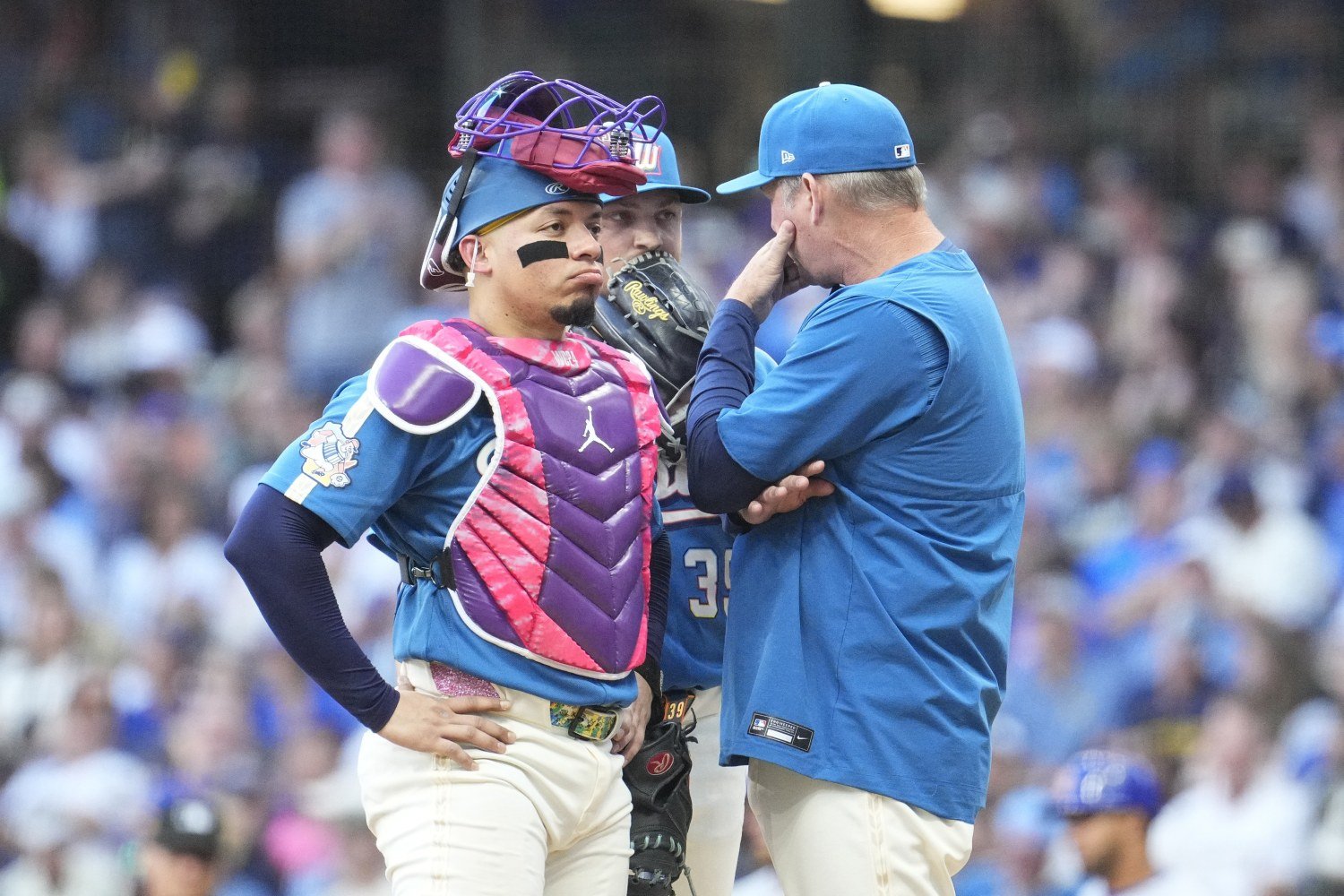
Thus, there's not as much for a catcher to do back there, really. Brewers pitchers rave about the way William Contreras calls games, but the truth of the matter is that he has the easiest job of any starting catcher in the sport. He can resort to the fastball more often than anyone else, and he does. In fact, this year, he's calling some form of fastball about 68% of the time, more than any other player (including past versions of himself) has done it in any of the last four years. Occasionally, that gets brought up as a point of criticism of Contreras. Pitchers might love being exhorted to trust their heaters, but should they mix it up a bit more? Could the team miss more bats and be a better pitching staff by going to offspeed offerings more? Is Contreras holding guys back.
Here's a chart that answers that question pretty neatly.

This plots all of the player-seasons by catchers with at least 2,500 pitches caught in that campaign since the start of 2023, by fastball usage (the x-axis) and run value per 100 pitches on fastballs (the y-axis). The navy dots are the Brewers' catchers: Contreras (x4), Eric Haase (x2), Gary Sánchez and Victor Caratini. As you can see, they're all clustered toward the right edge of the graph. All but one dot is also on the good side of 0.00 runs per 100 heaters thrown.
Contreras is pushing into new territory with the way he's hammering the fastball this year, but in part, that reflects the fact that he's working with two of the best heaters the game has seen this decade. Neither Misiorowski nor Harrison needs to throw much else; their fastballs deceive and dominate hitters in ways that are relatively exposure-proof. Sánchez is the navy dot second-closest to the right edge of the graph, and is third overall in this sample of player-seasons. The Brewers just have a lot of guys with multiple fastballs, a lot of great fastballs, and less motivation to throw other pitches than other teams have.
How sustainable this approach is—whether, for instance, you can lean this hard on fastballs and still advance through the postseason to where the Brewers are hoping to go—remains to be seen. It doesn't feel like throwing so many fastballs is why the team has been beaten in October time after time, but it might be worth exploring a change of strategy that prepares the team to do something more unexpected in the playoffs. For now, though, this keeps working. Moreover, it keeps showing up as an organizational imperative, rather than some quirk of Contreras's.
That makes the charismatic leader of the Crew a bit less valuable than if he were some pitch-calling genius, but this is one of those areas in which having a defined, top-down approach has lots of value to the Brewers. Should they elect to trade Contreras this winter, it won't disrupt their run prevention. That machine runs on things with more staying power, at lower cost: Chris Hook, Jim Henderson, the scouting and development teams, and a few other people in the front office. They might still be wise to retain Contreras, because his offense is hard to replace at that position and because the team looks to him as such an important figure. If they do move on, though, they'll be able to select their next starting backstop for their hitting ability, too, because they just need someone who can catch fastballs and manage moments well on defense.
For many catchers, calling the game is a matter of personality, and even identity. In Milwaukee, it's about identity, too, but the identity is collective, rather than individual. They know what works, because they've built an entire ecosystem in which that simple plan will work. They want a great catcher with a live arm, intensity and offensive value. They don't need that person to also be an elite tactician, planning at-bats with the precision of a military commander. It's a little less romantic than when a team does ask a catcher to be that brilliant, but you know what's better than romanticism? Outs. Outs and wins.
Are you optimistic about the Brewers right now?

Follow Brewer Fanatic For Milwaukee Brewers News & Analysis



-
 2
2


Recommended Comments
There are no comments to display.
Create an account or sign in to comment
You need to be a member in order to leave a comment
Create an account
Sign up for a new account in our community. It's easy!
Register a new accountSign in
Already have an account? Sign in here.
Sign In Now