


Brewers Video
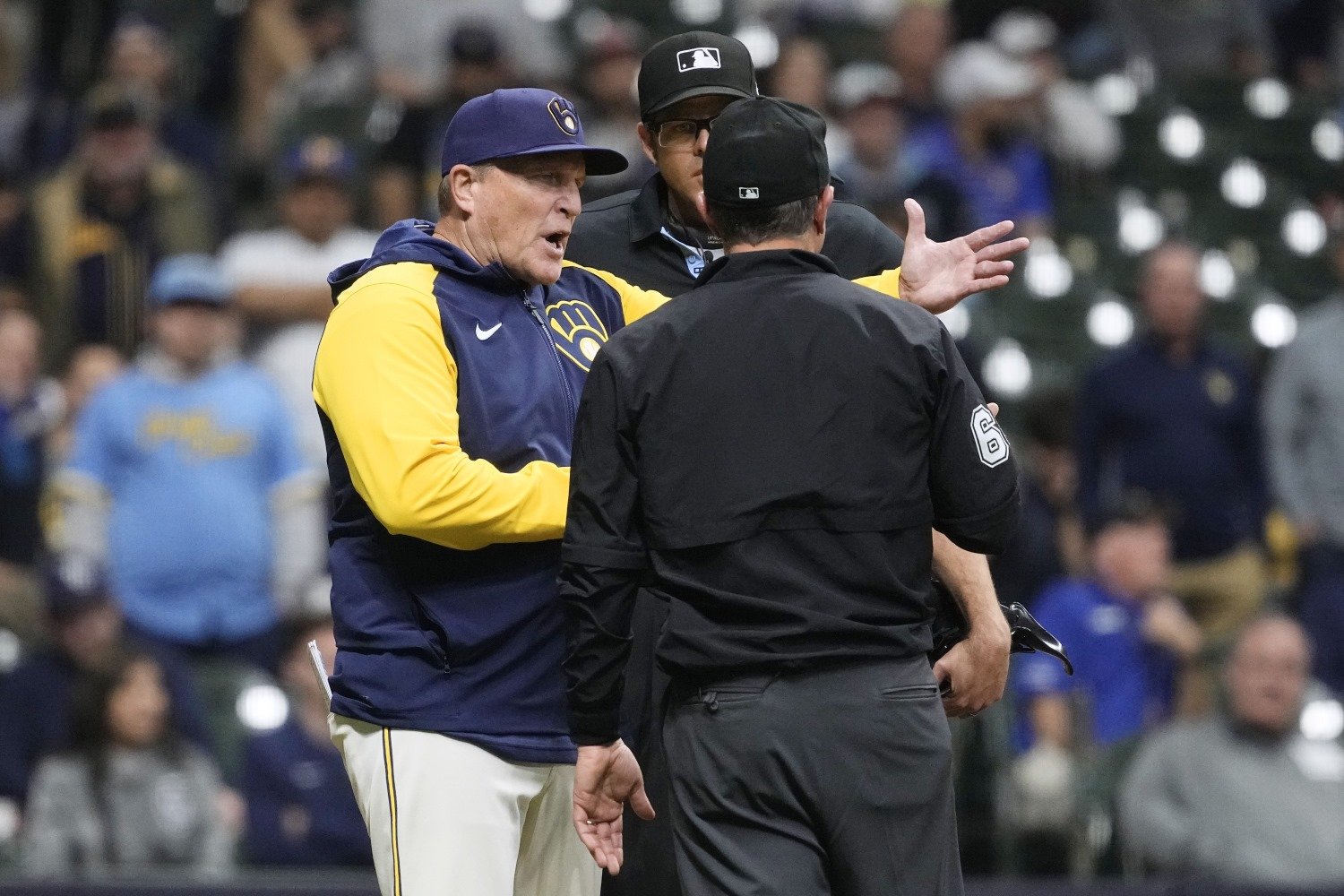
The Milwaukee Brewers lost a heartbreaker Monday night, partially thanks to a controversial call in which the umpires enforced one section of the rules governing interference by the batter, instead of another. The whole thing (and a bevy of other unfortunate things, too) could be avoided, though, with one simple change to the playing field.
I love catcher interferences. I think they're one of the wonderful little oddities of baseball--a seemingly fluky but occasionally important part of the game, and an exposure of the ways in which the game is a little bit broken. It is with a heavy heart, therefore, that I tell you: we have to get rid of them. Or at the very least, we have to take action to mitigate them, and that action figures to virtually eliminate them.
There have been 1,793 instances of catcher interference in MLB since 1912. Nearly a third of those, though, have come since the start of 2015. The league sets a new record for the number of times a batter reaches due to catcher interference nearly every year, anymore. In 2022, the new record was set at 74. Last season, there were 96 of them. Already, in 2024, there have been another 28 of them. We're hurtling toward a new record, by no smaller a margin than we saw last year.
Without an enforced change, this will continue apace. We live in the era of pitch framing, and the best way to frame pitches is to get as close up behind the batter as possible. William Contreras has run into too many bats over the last year-plus, himself, but it's part and parcel with the very valuable progress he's made in stealing strikes. It's worth the still-small risk of collision and a base lost to interference, to improve the chances of getting outs via better counts for the pitcher and catcher.
As the frequency of these plays increases, though, they begin to have a more distortionary effect on the game. By itself, that's fine by me. I like the way the interference rule and the value of framing push against each other, forcing catchers to decide how fine a line they're willing to walk and how far forward to come to catch a ball. I even like the fact that some hitters have gotten good at drawing catcher interference; it's a subtle but nifty skill, like defenders who excel at drawing charges in basketball.
Alas, as we saw Monday night, increasing catcher interference is only one symptom of the problem. There's also going to be a steady increase in backswing interference calls, In fact, though these are harder to find and count, we've already seen that increase. This, too, is a product of the modern game. Batters are crowding to the back of their box, just as catchers are crowding up into the area right next to it, because pitchers throw harder than ever and hitters need more time to see the ball and hit it. They're also swinging harder than ever, because the game is more about power than ever.
Combine all of that--more big swings, from hitters farther back toward catchers who are farther forward--and the collisions become inevitable. I won't delve deeply into it here, but these forces are also the driving factors pushing hit-by-pitch rates ever higher. The chaos this engenders is, at a certain point, bad for the game. Trying to tease out whether a standard batter interference rule or a backswing interference one should be applied--let alone whether the catcher's momentum into the batter's space should negate the interference altogether--isn't a fun way to spend our time at the ballpark.
The solution is simple. Right now, there's no official front line on the catcher's box in professional baseball. The league should create one, and it should be a foot or so behind the back line of the batter's box. That would enforce a separation between batter and catcher, dramatically decreasing the chances of interference on the way to the ball or on a backswing. It would also create a clear boundary. If the catcher wasn't in his box when hit with a backswing, for instance, the batter wouldn't be culpable.
There are some secondary things to consider before implementing and enforcing a front line for catchers. Firstly, it could lead to more balls in the dirt, and thus more wild pitches or passed balls. We're effectively forcing the catcher backward, here, and that does matter. It would also slightly increase the distance they would have to throw on stolen base attempts, further tilting that confrontation toward runners. On balance, though, it would be good for the game.
Here's one last reason, unlike the others: creating more space between batter and catcher would also reduce injuries. Fewer catchers would be hit on backswings, which is very good; plenty of backstops have been concussed that way. More importantly, though, a few fewer foul tips would hit catchers, too. Think about the moment when a hitter hits a foul ball, deflecting it from its normal trajectory but not fully redirecting it. With the catcher so crowded up behind the hitter, there's marginally less time and space than there used to be, within which the ball can both decelerate and deviate from its previous path.
In few cases will a foul tip hit under new rules enforcing a deeper catcher setup miss the player altogether, whereas it would have hit them under the current rules. Each such case would be valuable, though, because the balls that almost miss the catcher are often the ones that hit them, instead, in the top of the mask. More importantly, perhaps, the force of the collision would be slightly reduced by the extra moment of deceleration between contact with the bat and contact with the catcher (or umpire).
This is a small thing, but baseball is made up almost exclusively of small things. The game would flow a little better and make a little more sense if we reversed the trend toward the catcher and batter being right on top of one another. We might also see a few fewer injuries, and Brewers fans might not have to develop a migraine wading through conflicting rules on key plays. This small change is a no-brainer.





Recommended Comments
Create an account or sign in to comment
You need to be a member in order to leave a comment
Create an account
Sign up for a new account in our community. It's easy!
Register a new accountSign in
Already have an account? Sign in here.
Sign In Now