


Brewers Video
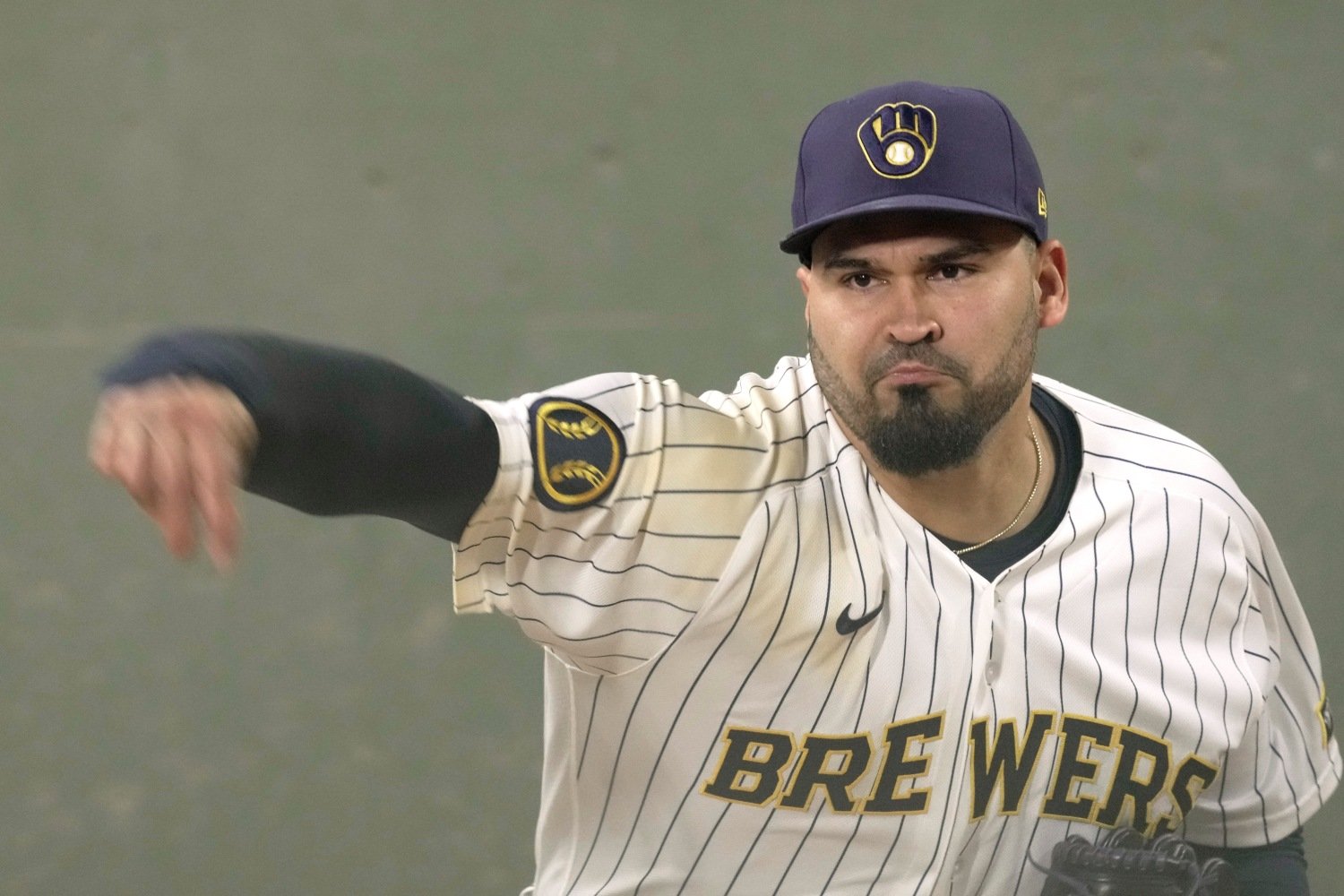
When they arrived ahead of the MLB trade deadline, Dustin May and Antonio Senzatela looked like matches made in heaven for the Milwaukee Brewers. Each had a three-fastball mix of the kind the Brewers adore, while both had breaking balls (albeit with differing degrees of feel) to keep hitters from simply selling out for velocity.
The problem, as you'll have heard about extensively if you tune in to the Brewer Fanatic Podcast every Friday, is what happens when a pitcher becomes too predictable. If hitters know they're getting a fastball (and know roughly how fast that fastball is going to arrive), they can get their 'A' swing off without having to worry about looking foolish out in front of a breaking ball.
The ability to vary shapes on the heater becomes problematic when they're all you have—when everything a pitcher throws lives in a similar velocity band. Rather than having to account for different speeds and shapes, hitters can get their foot down, time themselves for the fastball, and let it rip.
Antonio Senzatela: What's A Breaking Ball?
Senzatela is the better example of the two, if only because there's slightly less nuance to the problem. Comparing his pitch usage before and after joining the Brewers showcases it pretty clearly. He's gone from around 80% fastball usage with the Rockies to 95% fastballs with the Brewers. Previously, roughly one in five pitches was a breaking ball. With the Brewers, it's one in 20; that means a hitter can go through an entire plate appearance without having to account for one.
At that point, the breaking ball is barely part of the hitter's attack plan. Since being dealt to Milwaukee, Senzatela has scrapped his slider and his changeup. For that matter, he's also dramatically reduced his four-seamer usage.

His cutter has sharp break that distinguishes it from the sinker and four-seamer, but it's only a few miles per hour slower than they are. There's a movement differential, but not a velocity one.
The swing data shows exactly what that predictability is doing. Hitters are swinging harder more often, and they're no longer finding themselves swinging underneath the fastball as frequently: You'd expect this, not only based on the elimination of the curve (and its velocity gap) but based on the absence of the four-seamer, which is the version of the fastball hitters would typically swing underneath.

With the Rockies, Senzatela saw about 38% of swings at fastballs end up underneath the meat of the ball. With the Brewers, that number has dropped to around 20%. Part of that comes from the change in usage to a more sinker-heavy arsenal compared to a four-seam-heavy one, but that doesn't explain the whole problem.
Because batters aren't worrying about changes of speed, they're swinging faster, on average, and a higher percentage of their swings are full, convicted ones. The data are telling us everything Spencer and Jack have been talking about on the aforementioned podcast: without the curveball, Senzatela isn't doing enough to push hitters off their timing, and that's affecting the performance of his fastball.
Even if he uses it purely as a waste or chase pitch, a breaking ball forces the hitter to account for a different speed and shape. The swing can become so out of time that, when the fastball comes back into the zone, the hitter has less chance of squaring it up, having lost the rhythm of their timing mechanism.
There is some compensation for this, of course. The lateral movement profiles of his sinker and cutter mean that more of opponents' swings lately have found them making contact off the barrel, be it at the end of the bat or up toward the handle. That should produce plenty of weak contact. If batters can swing 2 MPH harder, though, that offsets the loss of efficiency of contact, and the ball gets hit hard just as often.

Senzatela's breaking ball is by no means a great pitch on its own. That's part of why the Brewers have distanced themselves from it. He doesn't have much feel for spinning it, and that creates problems, but it's an important cog to make sure the wheel turns smoothly. It needs to be reintroduced to generate whiffs; weak contact isn't a sufficient goal.
Whether he pivots his arsenal ahead of the NLDS will be fascinating, especially for a Brewers team that has some questions in right-handed middle relief.
Dustin May - Stuff+ Matters, But So Does Command
The Brewers have made similar tweaks with Dustin May. He's using more fastballs than ever, up from 67% to 74%, but most of the tinkering has come from how he's redistributed those fastballs. May has leaned more on his cutter and sinker with the Brewers (until his last start, at least), while slightly reducing the four-seam fastball. Here's how his pitch mix looks in St. Louis compared to Milwaukee:
.png.7b5b72079408da7706eee04794f0e14a.png)
The biggest downgrades have come on the sweeper and four-seamer. I've gone into depth about May effectively being two different pitchers, with a low arm slot for his two-seamer and sweeper. Both pitches break so much from that slot that they can be relatively easy to pick up early in the ball's flight, and that may partially explain why he hasn't recorded a single swing-and-miss on his sweeper against a right-handed hitter since joining the Brewers.
The Brewers have moved him toward a curveball, something that tunnels better with his four-seamer and cutter, but May has also struggled to command it consistently. That's where the raw stuff can become a little misleading. The movement is outrageous, but if the breaking ball isn't landing close enough to its intended spot, hitters can simply spit on it and sit on the fastball. That's one reason why the expected run value on batted balls has skyrocketed with the Brewers.

There is some good news. For the first time since June, hitters have been off-time on his breaking pitches. The problem is that without being able to command those pitches, or tunnel them effectively with the fastballs, May has been forced to lean too heavily on the fastballs themselves. That's where the predictability comes in.
Hitters have a higher fast-swing rate in September, they're making more competitive swings overall, and May is struggling to disrupt their timing in the way someone with his stuff typically could. The stuff hasn't disappeared. He's just not consistently using it in a way that forces hitters to account for it.
He's beginning to find some comfort with the curveball, though, and that could go a long way. In his final outing on Saturday, May used his pitches in a way that more closely resembled his Cardinals usage, with some fascinating results. He used the curveball 15% of the time, generating some ugly swings and misses, while using the four-seamer to attack hitters at the top of the strike zone.
.png.54e2748c08f2b0e9b6c434cd74350607.png)
That might be the way forward for May. The curveball doesn't need to become his best pitch; it just needs to be good enough, and well-commanded enough, to make hitters respect it. If he has the confidence to continue throwing it, the rest of the picture might start to come together.
There is enough stuff to create disruption for May, but he isn't consistently commanding or using it well enough to actually create that disruption. Without it, hitters are finding it too easy to get on time and on plane with his three-fastball mix, and that's why we're seeing him blow between hot and cold within an outing.
The Brewers have plenty of fastballs capable of getting outs. The question, particularly with May and Senzatela, is whether they're giving hitters enough reason to worry about everything else. A breaking ball doesn't have to be a putaway pitch to be valuable. Sometimes, it just has to be good enough (and well-commanded enough) to make a hitter hesitate. Once a hitter knows he can sit on the fastball, all that velocity and movement becomes a lot easier to handle.
Do you approve of Brewers' ownership?

Follow Brewer Fanatic For Milwaukee Brewers News & Analysis



-
 2
2



Recommended Comments
Create an account or sign in to comment
You need to be a member in order to leave a comment
Create an account
Sign up for a new account in our community. It's easy!
Register a new accountSign in
Already have an account? Sign in here.
Sign In Now