


Brewers Video
2024 was a great year for Brice Turang. His game took a big step forward in nearly every aspect. While he was unable to maintain his offensive momentum after the All-Star break, he established himself as one of the best overall defenders in MLB. He received a Platinum Glove for his efforts, and statistically, it should have come as no surprise. He led all of MLB with +22 Defensive Runs Saved and placed in the top decile of qualified players for Outs Above Average.
While not immediately concerning, there’s still quite a discrepancy between being ranked first overall in one defensive statistic and being ranked 56th in the other. This year, the difference is somehow even greater. Turang’s seven DRS places him 33rd in MLB, while his OAA of -3 places him 199th. So, how is it that one statistic still rates him as a pretty solid defender while the other grades him out to be quite a bit below average?
Unlike stats like wOBA and OPS, which have slightly different formulas but more or less evaluate the same qualities, it’s not too uncommon for players to have very different values between OAA and DRS, and this is because they measure different aspects of baseball defense.
MLB has a long, convoluted definition of OAA and even has different definitions for outfielders and infielders. For Turang, we’ll obviously focus on the infield definition, which, according to MLB, is defined by four qualities:
- How far the fielder has to go to reach the ball
- How much time does he have to get there
- How far is he then from the base the runner is heading to
- On force plays, how fast the batter is, on average
So, like a lot of advanced stats like Expected Batting Average, each batted ball is assigned a value based on the above characteristics, and the more challenging the play, the more it counts towards accumulating OAA. In essence, OAA tracks one thing - the ability for a player to get a batted ball into his glove.
DRS, on the other hand, has a far more complex formula that is designed to be a far more holistic evaluation of defense. Things like double plays and throwing errors are factored into DRS but are not fully captured in OAA. This is intentional, as OAA is meant to be a fielding and positional metric, not a catch-all defensive statistic.
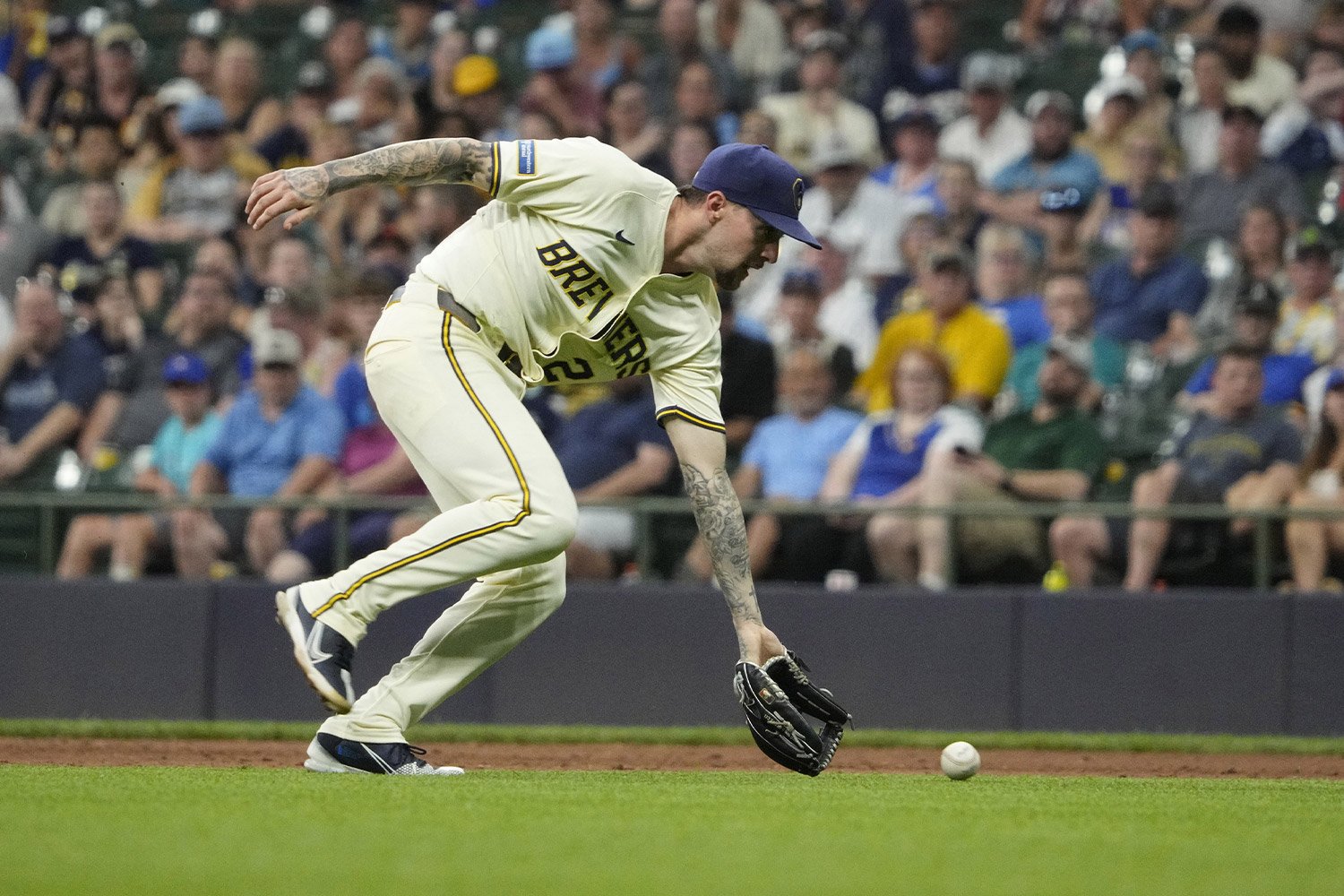
This brings us back to Turang. Broadly speaking, players with poor OAA but high DRS are typically ones who aren’t as mobile but are positioned correctly and don’t make very many mistakes. Although he’s still on the faster end, good positioning makes it such that he doesn’t see a lot of rewarded OAA for making plays on hard-hit balls that come right to him. For example, this ground ball by Dansby Swanson was 102.9 mph off the bat but fielded cleanly without much movement required.
Statcast also breaks down OAA by lateral direction, which shows us that he has -6 OAA when moving towards first base, specifically in the 1B/2B hole, which is outlined below as section 2B-2.

Sometimes, he doesn’t get to the ball because he seems to be shaded more to the pull side and gets caught off guard when the hitter goes the other way, like with this Jorge Polanco single:
While neither one of these was ruled as an error, they likely had a negative impact on his OAA. It’s hard to say for sure since we don’t know exactly how much value Statcast assigns to each play, but we can say that many plays are rewarded by DRS but not by OAA.
To me, the best example of this was a play made on June 23rd against the Pirates. On a tough ground ball that Turang ultimately failed to field before Spencer Horwitz made it to the bag, he was still able to make an out at third base with some quick thinking and a strong throw.
So there are a couple of takeaways for this season based on these two statistics and watching the tape. First, he has a weakness in fielding balls towards first base. Whether that’s a result of unfortunate positioning, getting a bad jump, or simply a coincidence is unclear. Second, despite this aspect of his game regressing from last year, he’s still a good defender overall. He may not get to every ball in a timely manner, but he’s still able to convert more than his fair share of outs.
He isn’t the same elite fielder we saw last year, but few players are able to maintain an elite level of defensive production year over year. It’s a far more nuanced and variable aspect of the sport than hitting, and it’s the same reason why the figures we use to describe a player’s abilities can often tell diverging stories. This is all the more reason to avoid depending on one number to tell the whole story.
Turang's tale is as complex as any other’s. Despite his flaws, his valuable contributions with the glove and increased production at the plate still make him one of the most important players on this year’s Brewers roster.
Do you approve of the job Pat Murphy is doing as Brewers manager?

Follow Brewer Fanatic For Milwaukee Brewers News & Analysis



-
 1
1


Recommended Comments
Create an account or sign in to comment
You need to be a member in order to leave a comment
Create an account
Sign up for a new account in our community. It's easy!
Register a new accountSign in
Already have an account? Sign in here.
Sign In Now