


Brewers Video
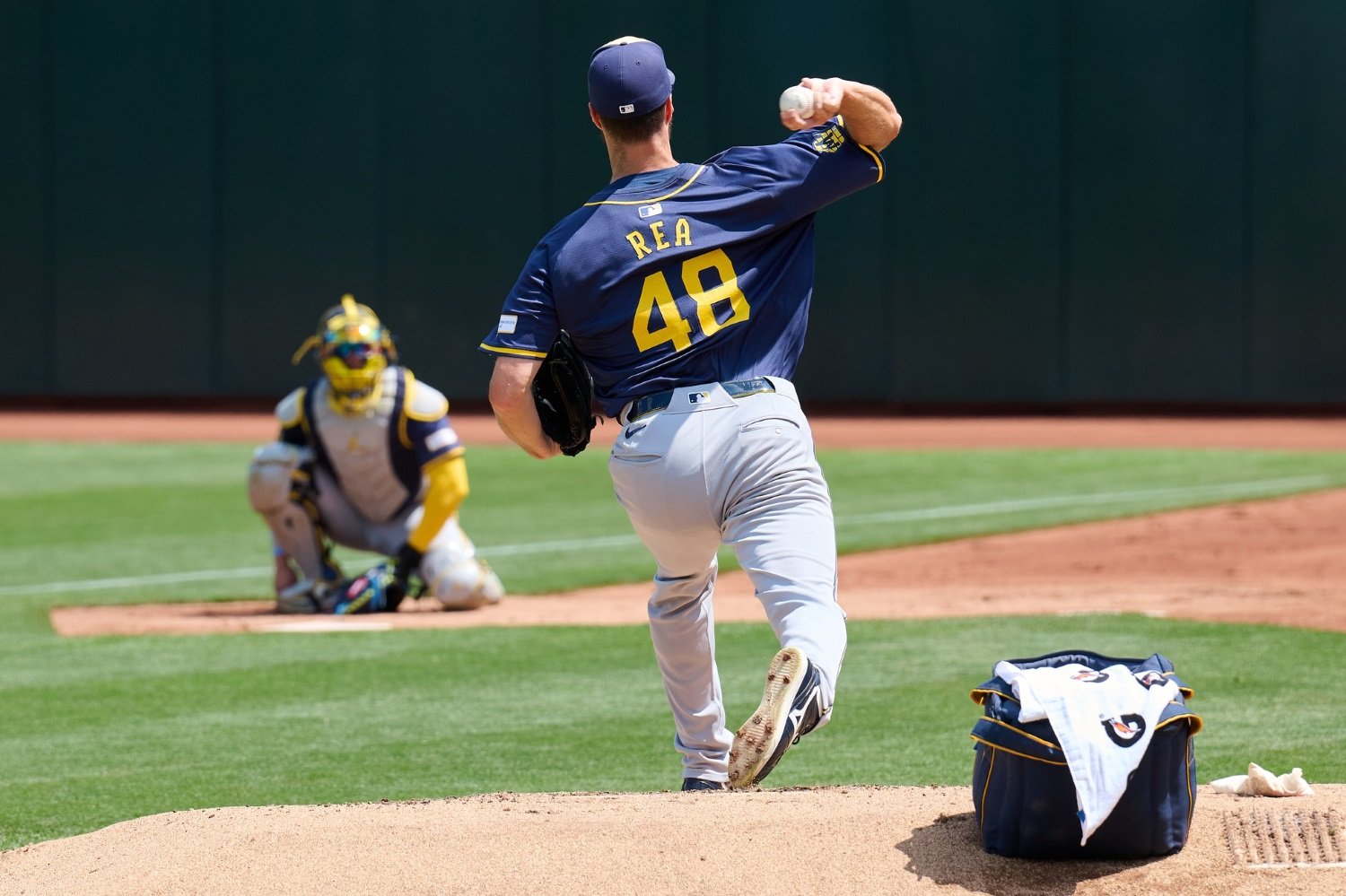
For the majority of this year, Colin Rea has exceeded expectations. Despite being a back-of-the-rotation guy in 2023, he ascended to new heights in 2024. After his 19th start on Aug. 6, he had a 3.38 ERA and a 1.18 WHIP. Since then, he’s managed just one quality start, while conceding seven or more earned runs twice, dragging his overall statistics down to a 4.21 ERA and 1.22 WHIP. How did this happen?
Rea’s array of fastballs sits in the low 90s (though his cutter more often registers in the high 80s), and isn’t anything spectacular. Opposing batters are slugging .506 against his sinker and .647 against his cutter this year--a big problem, since those are the two pitches he throws most frequently. He has had slightly more success with his four-seam fastball, but he’s still conceded 11 earned runs with it, around the same number as his other two fastballs. Instead, the secret sauce has been his sweeper.
Prior to Aug. 7, Rea threw his sweeper 329 times. Over this span, he gave up just five hits and zero earned runs. At an average velocity of 82 mph, with 42 inches of vertical drop, it’s a pretty good pitch. It has some late break, and to his credit, Rea was commanding it well, attacking the bottom portion of the zone while hitting the upper portions with his four-seam fastball.
Hitters had a cumulative .182 OPS against the sweeper to that point, while whiffing on 24.8% of swings. A whopping 32.4% of their takes ended up as called strikes.
Aug. 13 is when things started to unravel. Rea had a six-inning start against the Dodgers that saw him give up 10 hits and seven earned runs. It took him 92 pitches to get through four innings against the Reds, and his most recent start against the Giants was an unmitigated disaster, ending in a final line of 10 earned runs over four innings. His greatest pitch suddenly became his worst enemy, as hitters started catching on. While he allowed five hits and zero earned runs on his first 329 sweepers, his last 96 have resulted in eight hits and eight earned runs.
The biggest cause for concern seems to be his command, especially against lefties. In the first portion of the year, he did a great job of placing the pitch either on the low inside corner or on the outside edge, painful spots for any batter. Lately, too many of his pitches are in the heart of the zone.


That makes sense, as command tends to deteriorate quickly under the duress and fatigue of leading a top-notch rotation for a lengthy baseball season. Rea has never pitched this many innings, his closest mark being the 124 ⅔ innings he tossed last year. He’s already at 154 innings this year, with a few more turns of the rotation left plus playoff games in October, it’s not looking great for his workload.
Furthermore, analytical fans will note that his FIP has always seemingly foreshadowed a return to Earth. Even through early August, when his ERA was at the 3.38 mark, his FIP was 4.27, heavily affected by a relatively low strikeout rate (19.5%) and average walk (7.1%) and home-run rates (3.1%). While it's not a perfect metric and can seem somewhat arbitrary, it's been a better predictor of future ERA than pretty much anything else.
Milwaukee has the privilege of having several playoff-viable starters. Tobias Myers, while inexperienced, has been excellent all year. Freddy Peralta and Frankie Montas have several postseason appearances, and both have been on an upward trajectory in this final stretch. Even Aaron Civale has been more productive than many expected, after a brutal stint with the Rays. All of this means that Rea isn’t a necessary part of the playoff pitching picture. However, he’s demonstrated his ability to be great when in his full form, so perhaps some rest and recovery could help him help the team. In a worst-case scenario, maybe he crawls over the finish line of the regular season and finds himself in a long reliever role out of the bullpen, eating medium-leverage innings or coming in to stabilize the situation in the event of an emergency.
Managing the pitching staff in the postseason is a unique exercise. Because of the higher importance of each game and the compressed schedule, teams usually shift from a five-man rotation to a four-man corps. The four names mentioned above could fill these spots and take the pressure off of Rea, allowing him to find the peak version of himself once again. Otherwise, seeing a depleted version of him taking the mound against the Dodgers, Phillies, or Diamondbacks in an elimination game could end in new, disappointing postseason memories for Brewers fans all over the world.





Recommended Comments
There are no comments to display.
Create an account or sign in to comment
You need to be a member in order to leave a comment
Create an account
Sign up for a new account in our community. It's easy!
Register a new accountSign in
Already have an account? Sign in here.
Sign In Now