


Brewers Video
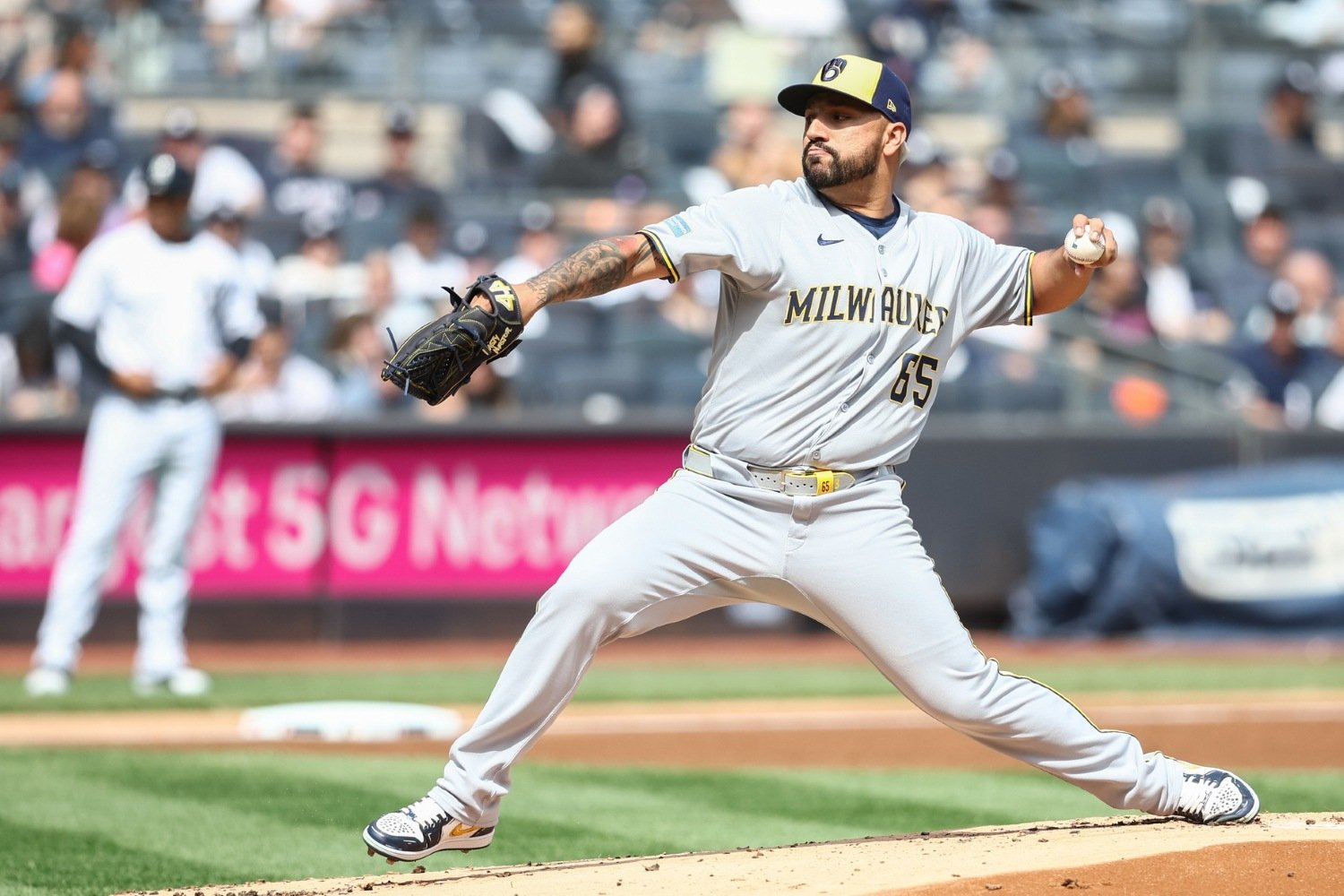
The Brewers' newly-acquired lefty workhorse couldn't keep the ball off the barrels of Yankees bats in the first start with his new team. There's a mechanical issue here, but it's too soon to tell whether it's intentional.
There's no avoiding or ignoring it: Nestor Cortes's first start as a member of the Milwaukee Brewers was lousy. He gave up four home runs in the first inning and a fifth in the second. He issued five walks and only got six outs. It wasn't just an unhappy reunion with his old team; it was a humiliation. If we know nothing else for certain, we can be sure he'll have a burning desire to redeem himself in his second start Thursday.
To give himself the best chance to do so, Cortes had better be intentional about his arm angle. In his start in the Bronx, it was noticeably higher than when he was going well in 2024 for the Yankees. That gave his fastball more sheer carry—more induced vertical break—which is typically a good thing. When a pitcher raises their arm slot, though, the hitter naturally, visually expects more vertical break, so Cortes lost some deception. He also lost some run on the pitch. In general, it straightened out, and the mechanics were a driving force behind that. If we had any doubt about the tradeoff between less deception and more pure movement, the Yankees provided plenty of feedback.
Cortes's arm angle was higher on all his pitches in that first regular-season contest, relative to the rest of his career. He was very much over the top—too much, really, to achieve the east-west wriggle that makes a few of his pitches work best. That rules out the otherwise-plausible notion that Cortes's numbers were thrown off by a dearth of the wackier pitches on which he sometimes famously drops down or changes his delivery to deceive hitters.

Even in Statcast-equipped parks, we don't have arm angle data for spring training. What we do have (x,y coordinates of release point, extension, and movement) suggests that Cortes was doing some of this during spring, and thus, that the mechanical change might be a conscious one, rather than a matter of nerves or adrenaline wrecking good habits. However, we can't yet rule out that what's happening is an accident he's yet to fully recognize, or is unable to correct. His arm angle spiked higher late last season, as he began to deal with the elbow trouble that shelved him for most of the postseason. If he's compensating for lingering pain or discomfort, that would be even worse news than if he was struggling to stay under control when he took the mound Saturday.
We simply need more data. Cortes didn't pitch as much as most of the rest of the staff during spring training, taking two of his potential turns in the Cactus League rotation under simulated-game settings instead. He's a bit of a black box, because of that elbow issue and the fact that we know the Brewers like to take pitchers who do unusual things and push those things toward extremes. He could be making data-driven, coach-monitored adjustments designed to open up the whole zone, or he could be making a random error in his delivery. He could even be limping through an injury he doesn't want to admit, given how thin the pitching staff already is. Thursday's outing against the Reds will double our amount of information. For now, it's just worth keeping a close eye on his mechanics, and looking for a bit more free an arm action. A lower slot might be a good thing, even if it means a few fewer whiffs at the top of the strike zone.





Recommended Comments
Create an account or sign in to comment
You need to be a member in order to leave a comment
Create an account
Sign up for a new account in our community. It's easy!
Register a new accountSign in
Already have an account? Sign in here.
Sign In Now