


Brewers Video
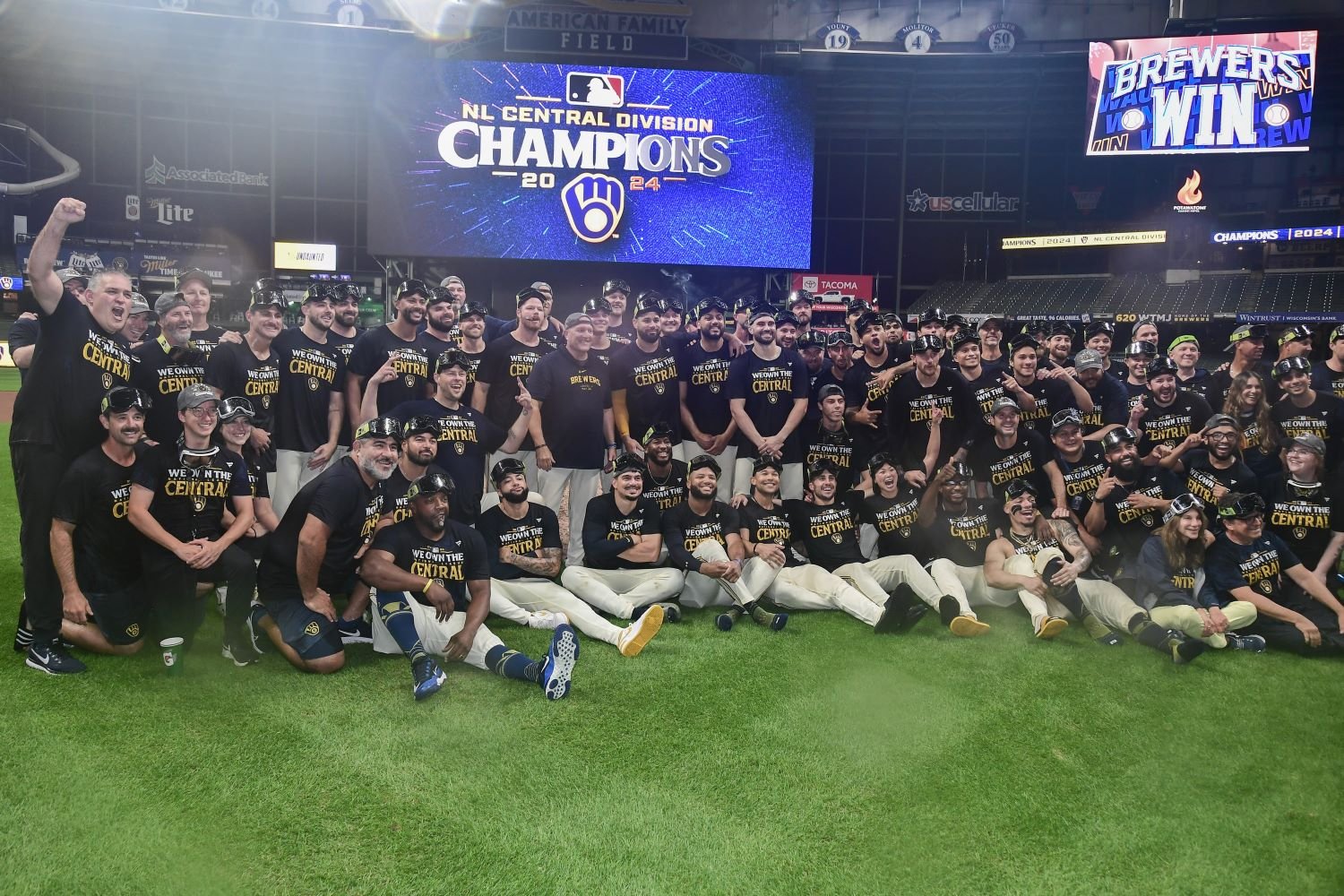
The latest division-winning Brewers team featured a new manager and a revamped roster, both of which deserve credit for this year's success. However, an excellent coaching staff and front office that remained intact from previous seasons also lie at the center of the organization's sustainability.
The Brewers secured their third division title in four years, after an offseason of turnover. Brandon Woodruff ultimately re-upped on a two-year deal, but his recovery from shoulder surgery ruled him out for the entire season. Corbin Burnes was traded to the Orioles two weeks before pitchers and catchers reported for spring training.
Perhaps the most noteworthy change, however, was to the team’s leadership in the dugout. Craig Counsell departed Milwaukee, traveling 90 minutes south to join the division-rival Chicago Cubs on a record contract for a big-league manager. Pat Murphy assumed the mantle of skipper after serving as Counsell’s bench coach for eight seasons, and Rickie Weeks joined the staff as associate manager.
While much of the personnel changed, the quality of the on-field product did not. The Brewers figure to cross the 90-win threshold in the regular season’s waning dayss and will play a postseason game for the sixth time in seven years.
In hindsight, no one should be surprised. The Brewers are a well-oiled machine, and despite the front-facing turnover, nearly all of that machine’s most integral pieces remained intact. The Brewers lost their two best starting pitchers. They lost Counsell. The lineup underwent a makeover.
Most of the individuals responsible for assembling, organizing, and guiding the roster were the same people who filled those roles last year. Counsell’s entire coaching staff remained in Milwaukee after his departure, and they proved indispensable to Murphy in his first full season as a big-league manager.
“I knew the whole coaching staff for the most part,” Murphy said minutes after the Cubs lost on Wednesday afternoon to secure his team’s division title. “We made three or four changes. I think they’re unsung heroes.”
Hitting coaches Connor Dawson and Ozzie Timmons have continued to work with a lineup that’s been among the team’s best in the last decade. First-base coach Quintin Berry has advised a group of smart baserunners who have stolen 197 bases this year, the third-most in baseball.
The fruits of continuity are perhaps felt most on the run-prevention side. Berry continues to instruct a group of rangy young outfielders who convert would-be extra-base hits into outs. Meanwhile, a pitching brain trust led by Chris Hook, Jim Henderson, and Walker McKinven has optimized a hodgepodge of castoff arms in front of that defense.
Pundits perceived the Brewers’ pitching staff as a weakness after losing Burnes and Woodruff (and Devin Williams for the entire first half due to stress fractures in his back). It currently boasts the fourth-lowest ERA in baseball.
Much of that is due to that elite defense, which is helping the group overperform a 4.20 FIP that ranks 22nd in the sport. However, the pitching department also excels at making pitchers with unremarkable arsenals – Colin Rea, Tobias Myers, Frankie Montas, and Aaron Civale are all examples – as deceptive as possible.
Achieving that deception takes different forms based on each pitcher’s abilities and mix. Sometimes, it means mixing three fastball variations to keep hitters off-balance. Other times, it means resurrecting an old breaking ball to close a gap in pitch shapes. It could be a simple mechanical tweak that makes the ball harder for hitters to read out of the hand.
The Brewers do not have a spotless hit rate with their pitching projects, but their track record is quite impressive. What many perceived as a weakness remains Milwaukee’s greatest strength.
The continuity extends to the front office, where Matt Arnold continued to supply his roster with a productive mix of diamonds in the rough, reliable veterans, and young talent.
“Arnold will never take any credit, but he’s been here how many years doing it,” Murphy said. “He’s been a huge cog in this whole thing, not just since he’s been running it, but he’s been a huge cog the whole time.
“I think the guys in the front office are never going to get the credit they deserve,” he added.
Above all else, the players earned a playoff berth with their performance on the field. Murphy earned it by skillfully shepherding an inexperienced group with more public detractors than believers. However, a significant amount of credit is due to the less visible coordinators who identified these players, developed them into the best versions of themselves, and put them in positions to succeed.
That system is likely to continue succeeding long-term. The Brewers have built a deeply ingrained winning culture that spans the front office and coaching staffs across all levels of the organization. The team will, inevitably, lose some of its current coaches as time progresses, but it should be able to weather those subtractions due to how deeply its models of leadership, player development, and strategy are embedded into its being. It’s how they’ve kept chugging along after losing Derek Johnson, David Stearns, and now Counsell.
“It doesn’t happen overnight,” said Christian Yelich, who has seen that sustained culture develop over his seven years in Milwaukee. “It doesn’t take one year or two years for that to become your identity as an organization or the team. It takes a lot of talented people. It takes a lot of the right people. It takes a lot of consistency from ownership on down, throughout the organization, you know? It’s not all because of one person.”
It’s no coincidence that the Brewers find themselves here yet again. Few organizations boast the level of cohesion and efficiency present in Milwaukee. The rest of baseball ought to be on notice.
Do you approve of the job Pat Murphy is doing as Brewers manager?

Follow Brewer Fanatic For Milwaukee Brewers News & Analysis



-
 2
2
-
 2
2


Recommended Comments
Create an account or sign in to comment
You need to be a member in order to leave a comment
Create an account
Sign up for a new account in our community. It's easy!
Register a new accountSign in
Already have an account? Sign in here.
Sign In Now