


Brewers Video
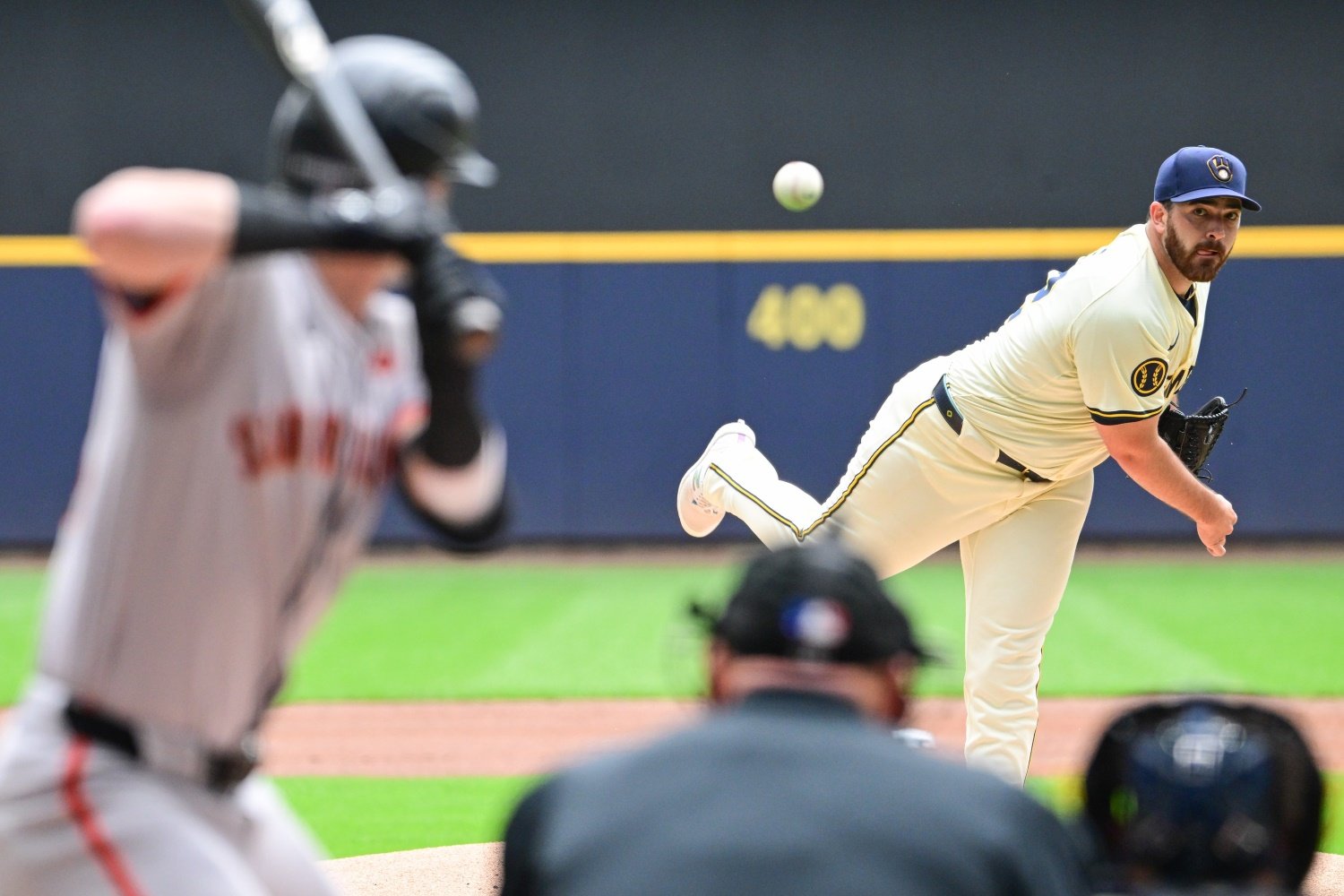
When the Brewers acquired Aaron Civale from the Tampa Bay Rays in early July, he looked like a great fit for their run-prevention system. Not only could Milwaukee’s elite defense nudge his results in a positive direction, but its pitching development crew was welcoming the kind of makeup it has repeatedly developed into sources of solid bulk innings. Civale joined the club with a six-pitch mix that featured three distinct fastballs; a pair of breaking balls with plus movement; and a splitter.
Fast-forward a few months, and things are playing out as hoped. None of Civale’s peripherals have meaningfully improved, but his BABIP has dropped from .312 as a Ray to .257 as a Brewer. On the pitch mix front, the Brewers have not just emphasized his mix-and-match profile. They have also expanded it.
When the team was on the road in Atlanta, Civale had what he described as an “in-depth dive” with members of Milwaukee’s pitching development team. They wanted him to reintroduce a harder, shorter slider into his arsenal.
“I think it’s something that, internally, is a pitch that the Brewers’ system liked and something that can serve a purpose,” Civale said. “So it’s something that we’ve just been messing with the last few weeks. It’s not necessarily brand new, but just another thing to mix into what we’ve been working on.”
Civale had thrown the shorter slider in past seasons, but seldom used it. This year with the Rays, he traded it for a bigger sweeper that became a prominent part of his arsenal.
The sweeper averages 17.2 inches of horizontal break, and regularly exceeds 20 inches. It also separates itself from Civale’s curveball, which sweeps 13.4 inches laterally and drops nearly 65 inches. Both breaking balls have elite movement.
The Brewers identified a drawback to only having sweeping breaking pitches to pair with Civale’s trio of fastballs. They felt his pitches were not playing off each other as well as they could due to the big movement.
“He was getting so shape-oriented – ‘How big can I make it?’ – and none of his pitches tracked in the strike zone,” said pitching coach Chris Hook. “It just put him at a disadvantage.”
Covering an array of shapes with a deep arsenal like Civale does is desirable, but one could argue that his big breaking balls had too much separation from his fastballs. The horizontal break on his sweeper differs more than two-and-a-half feet (nearly 32 inches) from his two-seamer and almost two feet (21.6 inches) from his cutter.
When the discrepancy is that dramatic, some hitters can spot the separation and recognize the pitch earlier in its flight to the plate. The Brewers want that identification to occur as late as possible.
“There’s some advantages to having great pitches that move,” Hook said, “but I think it’s a great advantage if your pitches all look the same and move in different ways. That’s the bottom line.”
In that sense, the shorter slider was the missing link for Civale. It bridges the movement gap between his cutter and sweeper, and tunnels better than the sweeper with a comeback two-seamer.
The pitch break graphs below visualize the slider’s impact. Notice how it fills the once-open space between Civale’s cutter and sweeper.

“He’s got a short, medium, and long,” Hook said. “That’s kind of how we look at his pitches that go left, you know what I mean? It’s a short, medium, long with the cutter, the slider, and now the sweeper.”
Civale unveiled the shorter slider on Aug. 9, in his first start after that discussion in Atlanta. He’s since used a balanced mix of curveballs, sweepers, and sliders.

It’s too early to read heavily into the results, but the initial signs are promising. After slugging .488 with a 10.6% barrel rate against Civale’s bigger breaking balls through Aug. 3, opponents are slugging .208 with no barrels off a breaker since he added the slider.
Those numbers could easily change after one outing, due to the small sample. Regardless of the long-term outcome, the change is the latest example of Milwaukee’s pitching development brass optimizing a pitcher’s strengths.
Civale’s greatest attribute is mixing speeds, shapes, and locations. While the shorter slider is unlikely to become one of his most prominent pitches, showing it throughout an outing makes it even harder to cover his wide range of pitches and opens up more sequencing options.
“He can do it naturally.” Hook said of Civale’s ability to manipulate the baseball. “I think he’s doing more things that look similar ... Now I feel like he’s in a better position to do that, and I think his headspace is good.”
Civale is controlled through the 2025 season. Getting him to his most deceptive form could pay off for the Brewers beyond just this year.
Which team do you dislike the most in the NL Central?

Follow Brewer Fanatic For Milwaukee Brewers News & Analysis



-
 4
4


Recommended Comments
Create an account or sign in to comment
You need to be a member in order to leave a comment
Create an account
Sign up for a new account in our community. It's easy!
Register a new accountSign in
Already have an account? Sign in here.
Sign In Now