


Brewers Video
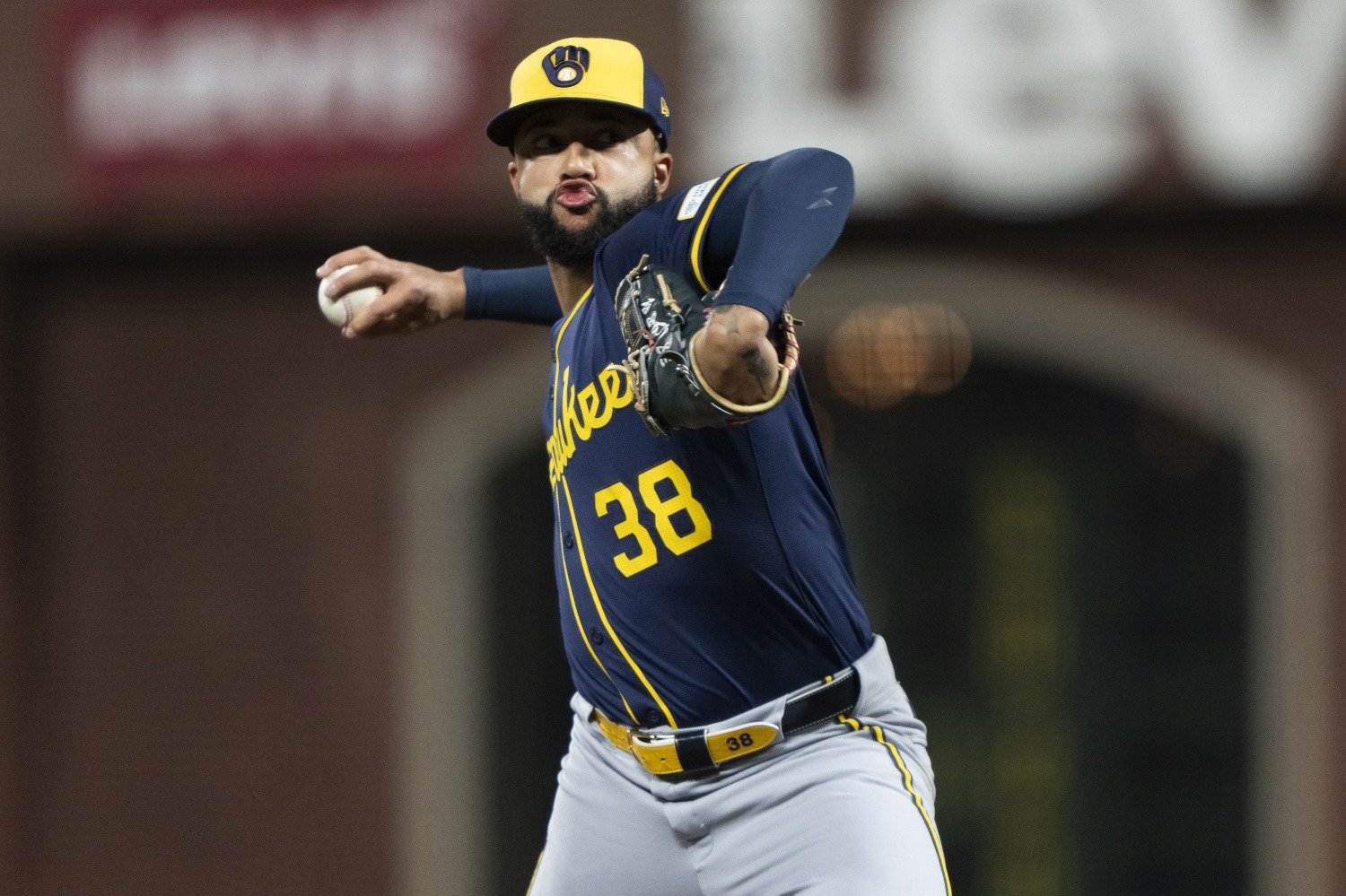
In the bottom of the ninth inning Tuesday night, the Brewers’ closer had to face an imposing rookie threat to preserve the team’s one-run lead.
Milwaukee got to work quickly against the Giants, scoring two runs in the first inning and adding a third by way of a Garrett Mitchell home run in the sixth inning. Unfortunately, the Giants went tit-for-tat, keeping things within one run throughout the entire game. The Brewers were up 3-2 in the bottom of the ninth inning, and with the heart of the order coming to the plate, Pat Murphy called on the services of Devin Williams.
After giving up a single to Heliot Ramos, Williams struck out Michael Conforto, got Matt Chapman to pop out, and walked Mark Canha. With the winning runner now on first, this called for a mound visit. Williams was 17 pitches into this appearance and the fatigue was starting to show. In his at-bat against Canha, he threw just one strike while his four-seam fastball struggled to find the plate. He needed just one more out, but with no margin for error, it wouldn’t be an easy one to get.
Tyler Fitzgerald has been a welcome surprise for Giants fans this year. He has posted a .870 OPS over 288 plate appearances, and has consequently become one of the most valuable members of the team. He has performed slightly worse against right-handed pitching (.827 OPS) than he has against left-handed pitching (.947 OPS), but his numbers are still competitive. To make matters worse, he has a .854 OPS against four-seam fastballs and a 1.000 OPS against changeups from the right side, a seemingly uphill battle for Williams who throws these pitches exclusively.
Williams led off with a changeup, perhaps wanting to recreate the success that DL Hall had against Fitzgerald with his change in the seventh inning, albeit from the left side. It was actually a pretty good pitch, boasting 44 inches of drop and 22 inches of arm-side run. Fitzgerald, likely expecting a changeup after witnessing Williams’s lack of command with the fastball, decided to take it, putting him in a 1-0 count.
So it was time to turn up the gas, or at least as much as possible. Because of the workload, Williams was sitting around 93 mph on his fastball, a dip from his usual velocity around the 95 mph mark. Still, if it was tunneled and commanded well enough, he’d get a whiff or at least some soft contact. Fitzgerald was probably still expecting another changeup, since the last one had been a ball, so he decided to take again, watching his first strike on the outside edge. Williams was back to an even count at 1-1.
In even counts with fewer than two strikes, Williams has a slight preference for throwing his fastball. While he’s famous for his “Airbender”, his fastball is still immensely effective, not necessarily because of its scorching velocity or wicked spin, but instead, because of how well he sequences it with his changeup. Batters are constantly expecting the change, which allows him to get away with free heaters in the low 90s. That's exactly what he did on the third pitch of the at-bat. It clocked in at just 93 mph, one of the slowest fastballs he has thrown all season, but Fitzgerald just watched it go by him to put him into a do-or-die 1-2 count.
At this point, Williams had the clear psychological advantage. He was ahead in the count, and even with runners on base and the game on the line, it was a position he had been in before, as a six-year veteran. Tyler Fitzgerald, on the other hand, had just stared at two strikes and was one mistake away from costing his team the game. He couldn’t possibly afford to stare at a third strike in the zone; Giants Twitter would have his head for it. He was going to, at the very least, try to fight off the next few pitches if they looked even close to the plate. So what did Williams do? Go back to the bread-and-butter bender of air. Perhaps sensing a green light for Fitzgerald, William Contreras set up on the outside edge, wanting to avoid any chance of contact. Williams delivered, getting a foul tip that looked more like a pure whiff to end the game.
After some adversity, Williams came away with a two-strikeout save in 21 pitches. His final strikeout added 17% of win probability, the biggest change of any single plate appearance in the game. His performance under duress helped start the series on the right foot and bring the Brewers into single-digit magic number territory, in terms of clinching the NL Central for the fourth time in five years.





Recommended Comments
Create an account or sign in to comment
You need to be a member in order to leave a comment
Create an account
Sign up for a new account in our community. It's easy!
Register a new accountSign in
Already have an account? Sign in here.
Sign In Now