


Brewers Video
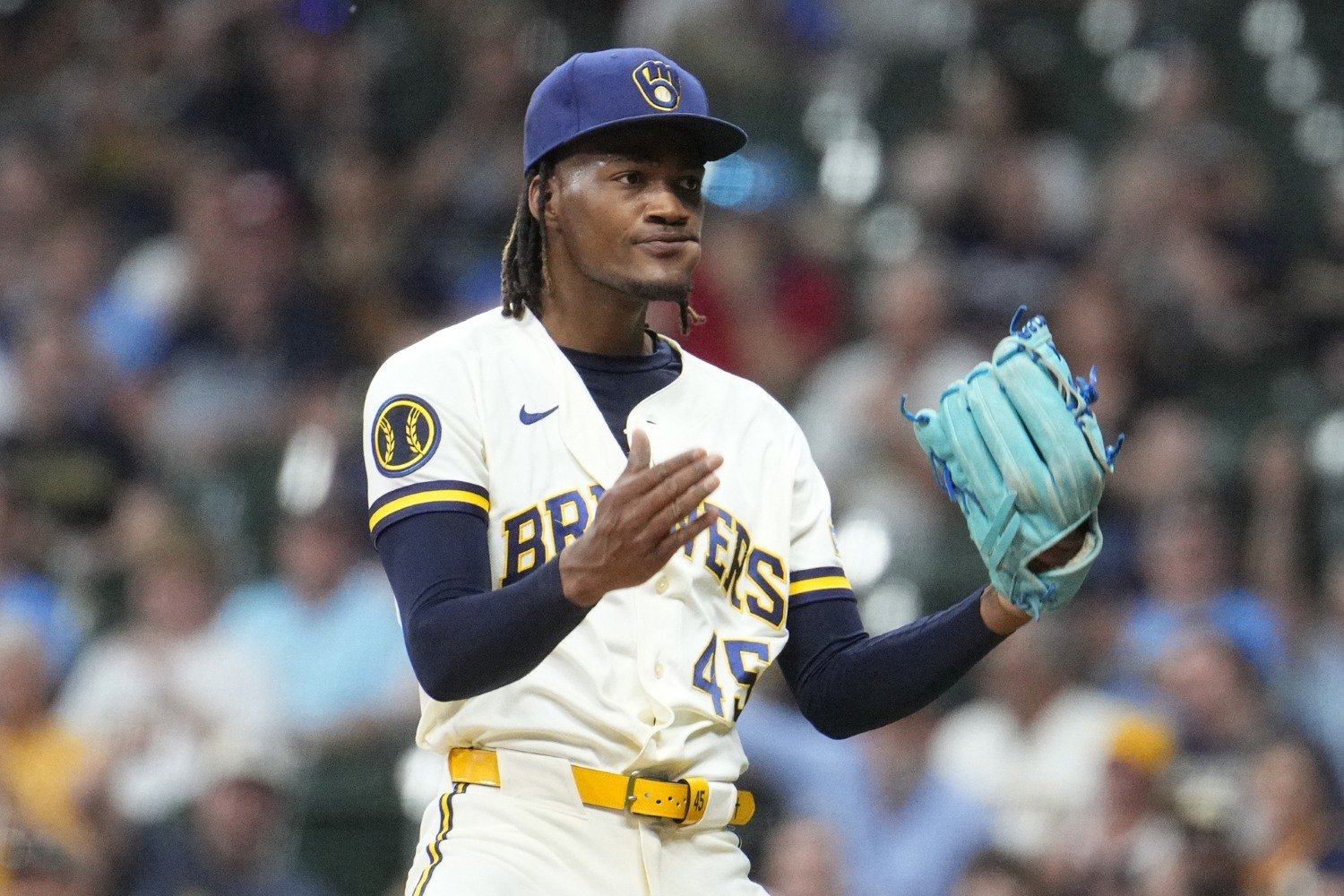
Abner Uribe is, in one reading of all this, just that loud person at the party who no longer has any desire to let some quiet tensions simmer. Maybe they actually challenge someone to step outside and take care of things, but more often, they say something they know will stir up what they feel has been allowed to settle and stagnate when it shouldn't. They don't throw fists; they throw down the proverbial gauntlet. A mess ensues, and everyone at the party ends up doing one form of cleanup or another. You just hope the air is actually clearer afterward.
In this case, the match that lit the waiting fuse was fairly vulgar, like a drunken but unmistakable accusation of cheating or a carefully chosen, exceptionally rude bit of name-calling. He struck out Alec Burleson Tuesday night, and turned to the Cardinals dugout with relish. As gleefully as untold millions of 11-year-olds have done it over the last few decades, he gyrated his hips and elaborately, repeatedly chopped his crotch, inviting the Cardinals to suck it and (ironically) drawing a sharp intake of breath from just about everyone except the occupants of the visitors' dugout.
The tea has spilled pretty freely since. Uribe removed subtext and shattered the fragile privacy of the diamond by doing what he did, so reporters have followed up doggedly ever since. In brief, here's what happened:
- The Cardinals suspected the Brewers of picking up a tip or a pitch grip from St. Louis starter Matthew Liberatore on Monday afternoon, and relaying the needed information to their batters via the hitting coaches in the dugout. No one has suggested to me, on or off the record, that the Brewers were using illegal sign-stealing, with any kind of technological assistance, but the league has cracked down this year on the practice of base coaches relaying intel to hitters, too. That's why base coaches have to stay in their boxes now, and the spirit of that rule is that non-players shouldn't use their advantageous angles to give information directly to the batter. If the Brewers were doing so, it's not a violation of a written rule, but it won't be taken kindly by opponents.
- Once that suspicion arose, Cardinals manager Oliver Marmol began staring daggers into the Brewers dugout throughout the game Monday. That, too, is considered gauche, if not outright aggressive. Brewers personnel saw him staring them down in a way they interpreted as both intrusive and threatening, and he gestured to his side and to his head as he yelled across at one juncture. Marmol admitted to this in the fallout after Uribe broke the seal, saying his message was, "Don't do it. Be smart. You're going to get someone hurt."
- During the Cardinals' batting practice on Tuesday, hitting coach Daniel Vogelbach and Marmol aired their respective grievances with one another. It caused a minor commotion, but no fracas or physicality came of it.
- Uribe saw some of the above first-hand, and heard some about it from teammates after the game Monday and before the game Tuesday. In his mind, the aggression toward the Cardinals after finishing the top of the eighth inning was a matter of showing them Milwaukee would not be intimidated or denigrated.
If all of this sounds a bit petty or childish, it should; that's what it is. Uribe's demonstrations were inappropriate in their intensity and escalatory effect, but apropos in their immaturity. Every team is trying to pick up and relay information, at all times. It should very rarely lead to this kind of sudden surge in tension, and certainly didn't need to do so this time. That said, let's assess some of the claims on both sides.
Were the Brewers Doing Something Wrong in the First Place?
This is the hardest question to answer, really, because it depends a great deal on whom you ask. For a long time, players and teams felt that any intelligence that could be gleaned with naked eyes on the field or from the dugouts or bullpens was fair game, as long as it was relayed via organic means. The infamous trash can-banging Astros were regarded as doubly criminal, because the way they got their information broke the first part of the unwritten rules, and the way they got that information from the tunnel behind the dugout to the field broke the second part. For most of baseball history, though, what the Cardinals accused the Brewers of doing this week would not have been considered a breach.
As discussed above, the league changed an actual rule (or, rather, its enforcement) recently, to try to curb on-field collection and relaying of tips and tells. That's partially because, in the wake of the revelations about the Astros, the league's collective attitude toward intelligence gathering and communication shifted. Ironically, the Cardinals—an organization with a reputation for extreme old-fashionedness—took umbrage with the Brewers because they have a very new-school understanding of what's ok when it comes to picking up information from the other side.
Two players, a coach and two front-office employees from other organizations acknowledged that the Brewers have a reputation for drawing a bead on you, often via the acuity of non-players. They get that information to the field, the sources said, via direct conversations between players and coaches both on the field and in the dugout, but also via surreptitious signaling. No one I spoke to said they believe the Brewers are doing anything explicitly against the rules or egregious, but one former Brewer now playing for another team admitted that his new teammates asked him some probing questions about Milwaukee's methods at the beginning of spring training. Crucially, Marmol didn't accuse the Brewers of doing anything truly wrong—and teams are often trying to enforce something other than actual rules when they engage in the kind of behavior Marmol did Monday. That brings us to the next question.
Was Marmol Really Threatening to Hit Brewers Batters with Pitches?
This one, by contrast, is easy. Yes. Yes, of course he was, and this is one of the silliest layers of unwritten rules and their passive-aggressive enforcement. Marmol explained to reporters exactly what he communicated to the Brewers on Monday, as detailed above. He said that wasn't a threat to hit anyone, but a simple matter of telling them to knock it off.
Well, that's stupid, and anyone really listening and unwilling to put up with microaggressions will see why. "Be smart," Marmol told the home side, pointing to his head. "You're going to get someone hurt," he said, pointing to his side. He wasn't implying that Christian Yelich was going to strain an oblique turning to peak at whatever sign Vogelbach might have been sending him. The gesture to the side is a threat to hit a batter if the other team doesn't stop the behavior they're being told to stop. Marmol refused to characterize it that way, but in doing so, he was either insulting the intelligence of the whole baseball world or (more like) asking everyone to play along with him.
Moreover, doing so is a bit of old-school intimidation in the service of Marmol's aforementioned new-school ethics about the game and its balance of intelligence and counterintelligence. For the lion's share of baseball history, a threat (veiled or otherwise) to plunk someone for being in violation of the unwritten rules has been considered in-bounds, but that's going the way of the complete game. Teams very rarely throw at anyone on purpose anymore, and the intimation of an intention to do so is no longer considered light fare between friends. So:
Was Marmol Wrong, and If So, for What?
Ask many baseball people about this aspect of Marmol's tenure with the Cardinals, and you get quick, decisive answers. The Cardinals' skipper is not well-liked inside any other dugout in the league. In most of them, he's one of the most aggressively disliked. Implying that the team would throw at a Brewers batter might not have been over the line for everyone, and Marmol said he's never actually ordered any such action. However, players, coaches and one former opposing manager all confirmed that Marmol is often guilty of staring into the opposing dugout, looking for a reason to get upset or to raise the temperature of the conflict on the field.
Even those who guard information dearly and don't want to let a rival get an advantage without feeling some pushback often try not to introduce the distraction of these often subtle but distracting bouts of back-and-forth. Marmol, one ex-Cardinal who spoke only on condition of anonymity because of their new role with another organization, "seems to love that s---," and tries to motivate his team by raising the emotional stakes that way.
Few people in modern dugouts take well to the threat gestures Marmol made, but his eyes can be as much of a problem as his hands and mouth. In the opinion of most people outside this particular conflict, Marmol effectively started it, by hunting for something to which to react and (arguably) overreacting when he found it.
To return to the metaphor of a late-night house party, Marmol is the guy who actually wants to fight way too often, even if he has the restraint and the cooler-headed friends to prevent that from happening most of the time. Vogelbach might have actually committed a party foul, or Marmol might have only imagined he did, but either way, the party took on an uneasy edge after the two had their say and went back to their sides of the room. Uribe, who emotes freely, loves antagonism just as much as Marmol, and didn't care for the vibe shift on his side of the party after the initial dustup, decided he would put things right by doing a foolish stunt to assert his side's dominance.
It didn't work as well as he might have envisioned, in that plenty of people on his own side found his tactics distasteful. It will surely draw a fine from Major League Baseball, as well it should, and the Cardinals will skate without any tangible punishment. But it was just ridiculous enough to take some of that serrations off the whole thing. Wednesday's series finale was a taut game, but not an overly tense one, and the teams both say they've put the matter to bed. As a visual communicator, Uribe is to be commended for his layered (though not nuanced) messaging, as well as his clarity. He asserted dominance. He stood up for his teammates. He also said, without words, "Here's a sign everyone will see, so we can all be clear about what we're being clear about." Of course, he also has to be castigated for a gesture that holds within it some implied homophobia, sexism and wanton malice, as well as being stupid-looking.
This was an interesting glimpse into the things often going on beneath the radar for the average fan, but the most important takeaways from it are that the Brewers are clearly in the heads of all their NL Central rivals; that the Cardinals and their skipper were looking for a fight when one wasn't really there to be had; and that Uribe can always be counted on to dispense with subtlety. Going forward, the Crew will hope he focuses on dispensing with batters, instead.
Do you approve of Brewers' ownership?

Follow Brewer Fanatic For Milwaukee Brewers News & Analysis



-
 3
3
-
 1
1



Recommended Comments
Create an account or sign in to comment
You need to be a member in order to leave a comment
Create an account
Sign up for a new account in our community. It's easy!
Register a new accountSign in
Already have an account? Sign in here.
Sign In Now