


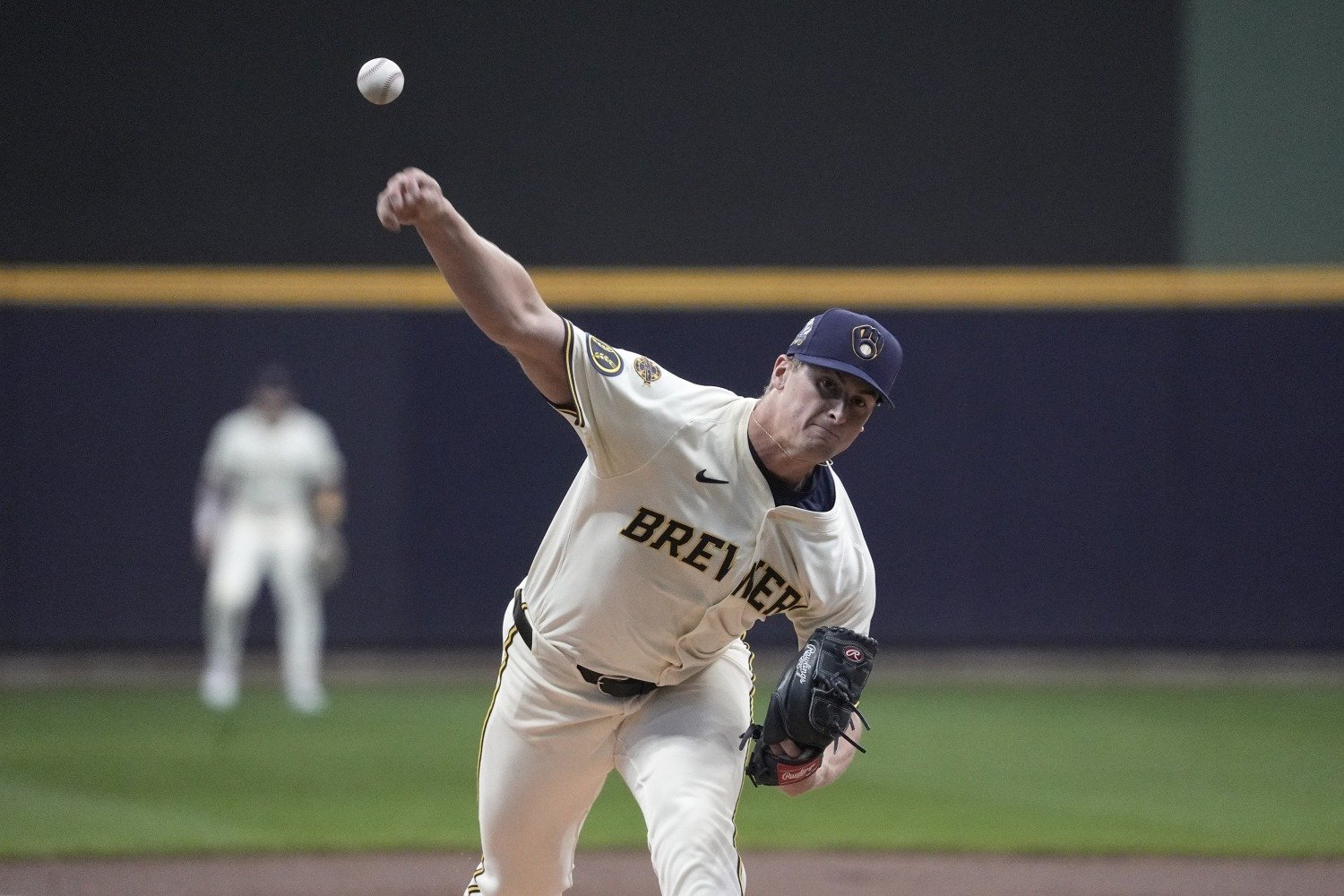
Brewers Video
Sure, Yophery Rodriguez could take off with that fancy Red Sox bat-speed training and end up making you mad. The Brewers could blow the draft this year and leave you longing for the 33rd overall pick, which the team traded away along with Rodriguez this month to acquire Quinn Priester. Over his first two starts as a member of the Crew, though, Priester has pitched 10 innings, put just 12 runners on base, and allowed only one run to come around. It's safe to say that his true talent level is something less than "0.90 ERA guy", but if Priester is a legitimate starter, that deal has to be viewed through a much different lens.
Well, here's the thing: Priester is a legitimate starter. No, it's not too early to say so. He might stay healthy and be a successful part of the Milwaukee starting rotation for years to come, or he might not, but there's ample reason to buy into what he's done already. The Brewers have already finished the work the Red Sox began in 2024, turning him into a solid starter in the mold of highly successful ones like the Mets' Clay Holmes and the Astros' Framber Valdez—not to mention, despite his many injury issues, promising Brewers southpaw Aaron Ashby.
Since 2020, there have only been 12 player-seasons in which a pitcher threw at least 25 sinkers and had at least 25% of them meet the following criteria:
- An arm angle (relative to their body) of at least 43°
- Velocity of at least 93 mph
- Heavy action, with an induced vertical break between 0 and 6 inches
Hurlers with high arm slots strongly tend toward four-seamers and cutters, not sinkers, and most of the time, teams also try to push guys with that kind of release toward those offerings. Rare are the pitchers who can achieve that steep, genuine sink from a high slot. Here, in fact, are those 12 seasons, so you can see just how rare.
| Player | Season | Pitch % |
| Holmes, Clay | 2024 | 74.3 |
| Holmes, Clay | 2023 | 65.1 |
| Ginn, J.T. | 2025 | 53.7 |
| Holmes, Clay | 2025 | 53.4 |
| Holmes, Clay | 2021 | 52 |
| Santana, Edgar | 2021 | 44 |
| Britton, Zack | 2020 | 41.4 |
| Fried, Max | 2025 | 36.4 |
| Priester, Quinn | 2025 | 30.2 |
| Rodríguez, Manuel | 2021 | 28.1 |
| Ashby, Aaron | 2021 | 27.4 |
| Holmes, Clay | 2022 | 25.8 |
Almost half the list is Clay Holmes, by himself. The Pirates swingman-turned-Yankees reliever-turned-Mets starter made a handsome $38 million on a three-year deal over the winter, and his stuff plays. It's not something only he can pull off, as attested by the presence of dominant hurlers Zack Britton and Max Fried on the same list, but this is a very rare skill, indeed. Until this year, perhaps because it's so rare that the Pirates couldn't quite believe they'd churned out a second pitcher capable of having sustainable success with it, Priester didn't really lean into the pitch. It was there, and it did act as his primary fastball, but his four-seamer also played a major role, and his arsenal often ended up being less than the sum of its parts.

This is what you'd expect a pitcher with Priester's arm slot to look like, with the exception of the sinker. The fastball movement is right where a batter expects it to be from that slot, and the breaking balls have a predictably vertical shape. The changeup has the movement pattern you'd expect from it. The sinker is the pitch that doesn't fit the mold, which makes it the most interesting and the one with the greatest impact potential, but it doesn't play very well with anything else he was throwing at the time.
Here's what the arsenal looks like with the Brewers, through two starts.

We're sure to see these shapes change slightly, not just as the team makes changes, but as more data enters the sample. Right now, half of what we have on Priester in the big leagues this year came at Coors Field, where everything moves strangely. Already, though, you can see the enormous differences. He's almost shelved the four-seamer, in favor of much heavier cutter usage. The cutter is a hard, true version of that pitch, with lots of ride, clearly not a four-seamer but not in the slider-y family for the offering. It's his second fastball now. To make room for it, he's throwing his slider less hard—1 mph in raw velocity, but double that when you account for the fact that he's also throwing his sinker harder—and with more depth.
The slider change is, already, a significant one. Depending on your preferred pitch-modeling system, it's gone from below-average to average or from average to plus this year, based on these changes and how the new version plays off his two fastballs. His changeup and curveball each grade out slightly better, too, although in samples too small to draw much from just yet.
Priester and the Brewers aren't done tinkering with him yet, though. For one thing, I expect we'll see more of the curve, as he goes, because that pitch really plays nicely off his fastballs. Note, below, how the spin axes of the pitches out of his hand (left) leave the hitter struggling to discern the sinker, the four-seamer, the cutter and the curve from one another, because the curve has basically the exact opposite of the spin of the other three. That's called spin-mirroring. It takes advantage of the fact that hitters can't tell which direction a ball is spinning around a given axis. They can only see on what axis it's spinning, based on the position of the seams and the resulting visual effects as the ball comes at them.

On the right, you can see how he generates ample movement the hitter wouldn't expect, based on the spin axis, with the sinker and the cutter (in opposing directions). The curve moves as the spin would tell you to expect, but since hitters have such a hard time telling the pitches apart out of the hand, they can't do as much with the pitch as they'd like. They identify it too late, if at all.
You can continue the comparison with Holmes to see what Priester might be able to do to further augment his attack, centering it around this unique sinker. Holmes was just a three-pitch pitcher as a reliever over the last two seasons—sinker, slider, sweeper—but he's rapidly become a six-pitch starter this spring.

One big difference here is the sweeper, instead of the curve. If Holmes has that in his arm, maybe Priester does, too, and the sweeper would make a little bit more sense. Holmes gets most of the lateral movement on that pitch not from spinning it sideways, but from seam-shifted wake effects, which are easier to reproduce even if one is not an elite supinator. But we can see another difference by turning to video. Here's Holmes getting a strikeout on the sweeper earlier this year.
And here's Priester inducing a whiff on the slider.
Both guys set up at the far first-base side of the rubber, but as you can see, Holmes pushes that envelope farther. Then, he compounds the effect by striding straight, rather than slightly closed, as Priester does. Priester's way gets him more online with the middle of the plate, but you don't necessarily want to be online with the middle of the plate. Holmes's movement on the sweeper looks surreal, but part of that is exaggerated by the angle he's creating. Even when he throws a straight four-seamer, it's going right at the first-base edge of home plate. That makes his sinker look like it runs even more than it does, and his sweeper look like it sweeps even more. It's just a tough angle, especially on right-handed batters.
The Brewers might not do anything with Priester's stride direction within the season; that can be a big mechanical shakeup. Sometimes, a pitcher who opens up more that way loses the feel for the blocking aspect of their front side and gives up some velocity, which wouldn't be good. In the long run, though, Holmes is a viable template on which to sketch Priester's future—which is awfully encouraging, given that Priester is just 24 years old and will be under team control for the league-minimum salary for another year after this one.
It's not just Holmes, either. Framber Valdez and Max Fried (the latter of whom has leaned into this more this season, too, as he's gone from the team who plays by the highway in suburban Cobb County, Georgia to the Yankees) are left-handed exemplars of the value of locating a high-slot sinker with some steam—and especially of how the curveball can play off that. Aaron Ashby proves that the Brewers already understand what to do with this archetype of pitcher, and it's a bit telling that it's former Brewers executive David Stearns who won the bidding war for Holmes this winter.
I don't think the Brewers undertook the trade for Priester purely because their early injury trouble created desperation. It seems more like that impetus made them fractionally more willing to part with Rodriguez and the draft pick, to snag a player they'd targeted for a while. He has so much to offer, especially within the Brewers' preferred pitching framework, that it suddenly seems less than crazy to imagine him starting games—or, like Holmes, sliding into relief and becoming a major weapon with a streamlined arsenal—for the balance of the 2020s in Milwaukee.
Are you optimistic about the Brewers right now?

Follow Brewer Fanatic For Milwaukee Brewers News & Analysis



-
 1
1


Recommended Comments
There are no comments to display.
Create an account or sign in to comment
You need to be a member in order to leave a comment
Create an account
Sign up for a new account in our community. It's easy!
Register a new accountSign in
Already have an account? Sign in here.
Sign In Now