


Brewers Video
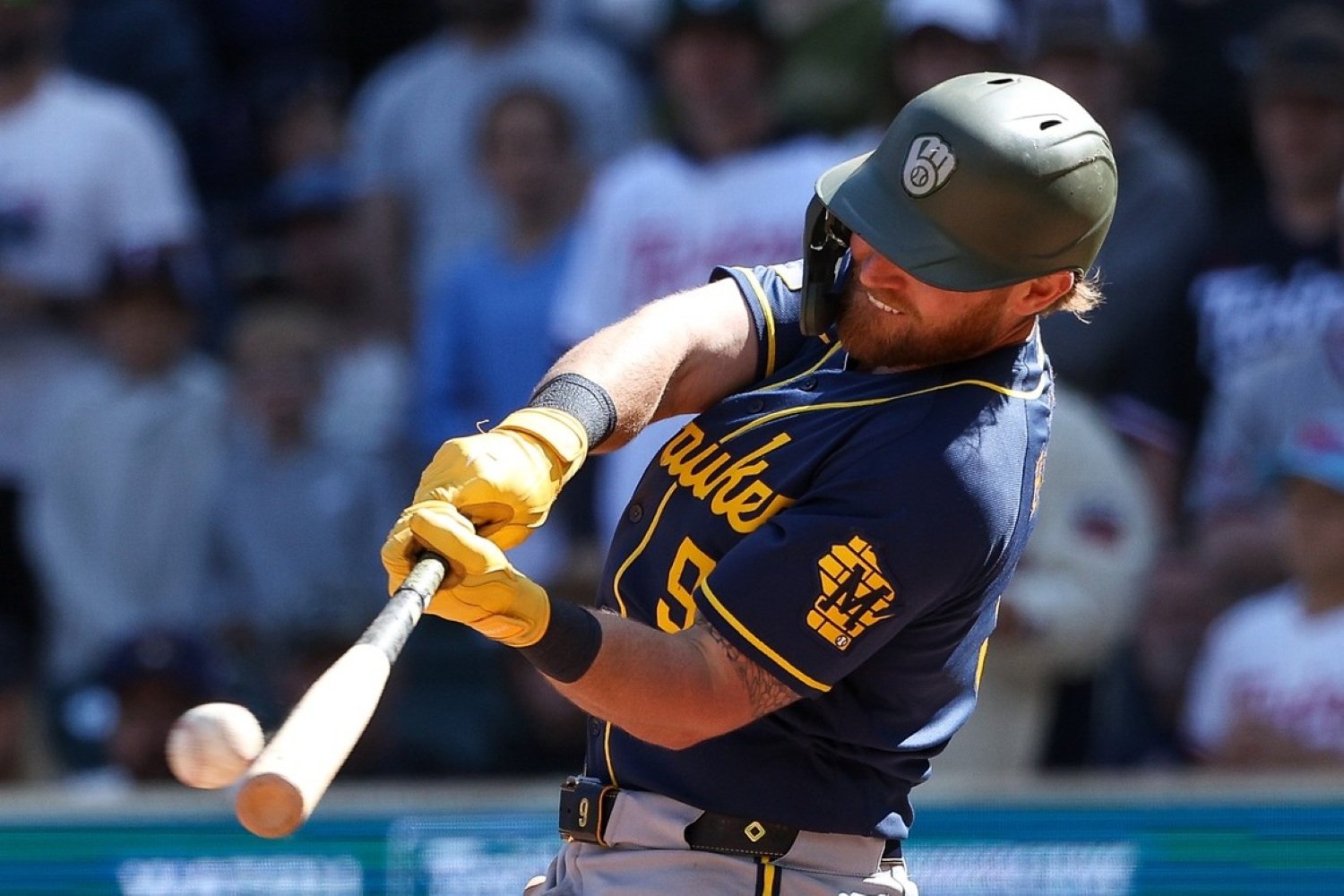
Jake Bauers has changed his stance this season. He's changed his contact point and his approach a bit. But all that work has amounted to the programming of muscle memory. Once he steps to the plate, his mind and his eyes are clear. He says that's the key to his late-blooming success. He changed his setup after dealing with an injury-related slump last summer, but hasn't spent time refining his new stance or tweaked swing. He's just focused on seeing the ball.
"I'll be honest with you," Bauers said Sunday morning, inside the visitors' clubhouse at Target Field in Minneapolis. "I haven't thought about mechanics in the box even one time since I got [to Arizona for spring training]."
The stats say it's working, and working exceptionally well. Bauers went 4-for-8 with a pair of doubles, a walk and a stolen base over the weekend against the Twins, and (as manager Pat Murphy noted) Sunday's double and one long flyout could easily have been home runs, if not for swirling winds that knocked the ball down for most of the final game of the set. He's batting .281/.358/.489 on the season, and there's room for growth from there, based on his batted-ball profile and the lowest strikeout rate of his career (21.9%). He's been a godsend, for a team sorely in need of that offensive juice.
They're just stick figures, but you can see the relaxation in Bauers's swing by comparing a Statcast animation of the very start of it to those of other lefty batters who roughly match his near-elite bat speed. Here's what Jac Caglianone looks like when his front foot lands and his swing begins.

His bat is fairly flat behind him, forcing it to describe a long arc to the hitting zone. Meanwhile, hie front shoulder is turned in, while his weight is already shifting from his back leg to his front one, opening his hips. It's not hard to see where Caglianone is getting the torque in his swing, but nor is it hard to guess why he whiffs on 31.8% of his swings.
Here's Kyle Schwarber, who does a lot of the same things—though he stays on his back leg a hair longer, allowing him to make slightly later adjustments and find the barrel more often.

Here's teammate Garrett Mitchell, built much the same way as Bauers.

Now, here's Bauers.

Notice how upright he is, and how his barrel isn't wrapped around behind him or flattened the way the others' are. Notice, too, how much closer together his feet are, and how even is his weight distribution. This hasn't always been how he's hit. You can see the difference even by looking at last year's visual, but to wash out the distortion created by the changes he implemented in late 2025, let's look at his 2024 self.

This is a much more standard lefty power hitter's initial swing position. The feet are farther apart; he's taken a longer stride. He's leaning forward a bit more as he uses his lower half to generate power, forcing a compensatory movement up top to stay balanced. His bat is flatter, and his hands are farther behind his torso. This was the version of Bauers the league saw for years. This year's is a new guy, full of confidence and clarity and the added functional strength on which he worked hard late last year and throughout the offseason. It doesn't look like most lefty sluggers do. That's a good thing.
"I'm just trusting myself," Bauers said. "It sounds simple; it's not simple. But you have to take some of those other thoughts out of it. In the past, I would be in the box thinking about my swing, thinking about what I was trying to do physically, and it just got in the way."
It takes a great deal of hard work to earn the privilege of hitting that way, of course. You have to know your swing exceptionally well, in order to start pushing thoughts about it down into the subconscious part of the brain during the activity itself. Bauers said he's also simplified the way he digests information about opposing pitchers, and uses reps on the Trajekt machine when the Crew is at home to prepare for encounters with specific pitchers in a setting that feels more alive than pages of a scouting report.
"Part of it is trusting the hitting coaches, that they'll bring something to me if there's something going wrong or something I need to be doing," Bauers said. "But I just want to be in the box with the plan to see it well."
Prospect lists can be overrated, in the sense that they give a false impression of certainty about which current minor-leaguers will become great big-leaguers. They encourage fans to see the game through the prism of talent, when there's much more in the stew that becomes success than just that key ingredient. However, they're not as irrelevant as some of their denigrators would have you believe, either. When you're a top prospect, you get an abundance of one irreplaceable currency: opportunity.
When a team has a player in whom they've made a major investment, and when that player gets the marketability and trade-value boost of being identified as a top prosect, they funnel chances toward that player. They pave a road to the majors for them, including a full-time role when they first arrive, and they don't give up on them easily. That stability—that routine, and that rapid familiarity with the league, and that absence of pressure to make something happen in every plate appearance, and most of all, all those reps—is hugely valuable.
In 2013, Bauers was a 7th-round pick by the Padres out of his California high school. He signed, but not for big money. After his first full season in the San Diego system, he was part of the infamous trade sending Wil Myers to the Padres and Trea Turner to the Nationals. Bauers landed with the Rays, where he spent the next four seasons. He didn't debut until 2018, but to their credit, the Rays did set him up to succeed, handing him a job on June 7 that year and never taking it away. Unfortunately, it would be (essentially) the last time he ever got that luxury.
That winter, Bauers was part of the beefy three-team trade that sent Yandy Díaz to Tampa, Carlos Santana back to Cleveland (for the first time) and Edwin Encarnación to Seattle. Bauers landed on the shores of Lake Erie, and Cleveland tried to give him (more or less) a full-fledged shot. He struggled so mightily, though, that they demoted him to Triple-A Columbus for all of August. He would languish a little longer in the Cleveland system, but get no more real chances. They traded him to Seattle for a player to be named later in June 2021. Seattle cut him that fall. He latched on with the Reds for 2022, and the Yankees scooped him up in a cash deal that June. New York cut him that fall.
They re-signed him about a month later, though, and a pattern began to emerge: Once you have Bauers around for a bit, you tend to want him around longer than you'd think. He certainly wasn't in Cleveland's plans, after that initial failure in 2019, but they weren't quick to jettison him, by any means. The Yankees went out of their way to get him twice. They traded him to the Brewers after 2023, and the Brewers would cut him one year later—but they also re-signed him, and voluntarily retained him again this winter.
Bauers's career high in plate appearances is still 423, from that 2019 season. That might change this season, though. Finally, at age 30, Bauers is getting some runway—partially because Andrew Vaughn got hurt on Opening Day, but partially because he's earned it, and is taking full advantage of it. He's on pace to qualify for the batting title, and he's been worth 6 runs more than an average batter, according to Baseball Reference. It's been difficult to make the last several years work for him, rather than against him, but Bauers now feels that he's amassed enough reps in the majors to achieve a level of physical and mental comfort that empowers him.
"It's just been getting the chances, getting the reps, and getting more confident about what I know to do," he said. The simplicity of it all undersells the achievement, especially because he never got his uninterrupted shot for a full season in the majors—let alone two or three of them, as many higher-profile prospects might have gotten.
Bauers is, quite suddenly, a respected veteran in the clubhouse, rather than someone clinging to the edge of the roster. He's friendly, thoughtful and just the right amount of talkative to fit into a big-league clubhouse. He, Brice Turang, Christian Yelich and others pass information well back and forth, and they have an easy camaraderie in their personal interactions, too. He exudes a California cool. Even though he's meandered from those roots and spends his winters in the Dallas area, he still likes the beach, and wears the same sand-colored sleeveless t-shirt around the clubhouse virtually all the time. A relaxed mindset was always where he was likely to find the power to emerge as a star, or as close to it as a 7th-round pick gets after only establishing themselves upon joining their eighth pro organization. That relaxation is a privilege conferred on elite prospects, but through enough resiliency and focused work, it can also be achieved by the Other Guys.
Are you optimistic about the Brewers right now?

Follow Brewer Fanatic For Milwaukee Brewers News & Analysis



-
 2
2
-
 1
1


Recommended Comments
Create an account or sign in to comment
You need to be a member in order to leave a comment
Create an account
Sign up for a new account in our community. It's easy!
Register a new accountSign in
Already have an account? Sign in here.
Sign In Now