


Brewers Video
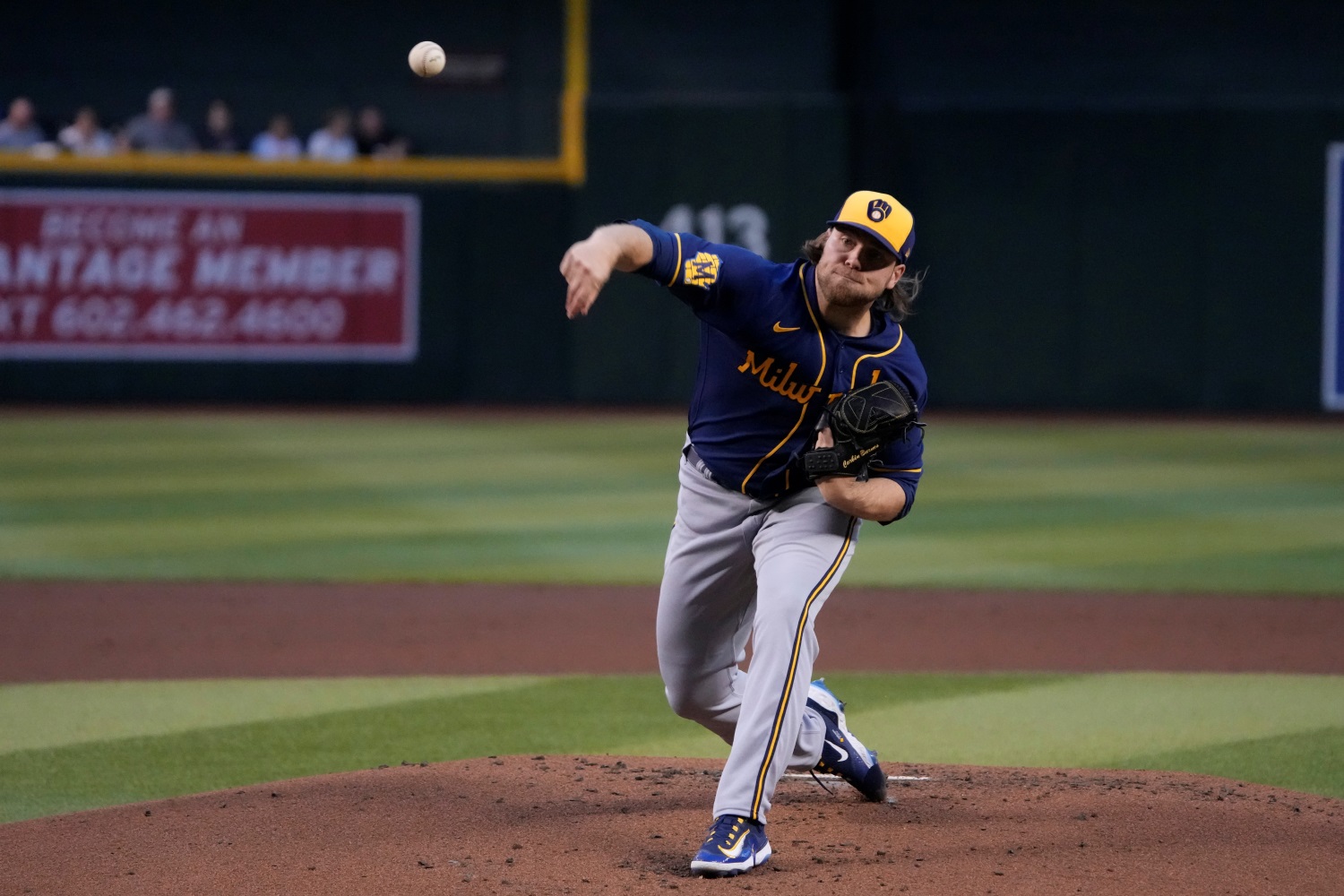
Early in a new season, it's a good time to dive deep even on players with whom most fans feel familiar. Today, let's discuss the arsenal of Brewers ace Corbin Burnes.
In the build-up to his performance against the Diamondbacks, the Milwaukee Brewers released a video talking to both Corbin Burnes and Brandon Woodruff, where Woodruff mentioned that after a bad performance, he sees Corbin in his black book analyzing his pitches, and knows something special is coming the next time he gets on the mound. We got that against the exciting, young Diamondbacks, who had just put up 29 runs across their last three games against the LA Dodgers. Burnes held them to just three hits and zero walks across eight innings of work. Later in the season, or with a healthier pitching staff, he likely would have finished the job, potentially with a Maddux.
So without further ado, let’s take a look at what makes Burnes potentially the best pitcher in baseball.
Pitch Mix
Burnes has a five-pitch arsenal: cutter, changeup, sinker, slider, and curveball, having eliminated the four-seamer altogether coming into this season. He has different approaches based on matchups, though, predominantly throwing cutters (41%) and sliders (33%) to right-handed hitters, with lesser use of the change-up and the curveball. Against left-handers, he eliminates the slider altogether and really hones in on the cutter (62%) with the change (23%) and curveball (15%) as his alternate options. He particularly likes working lefties down and in with the cutter, as well as with the back-door cutter curving in late. He has various options at his disposal depending on the hitter, so let’s take a dive into them.
The Cutter
The first thing that stands out about Burnes’s primary weapon is the velocity at which he throws it, averaging over 95 miles per hour in each of the last two seasons. It's the fastest cutter in baseball from a starting pitcher, by a fairly wide margin. Most of the time, such high velocity results in reduced movement, as the velocity requires more spin and energy to move the ball off its intended course. No such trouble for Burnes, who has slightly above-average vertical movement, and 80 percent better horizontal movement than the rest of the league on his cutter. It’s a pitch he used over 50% of the time in his last two full seasons, and uses it in a variety of ways, challenging hitters with belt-high offerings, curving it in the front door against right-handers, or dipping it down and away off the plate to force hitters to chase. He was, at times, guilty of overusing it last season, given he threw only the cutter in 3-0 and 3-1 counts. On 3-0, batters hit .429/.643 against him, contrasted to a .267/.467 line from 2021.
Aside from the strikeout stuff, he also induces a large number of ground balls with this pitch, with an average launch angle of three degrees. In 2021, he had a strikeout rate of 35% with a ground-ball rate of 48%. The cutter, specifically, was seven percentage points better than league average at producing ground balls, surpassing a 50% rate.

The Curveball
Burnes’ second-most-used pitch in 2021 and 2022 was the curveball, and on the surface, it’s difficult to see why it’s so effective. In 2022, opponents had a batting average against of .127 against that curve, and they slugged just .263. Yet, his expected numbers were even better, with a .118 average and .184 slugging. It has less vertical movement, compared to the average hook, but where it stands out is the horizontal break he gets on the pitch, 32 percent better than league average in 2022. The break is less of a loopy movement, and more of a sharp, late break as it enters the strike zone with slightly above average velocity for a curveball. All in all last season, it was worth a run value of -11.
In terms of how he uses it, 65-70 percent of Burnes’s curveballs are out of the zone, predominantly to put hitters away, but he’s rarely truly wild with it, with his heat map showing a lot of pitches just below the strike zone, which must be torturous to hit.

As you can see, over the course of 2022, his curveball was predominantly in the lower portion, or below the strike zone, though the occasional hanging curves can bite him, something he’s done a little more often in his first few starts of the year. The pace and snap on the delivery can bail him out of trouble more often than not, and it’s also important to note that last season he shelved the pitch in counts wherein he fell behind.
To sum up how dominant this pitch was, it had a strikeout % of 62.5%, and put-away percentage of 41.7%. Those numbers speak for themselves.
That’s all for part one, stay tuned for part two in the next day or two!





Recommended Comments
There are no comments to display.
Create an account or sign in to comment
You need to be a member in order to leave a comment
Create an account
Sign up for a new account in our community. It's easy!
Register a new accountSign in
Already have an account? Sign in here.
Sign In Now