


Brewers Video
Does Milwaukee really have one of the best pitching staffs in baseball again, or are they due for a statistical regression?
After more than 1,000 innings of baseball, the Brewers have a team ERA of 3.74, the fourth-best in baseball and just 0.02 higher than the second-place Phillies. It has been an area of strength for the past few years, and has helped make up for a relatively weak lineup during long stretches of the last two seasons. However, a closer look at some peripheral numbers indicates that things may not be as rosy as one might think. While they are fourth in ERA, here is where they rank for other key pitching statistics.
|
|
For pretty much every other rate statistic, the Brewers are average or worse. Why is this important? Well, FIP (or Fielding Independent Pitching) primarily measures the abilities of a pitcher to minimize home runs, walks, and hit by pitches, while maximizing strikeouts. Essentially, it gauges how well a pitcher does the things over which pitchers have a greater measure of control. Strikeout-heavy pitchers like Chris Sale and Tarik Skubal usually excel at this metric, while other pitchers like Cristopher Sanchez and Logan Webb make up for fewer strikeouts with fewer home runs conceded.
Milwaukee has quite a few players with a meaningful difference between their ERA and FIP. There are a few unlucky fellows whose FIP is actually better, but for the most part, things shape up to be the other way around.
|
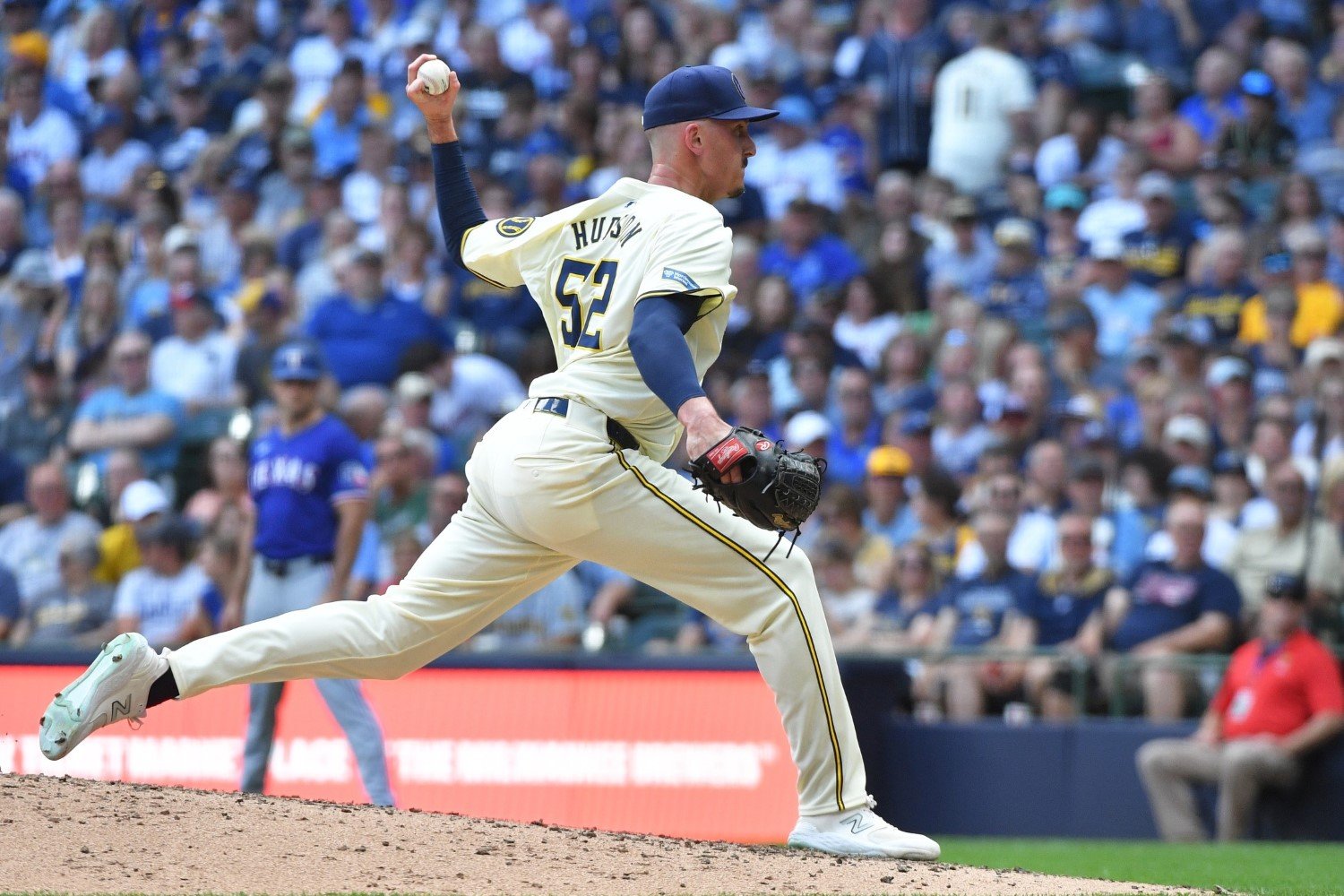
Bryan Hudson having the biggest negative difference is fascinating. His 28.4% strikeout rate is excellent, but his walk rate of 6.8% and home run rate of 3.2% are both closer to average. Because home runs are weighted so heavily (by a coefficient of 13 in the formula), the six that he has given up drag down his numbers, even though all except one have been solo shots.
On the other end of things, poor Hoby Milner has gotten the short end of the stick this season. He has gotten torched on batted balls this summer, but has only given up five home runs over 53 innings. His walk rate of 6.3% is right around the top quartile of the league, even if he’s not the greatest strikeout accumulator the world has ever seen.
So what does this mean? Are Brewers pitchers overrated? Is their success solely the result of eating a dozen grapes at midnight before each outing? Should you take the over on earned runs for every Milwaukee game from here on out?
As with everything in baseball and quantum mechanics, the answer is "sort of...?" We’ve already talked about what FIP is, so let’s talk about what it is not. Some people like to think FIP is a more accurate representation of a pitcher’s abilities because it’s isolated to things they can control, but there are several flaws with this thesis. First of all, there is far more to pitching than the three true outcomes. Second, the somewhat arbitrary weighting of the outcomes punishes pitchers more than others for unfair reasons. Giving up a three-run homer and one-run homer should not count the same, some argue, because they are very different results in a game.
Furthermore, a hypothetical pitcher with a penchant for giving up tons of runs on line drives while conceding no home runs or free passes would theoretically have a better FIP than someone who gives up a solo home run every so often, and nothing else. Finally, while Statcast has made intangible numbers like expected batting average more accessible, ultimately what happens on the field is what decides a game. Even if Bryan Hudson is "supposed to" give up twice as many runs as he has, he hasn’t. To broaden that to the Brewers as a whole, even if they were "supposed to" give up more runs, they haven't.
All that said, one upside of paying attention to FIP is that it has been a more accurate predictor of future ERA than ERA itself. It’s an imperfect stat, like everything in baseball, but it's not totally useless. In fact, FanGraphs deliberately uses FIP instead of ERA to calculate WAR for pitchers. The broader takeaway from this should be that Milwaukee’s arms may be overperforming, and these results likely won’t last--at least not with the roster as is. Luckily, the return of guys with great FIPs like Trevor Megill (in the short term) and Brandon Woodruff (in the long term) should help offset some of the anticipated backslide. For now, we can only hope that what they have is enough to get the team through a few more months of postseason-quality baseball.






Recommended Comments
Create an account or sign in to comment
You need to be a member in order to leave a comment
Create an account
Sign up for a new account in our community. It's easy!
Register a new accountSign in
Already have an account? Sign in here.
Sign In Now