


Brewers Video
Hopefully, there are still a couple of notable additions ahead for the Brewers this winter. While we await one, though, there's also value in contemplating the ways they might get more out of one player they've already brought in.
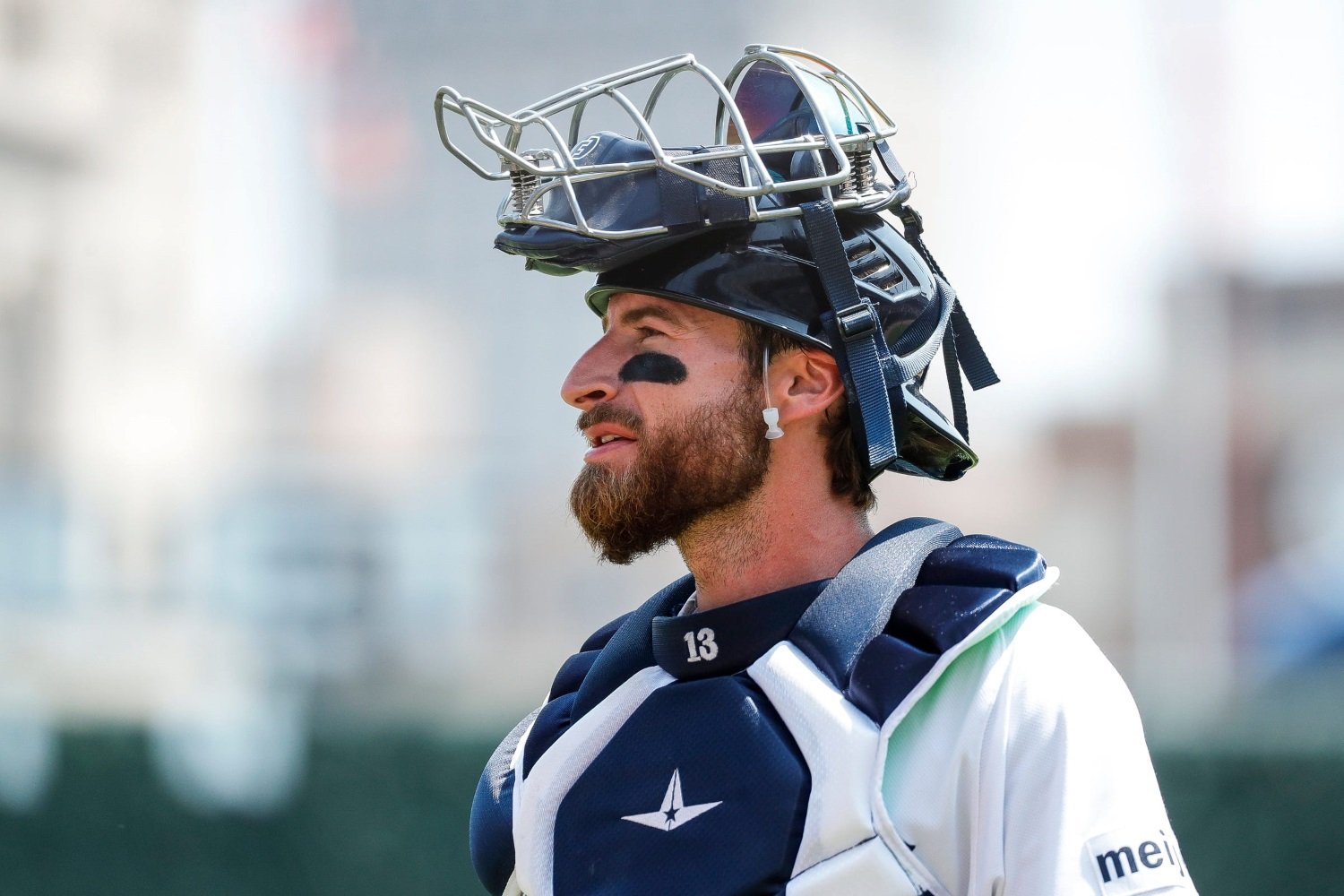
It was cheap and easy to acquire Eric Haase. The Brewers didn't have to compete very hard for him, because his skill set is not in much demand. Nominally, he's a catcher, but he's a poor pitch framer, and that's limited the playing time anyone has been willing to give him behind the dish. The rebuilding Tigers gave him a combined 150 games back there in 2021 and 2022, but only 57 of them in 2023. According to TruMedia's proprietary, count-sensitive Framing Runs Above Average metric, Haase was 9.8 runs below average as a framer in 2021, and 6.6 below average in 2022.
Here's a heat map showing the areas where Haase was above- or below-average as a framer in 2022.
.png.c586e14b9ea4f5ed8e0503236cb42d41.png)
In 2023, though, he was much-improved in that regard. He was only worth -0.8 runs as a framer. He still struggled to frame the high pitch, but he was much more consistent in shaping and extending the bottom edge of the zone.
.png.870c96ecfc2179d2b9bbfc335ab7a244.png)
How did that happen? Well, for starters, Haase went from a fairly compact, blockish one-knee setup behind the plate in 2022 to a much lower, more variable one in 2023. Here's a video of him losing a strike in 2022 that he would be better able to earn for his pitcher after adjusting his setup.
Technically, that's a one-knee-down stance, in keeping with the modern vogue. In reality, though, it doesn't give him much more flexibility or mobility than a squat. He's not able to shift his weight to anticipate the pitch or make subtle movements with his frame to catch the ball smoothly. Every stretch seems lurching, and the umpire is bound to notice it.
Besides, even when Haase was in his traditional crouch, he wasn't very mobile back there. Whereas some catchers are able to set up with their rear end high and move with the incoming pitch like a shortstop tracking a line drive into the glove, Haase belonged to brotherhood of the anchor droppers. Look at this video, with runners on base, and note the way the counterweight in his setup stops him from beating the high fastball to its spot, let alone drawing it back into the heart of the zone.
A big change to his setup did make Haase better last year. Even with runners on, last year, he was one-knee-down, and that undersells the difference. He switched to a deep fold, all the way down to the ground, to maximize his ability to steal strikes along that bottom edge that was such an encouraging orange in the heat map above.
As you can see there, he doesn't just benefit by being able to bring down the bottom edge of the zone, either. He also gets wider and can shift his torso more subtly, thereby letting him draw the horizontal edges better and wider.
Still, there are things to clean up here. Watch the way getting into this extremely deep position can sometimes leave him off-balance, especially because he gets there so late.
That ball is right at his chest protector. He's set the edge, and the pitcher hits his spot. Because Haase was so loud and bouncy in his movements, though, he wasn't able to catch the ball as quietley as the pitch deserved, and his extension through the ball was clumsy. He moved it up and down along the edge of the zone, but he wasn't able to bring it back over the plate.
To imagine how the Crew's deservedly famous catching coaches will help Haase get over the hump and into outright positive territory as a framer, let's contrast him with William Contreras, on whom they've already worked that magic. It's easy to forget now, but Contreras went from -5.5 framing runs in 2022 to 12.9 in 2023. Here hs is positively taking food out of the mouths of Jesús Sánchez's children.
Contreras, here, is maybe halfway between the Haase we saw in 2022 and the one we saw in 2023. He's compact and upright, not giving up the top of the zone by being too low and not giving away when he reaches down for the ball, because he does so with his arm, not his whole upper body. I'm increasingly convinced, though, that the Brewers excel at training catchers primarily in the mental aspects of framing, and also in two key physical cues:
- Setting up closer to the batter than most catchers do, thereby catching balls moving out of the zone a bit sooner; and
- Arm action. It's not always apparent from center-field cameras, and you can easily miss it if you're not looking for it, but much of framing is timing the forward extension of the arm to meet the ball. If you catch the ball in the middle of a strong, fluid forward movement (just before your elbow would lock out, freezing your arm a bit), it's pretty easy to make the move from wherever you catch it to the center of the zone look natural and even irresistible. Umpires fall for that.
That's what the team is going to try to do with Haase, too. He needs to creep up in the catcher's box, and he needs to smooth out the mechanics of coming through the ball as he catches it. If he does that, he has the other tools necessary to become a plus behind the plate. He won't unseat Contreras as the starter, but he can be part of what is perennially one of the league's best catching units in terms of shaping the strike zone.
Do you believe Haase can work with Charlie Greene and the rest of the support staff to deliver value as a framer? Can he even stave off minor-league signee Austin Nola for the backup gig? Discuss that here, and come back tomorrow for a look at Haase's offense--which also needs some work.
Do you approve of the job Pat Murphy is doing as Brewers manager?

Follow Brewer Fanatic For Milwaukee Brewers News & Analysis



-
 1
1


Recommended Comments
Create an account or sign in to comment
You need to be a member in order to leave a comment
Create an account
Sign up for a new account in our community. It's easy!
Register a new accountSign in
Already have an account? Sign in here.
Sign In Now