


Brewers Video
Baseball is becoming, more and more, a game of flat fastballs. A vertical approach angle (VAA) close to zero makes fastballs harder to hit, so pitchers are pushing hard to shape their heaters that way. That's bad news for the local nine.
An average VAA on four-seam fastballs and sinkers in 2023 was around -5.2 degrees. In other words, if you drew a straight line parallel to the ground from the pitcher's release point to home plate, then another line describing the actual trajectory of those pitches as they neared home plate, the two lines would form a 5.2-degree angle from one another. Let's look, then, at all fastballs with a VAA of -4.5 or higher--the flattest heaters in the game. On average, teams had between 500 and 600 at-bats end on such pitches in 2023.
The Brewers weren't quite the worst offense in baseball against those heaters, but it was close. Only the Royals and White Sox had worse overall results against flat fastballs. Only the Reds and Guardians had lower Barrel or Hard-Hit rates. Although they didn't rack up whiffs the way some other teams throughout the league did on flat-VAA heat, the Brewers couldn't generate any meaningful jolt against them. They hit the highest percentage of their batted balls against such pitches to center field of any team in the league. In effect, they became lazy fly ball machines when pitchers could attack the zone with a flat-VAA fastball.
It's ironic that the offense has such a brutal problem with flat VAAs, because it's not as though the team is unaware of the value of the attribute. On the contrary, the Brewers make use of flat VAAs on their heaters as much as almost any team in baseball. Freddy Peralta, Hoby Milner, and Devin Williams all have flat VAAs. So do ex-Brewers Brandon Woodruff, Peter Strzelecki, and Gus Varland.
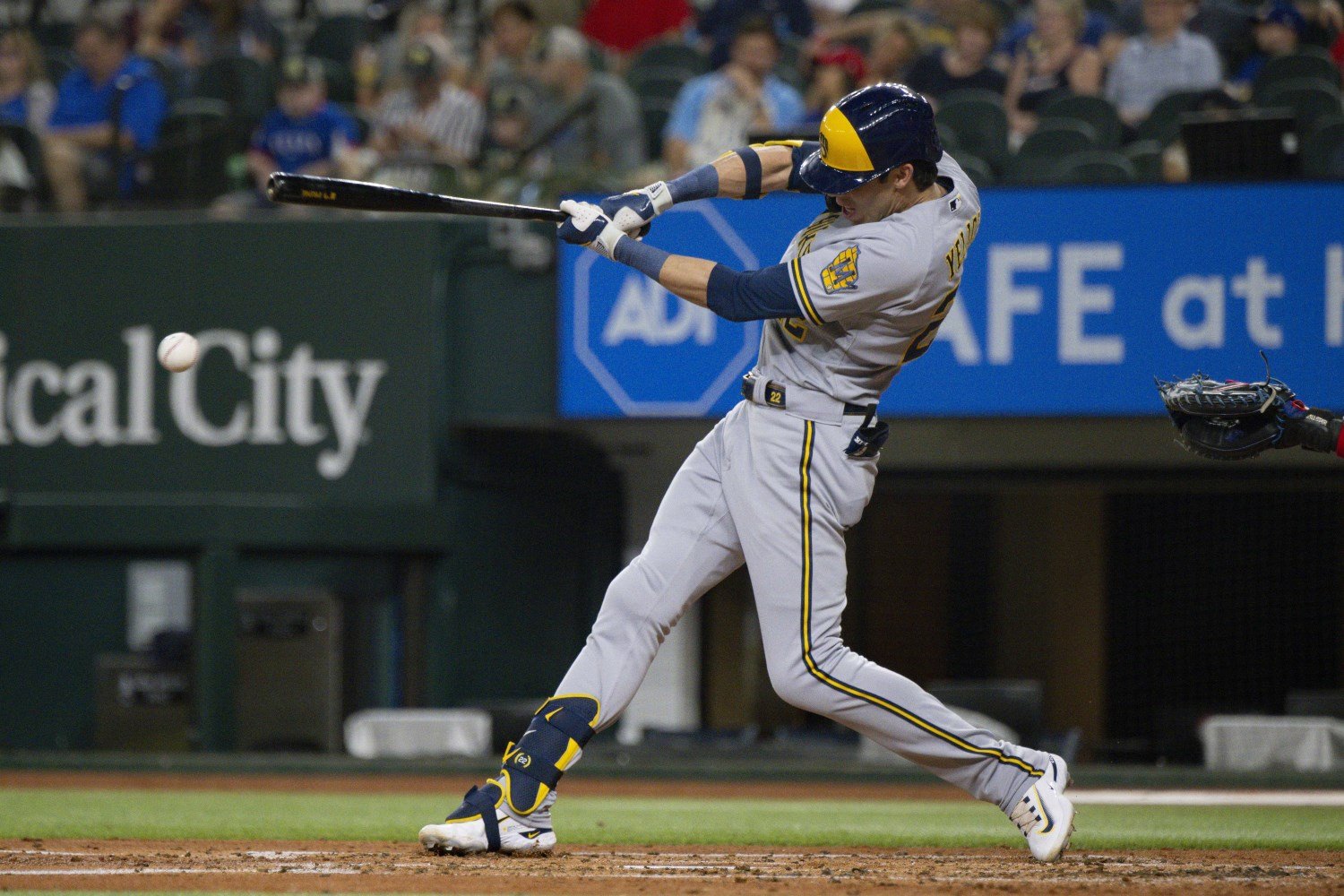
Let's take a look at one instructive contrast. Christian Yelich actually handles flat-VAA fastballs quite well, with a .376 wOBA against them.
.png.e8a63d4bacaf84016e57e23373314cd6.png)
William Contreras, by contrast, had a .271 mark, well down the leaderboard.
.png.a74282570ab71445f216ac5da578cdad.png)
Images and stats on fastball VAA courtesy of TruMedia.
That's an interesting finding, because Contreras and Yelich are superficially similar in their strengths and weaknesses at the plate. Each can hit the ball very hard, fairly consistently, but each struggles to elevate the ball. Each uses the big part of the field, but sometimes too much so, such that they don't take full advantage of their power even when they get it in the air. They're both relatively patient at the plate, and they both make contact at a good rate. Yet, when it comes to handling the kinds of fastballs toward which the league is trending, Yelich is in good shape, whereas Contreras is getting dominated.
A lot of that is adjusting one's sights and modulating approach. Yelich did much of his damage on the share of flat-VAA heaters that got down below the top third of the zone, where he could handle them. Fastballs with a flat VAA are better than ones with a steeper one, almost anywhere in the zone, but they're most effective at the top of the zone. That's also where most hitters (including these two) struggle to get on top of the ball. Yelich does a better job of letting the high fastball go for a ball, and of being ready when the ball is down just a bit, where his swing path can attack it.
He's also better, right now, at going the other way with that pitch. We saw Contreras slice some impressive shots to right and right-center last year, but it was nearly always when he was in a certain mode, waiting back and looking to push the ball that way. Almost all of those well-hit opposite-field pokes were on low pitches, and many of them were on breaking balls. Yelich is better at following the old hitter's saw, "Hit it where it's pitched." That's why he's doing well against the league's trendy cheese, while Contreras (and too many Brewers teammates) are scuffling badly. As the team looks to round out the lineup, they should focus on finding hitters who handle this particular offering well, but they also need to adjust their hitting philosophy to close what is essentially a team-wide hole in a collective swing.
What do you see in the team's efforts to hit the modern fastball? How can they ameliorate the problem? Let's talk some ball.





Recommended Comments
Create an account or sign in to comment
You need to be a member in order to leave a comment
Create an account
Sign up for a new account in our community. It's easy!
Register a new accountSign in
Already have an account? Sign in here.
Sign In Now