


Brewers Video
Old-school baseball fans and analysts talk a lot about modulating and modifying pitches--adding and subtracting on the fastball, changing the shape on breaking balls, and throwing to all quadrants of the zone. Rare are examples of pitchers practicing that art intentionally in the modern game. But the Brewers have one.
Pitchability is the silliest term in baseball. It's tautological. It's lazy word-building. You know what, though? It's also dead-on. It captures something real, in the simplest possible way. What do you want your pitchers to have, besides velocity and the ability to hit the broad side of a barn? Pitching ability. Pitchability. It means executing. It means thinking ahead of hitters. And it means doing something a bit more artistic and serious than throwing.
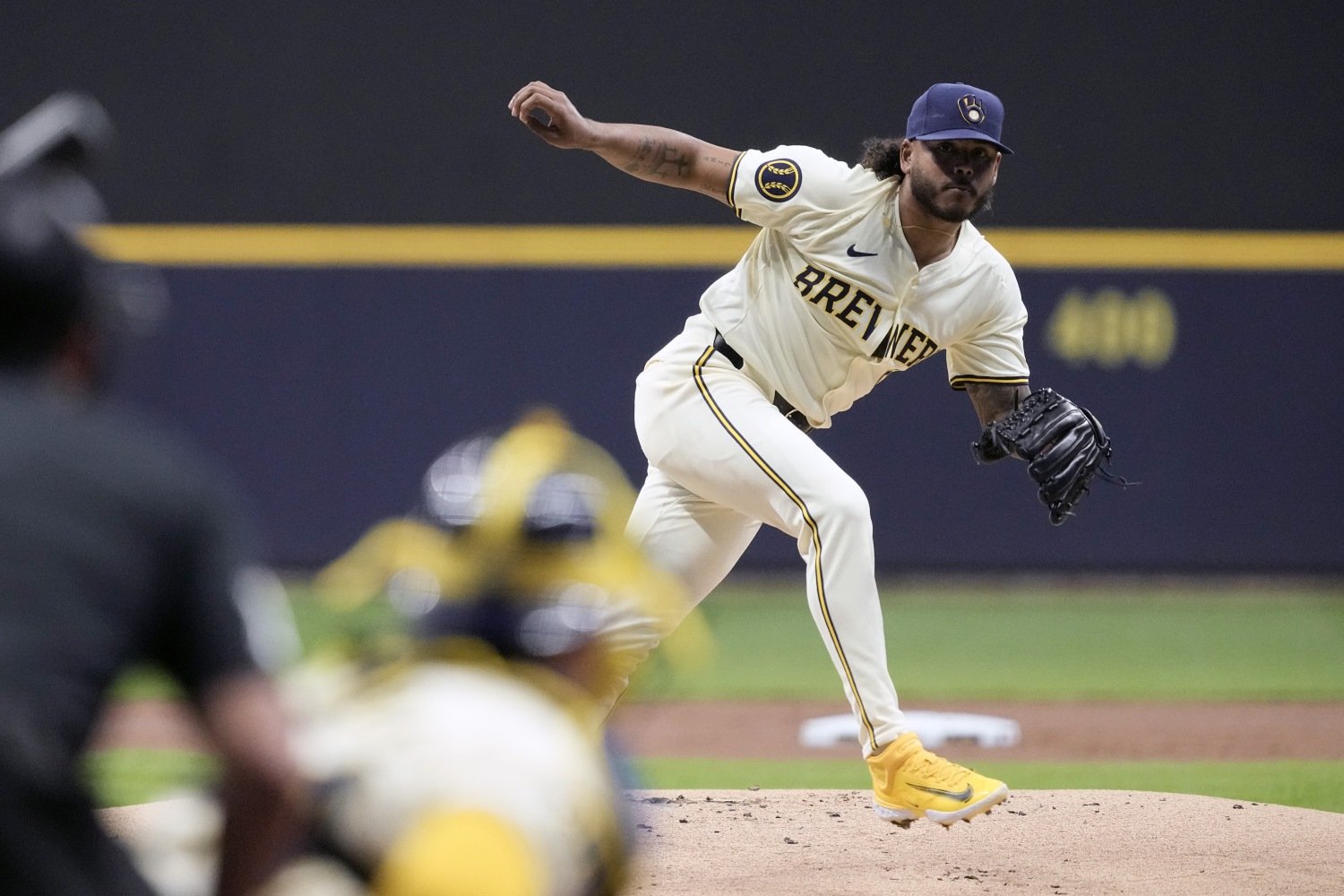
Freddy Peralta has pitchability, in greater measure than might jump out to the casual viewer. With his breathtaking athleticism, great velocity, and reputation as a fastball-firing miniature mound bully, he invites you to consider him as a physical specimen. In truth, though, he's a mind at work on the mound, and he extends that mental game all the way to the tips of his toes--and his fingers.
It's impossible to perfectly quantify pitchability, and thank goodness for that. What fun would there be in a world where we could slap a WAR on the soul? Just to get a conversation started on familiar terms, though, let's put a couple of numbers out there that loosely correlate to pitchability: movement ranges.
This is simple: Take the 90th-percentile movement for a pitcher on a given pitch (i.e., the fastball that rises more than 90 percent of Peralta's other fastballs), subtract the 10th-percentile movement (the one that rises less than 90 percent of his heaters), and you've got movement range, in the vertical dimension. It's good to check on both dimensions, so we'll deal with two numbers, I guess. But I don't want to talk about Peralta's fastball, today. I want to talk about his slider.
Having a wide range of movement in both dimensions on a slider is not an absolute good. (Remember, we're not trying to quantify, exactly! We just want to discuss an abstract concept in more concrete terms.) Some guys have a wide scatterplot on their slider movement just because they never know where the thing is going, or at what angle. That's not pitchability; it's close to being the opposite. And fellow Brewers starter Joe Ross, to take one example, has a great slider, specifically because he executes it in pretty close to the same way every time. The pitch doesn't beat hitters because they don't know what his slider will do; it beats them because he consistently fools them into thinking the pitch is his fastball.
Maybe I've already tipped my hand here, but Peralta is the opposite of Ross. No pitcher in baseball has a greater set of movement ranges on their slider than Peralta--and it's not, like, close.

That graph should make you gasp, or laugh out loud a little. Look at how far from everyone else Peralta is! It's almost hard to imagine how this could be a good thing. You can't scatter the movement on your slider this much without making a ton of bad mistakes, right? You're not really throwing a consistent pitch, at that point.
Exactly. Only, it's for a really, really good reason.
Peralta can make his slider into almost anything he needs it to be, from one pitch to the next--and thus, in essence, it becomes three or four different pitches in one. The maneuverability he brings to the pitch is otherworldly.
Here's the scatter plot of his movement on the slider, from the batter and catcher's perspective, with a color gradient applied to show the velocity of each pitch.

If it weren't for all the pitches connecting them like a bridge, we wouldn't even fathom calling the high-70s pitch on the lower right side of this chart the same thing as the mid-80s one on the upper left. The gap in movement and speed between them is funny. Yet, these are all sliders. They're clearly distinct from his curveball, and no one would mistake them for cutters. Rather, he can just throttle the pitch up and down in speed and change the shape and magnitude of its movement, based on who's up and what he wants to do against them.
After starting with a promise not to quantify, I'm throwing some awfully esoteric stuff at you. Let's take this into the real world. I want to look at four Peralta sliders, very briefly. Here's one he threw to Mitch Haniger, way back at the beginning of the season, in a 2-1 count and with runners on base.
That's a high slider. Most pitchers don't throw high sliders, at least on purpose. Note the target William Contreras flashed for him, though. That's exactly what they wanted to do with that pitch. They invited Haniger to see that the pitch was a slider, and that it wasn't going to be down where most sliders go, and thus, to swing out of his shoes. He came up with nothing but air, because that ball had some carry and stayed on plane, like a feather-soft (compared to his mid-90s fastball) cutter.
Turning that slider left, like a sweeper, is a comfortable feel for Peralta, but he usually throws it much slower than he did to Haniger there. It usually looks more like this.
That pitch is nasty, all on its own. It doesn't need a whole piece about pitchability around it to be understood and appreciated. As we grasp the fullness of Peralta's capacity to mutate the slider, though, we can deepen that understanding and appreciation. Because, see, that sweeper-like upper-70s thing is gross, but it works mostly against a right-handed batter. What happens when you have to get a whiff against a lefty?
Jackson Holliday, come find out.
Yurlgh. I mean YURLGH! That's a filthy, bullet-style slider. Six miles per hour harder than the sweepy thing thrown to Yainer Díaz, it's also going straight down, instead of coming in toward his bat path at all. I will reiterate my belief that the pitch classification algorithms are basically right, in labeling all three of the pitches above as the same pitch, but that's from an analytical bent. Just watching these videos, those are three totally different pitches. It's marvelous what he can do with them.
Nor is he simply saying, "Sweepy sliders to righties, gyroballs to lefties". Were that the case--were it that clean, rather than being movements along a spectrum--we could make a stronger case for dividing the pitch up into two types. Instead, though, Peralta sometimes goes vertical on a righty--and he'll even get a bit of run on the pitch, occasionally, without having it flatten out and sit on a tee for the batter.
This one is, partially, a mistake, but again, Peralta was aiming a slider with vertical tilt for the area just below the zone over the plate. Instead, he put it in off the plate on a right-handed batter, and the resulting contact was feeble.
Review the four locations we just saw him hit with these: Up, Outside, Down, Inside. All four pitches had different movement shapes, and they had varying velocities, but he was throwing the same "pitch" each time. A really good pitcher, with great pitchability, can shape and move their fastball like this. One who is desperately trying to get by with deficient stuff, like Kyle Hendricks of the Cubs, sometimes comes up with something wildly creative, like throwing two versions of a changeup to attack hitters from either side. What we're looking at, though, is a pitcher who can throw his slider as four different pitches, without losing the integrity of the offering itself--and thus, one who can put the slider almost anywhere in or outside the zone, when the situation demands it.
Pitchability doesn't mean never making mistakes, and Peralta does make mistakes. He's not yet the elite ace he's shown the ability to do, on a consistent basis. He's inching ever closer, though, and it's this kind of feel for his craft that will get him there.





Recommended Comments
Create an account or sign in to comment
You need to be a member in order to leave a comment
Create an account
Sign up for a new account in our community. It's easy!
Register a new accountSign in
Already have an account? Sign in here.
Sign In Now