


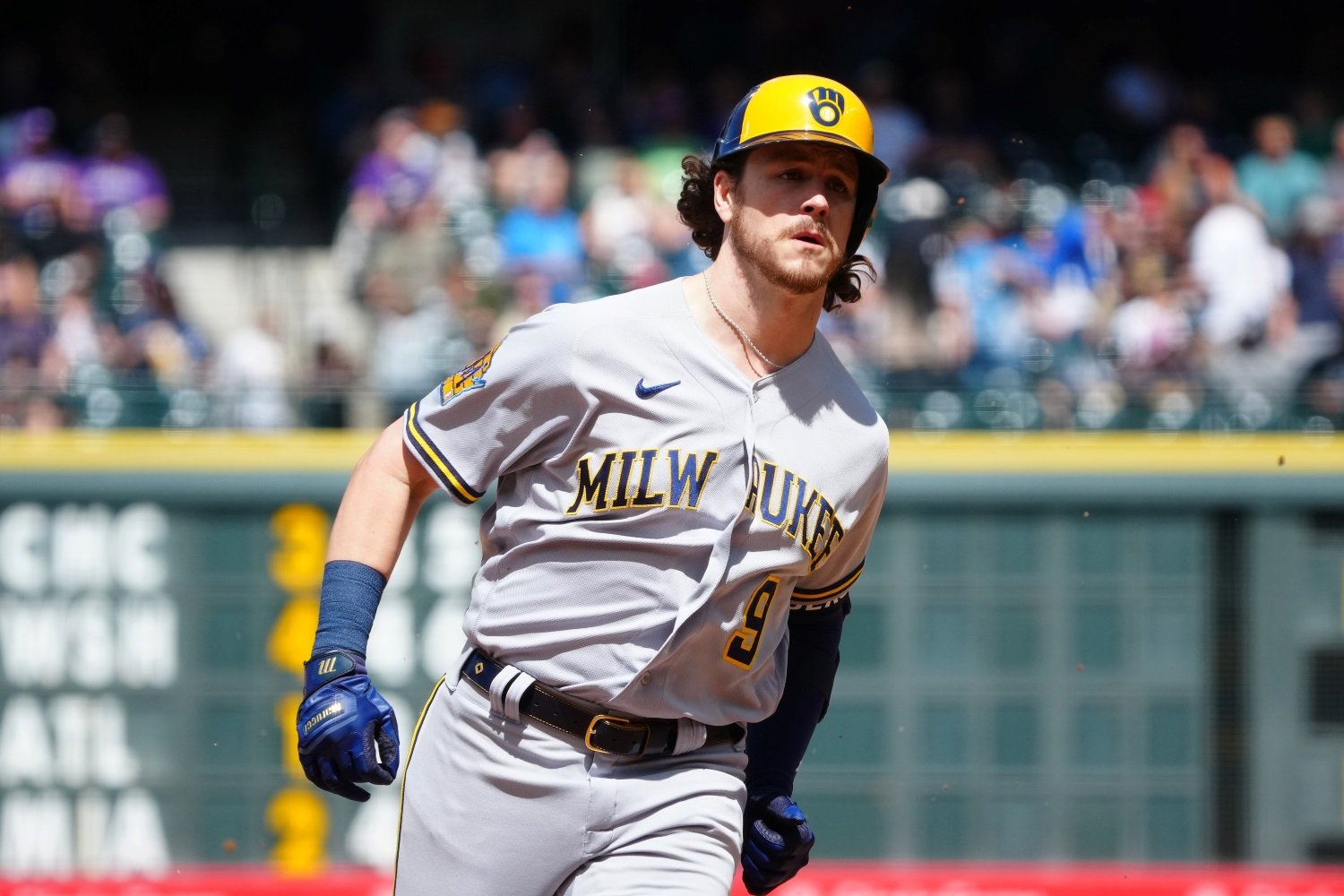
Brewers Video
The Brewers have had a rough go of it lately. Entering Colorado, our beloved nine had lost two of three home series, on a homestand that was only redeemed by a visit from two of the greatest ballplayers ever to set foot in the Midwest (Shohei Ohtani and Mike Trout, of course). But according to the scoreboard, even the Brewers' own performance against the Los Angeles Angels was not great -- they managed 9 Runs Scored / 9 Runs Allowed against their West Coast foe. Surely, that's not a recipe for certain victory, and that performance mirrors the larger disappointments of the homestand (which went 33 Runs Scored / 40 Runs Allowed en route to a total of four wins in nine games).
Throughout the season, I keep a daily tally of Milwaukee's "Pythagorean Win - Loss record," which is an estimation of the club's expected wins and losses based on Runs Scored and Runs Allowed. Why would anyone do this? Well, first and perhaps most importantly, Runs Scored and Runs Allowed are what they put on the scoreboard, and the balance of Runs Scored and Runs Allowed within one season have some suggestions about the true strength of a particular ballclub within that season (Baseball Reference has a nice brief discussion of the strengths and weaknesses of this). Even where its true statistical predictive qualities fail, following a club's underlying Runs Scored / Runs Allowed record over 162 games can maintain explanatory power, perhaps during short playoff series when seemingly improbable outcomes occur (remember, for instance, when the Toronto Blue Jays dismissed the supposedly superior Texas Rangers in the 2016 Playoffs? Or even when the seemingly inferior Los Angeles Dodgers ousted our beloved 2018 Brewers? [too soon?]).
Secondly, by following a team throughout the 162 game season, it is possible to take the Pythagorean Win - Loss record even further by averaging it throughout an entire season. This allows us to understand the deviation between each team's true strengths and weaknesses. For instance, a 90-win club won't always play like a 90-win club. Remember our beloved 2018 Brewers, once again, who easily played half the season as a .500 or worse club?
2018 Brewers on May 30: 36 wins / 21 losses (on this date, the club just finished a series win against St. Louis)
2018 Brewers on August 30: 75 wins / 60 losses (on this date, the club just finished a series win at Cincinnati)
I recall many Brewers fans ready to write this team off following relatively excruciating June, July, and August performances. In these months, the Brewers scored 362 runs, and allowed 370 runs, so they were truly about as bland as their record during those months showed. And then they rattled off #Craigtember, and all was forgiven. Hell, let's not forget that team had such an iconic run that Major League Baseball changed several rules because of their success (can't have small-market clubs using their full 40-man roster or so-called "openers" in the playoffs ). In almost every 96-win club, there is a .500 club for the bulk of the season, and you could say that about many losing clubs, too.
Matthew Trueblood's series is truly aptly named: despite the long run of a 162 game season, whether a club is an elite winner or a cellar dweller truly does come down to the third set of 54 games in many cases. I don't believe it's a truism to suggest that on most MLB clubs, you could squint and see a 75-win club or an 85-win club, depending on how everything breaks and which assumptions you would make.
So by averaging a club's daily win-loss and Runs Scored / Runs Allowed record, it is possible to catch trends relatively quickly and also understand the true strengths and weaknesses of a ballclub. For these reasons, roughly once a month this season I will write a brief summary of where the Brewers are in terms of their underlying record.
May 4, 2023: 31 games complete
Brewers Runs Scored: 137
Brewers Runs Allowed: 119
162 Game Pace Runs Scored versus National League and American Family Field: -5 (five runs below average). This means that if everything else was held equal, placing the Brewers current offense on an otherwise average club would produce an 80 win team.
162 Game Pace Runs Allowed versus National League and American Family Field: +93 (ninety-three runs better than average). This means that if everything else was held equal, placing the Brewers current defense and pitching staff on an otherwise average club would produce a 90 win team.
Average Daily Win Loss Pace (Actual Wins): 94 wins (14 standard deviation, ex., between 80 and 108 wins)
Average Daily Win Loss Pace (Pythagorean / Runs Scored vs. Runs Allowed): 107 wins (27 standard deviation, ex. between 80 and 134 wins)
Immediate Trends: if the Brewers played the remainder of the season at the quality of their last 10 games, they would win approximately 67 games all season; if the Brewers played the remainder of the season at the quality of their last 20 games, they would have approximately 83 wins.
Overall: the Brewers are currently averaging between 90 and 92 wins based on their total Runs Scored / Runs Allowed. Their daily average for the entire season is much higher due to the club's hot start (they spent nine of their first 14 games playing 120+ win baseball based on their Runs Scored / Runs Allowed). Their recent trends are much lower, due to a cold offense and injured rotation, which is suddenly exposing the strength of the club (its bullpen).
By Element: Over 31 games, the Brewers offense has spent 15 games better than average, and 16 games below average. The pitchers have spent 20 games better than average, and 11 games below average. Thus far, on an average basis and a daily performance basis, the pitching / Runs Prevention Unit is leading the way for the club.
The Gist: It's no secret: Adrian Houser, Aaron Ashby, and Brandon Woodruff are all injured for prolonged periods of time, and regardless of what you think about the quality of each of those pitchers, losing all three at once places immense stress on the bullpen and rotation. Indeed, if all of these arms were healthy, the Brewers would likely run out of rotation spots, resulting in Houser or Ashby filling a bullpen or swingman role. On top of this, Corbin Burnes has been average at best, and neither Eric Lauer nor Colin Rea have stepped up in their roles. Meanwhile, the offense is much worse than last season's club thus far, with only Rowdy Tellez, Brian Anderson, and William Contreras producing above-average OPS+ figures entering Thursday's series finale in Colorado.
Thank goodness for the hot start, because recently the Brewers look like they are in trouble. Can rookies Brice Turang or Joey Wiemer seize starting roles with their bats? Will Christian Yelich or Jesse Winker snap out of their respective funks? This is a very good baseball team whose fortunes could go south very quickly; who's going to rise to the occasion and lead the club back to their next winning streak?





Recommended Comments
There are no comments to display.
Create an account or sign in to comment
You need to be a member in order to leave a comment
Create an account
Sign up for a new account in our community. It's easy!
Register a new accountSign in
Already have an account? Sign in here.
Sign In Now