


Brewers Video
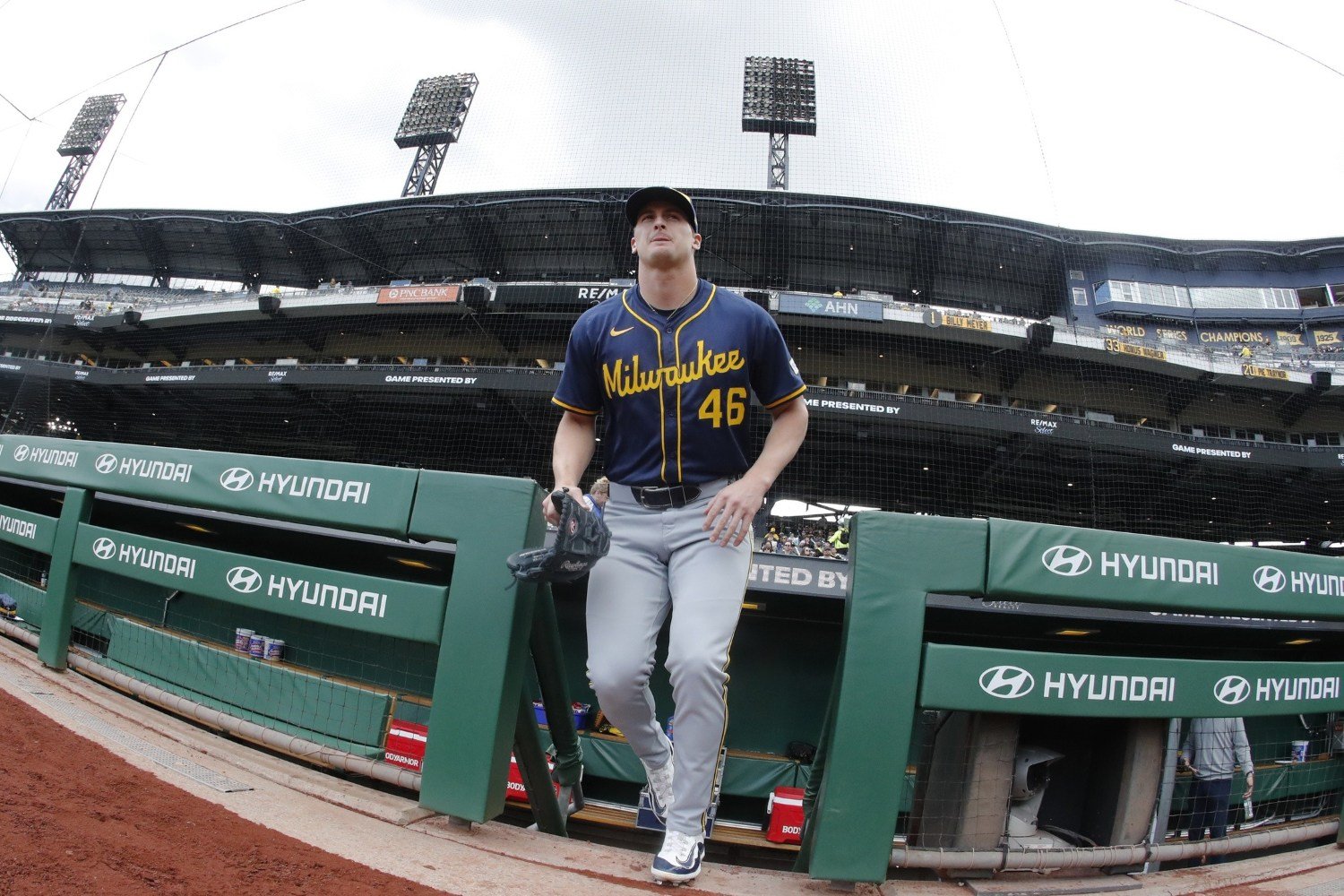
The Brewers showed how highly they thought of Quinn Priester when they paid a steep price to acquire him from the Boston Red Sox in April. At the time, the former first-round draft pick owned a 6.23 ERA in 99 ⅔ big-league innings, but Milwaukee felt he had the tools to become a long-term rotation mainstay.
"When I first saw Priester, I remember talking to [Chris Hook] and [Jim] Henderson," Pat Murphy recalled. "We talked about, 'This is a guy we just need to get our hands on and work with him a little bit.' And it'd be nice if we had two or three weeks with this guy before he had to pitch, you know?"
Neither Priester nor the Brewers had that luxury, as the 24-year-old immediately joined an injury-ravaged rotation. The early results were uninspiring: a 5.79 ERA, 5.34 FIP, and 5.35 SIERA in his first five outings. Since a seven-run blowup against the Chicago Cubs on May 2, the results have flipped. Priester has posted a 2.51 ERA in his last six outings, with a 61.1% ground ball rate. His 4.03 FIP and 3.93 SIERA during this stretch indicate that Priester has pitched more like a capable back-of-the-rotation starter, but even those marks reflect substantial improvement. Furthermore, the Brewers aren't asking him to pitch in a way that peripheral metrics love—at least, not yet. For now, they want Priester to be a ground-ball machine in front of their infield defense. He's unlikely to sustain his recent level of success in his current form, but some of his overperformance is by design.
The turnaround came after a few adjustments. Priester and the Brewers' pitching brass simplified his game plan to emphasize his two best pitches, and moved him toward the middle of the pitching rubber. Priester has a full five-pitch arsenal, including a curveball that received a 70 grade from FanGraphs in 2023. He used his entire mix in his first few outings, but since that Cubs start, he's leaned heavily on his sinker and slider.

The results quickly improved. Opponents have since slugged .330 against Priester, with an expected slugging percentage of .350.
"He's overpowering people with the sinker," Hook said. "Why would we do them a favor sometimes, you know? At this particular moment, he doesn't need a six-pitch mix."
"I think it's a lot of 'If it's not broke, don't fix it' type of thing," Priester said. "We know there's tons of quick outs in the sinker, and we know I'm at my best when they have to respect that pitch. And then the slider's just a natural second off it."
The Brewers targeted him largely because of that sinker. It has drawn unassuming reviews from public stuff models (career 0.2 StuffPro and 100 Stuff+) but rates highly within the organization's internal valuations. Its raw movement seems unremarkable from afar, but it sinks more than a hitter expects it to from Priester's high-three-quarters arm slot.

"It's a very unique sinker," Hook said. "You look at the movement like, 'Oh, God, that's not that good.' But I think the entry angle and the movement, it's not the expected movement. It just looks different. It's a bowling ball."
The sinker-slider combination is playing better from the middle of the mound. Priester used to stand with his back heel hanging off the rubber, but since his start against the Baltimore Orioles on May 19, he's stood roughly seven inches to his right.

Brewers pitching coaches had several potential benefits in mind when they approached Priester about moving over.
"In one bullpen, Hooky asked if I kind of am uncomfortable being in the middle," he said. "I just had always thought the first base side had helped me out. Then had a couple other people mention, 'Hey, maybe the middle will just kind of help the sinker sink more, just the different angles we can play.' And same with the slider. The slider's going to hold more plate just because I'm now seven inches over on the other side."
Because it now appears to stay in the strike zone longer before breaking off the plate, hitters are chasing Priester's slider more. Since he moved on the rubber, the chase rate against it has increased from 36.9% to 42.9%.
More important, though, was how sliding over could help the sinker. The Brewers believed it played in the zone, but needed Priester to throw more strikes. From the middle of the rubber, his in-zone rate has improved from 50.9% to 53.4%, his walk rate has dropped from 14.2% to 5.8%, and his first-pitch strike rate jumped from 58.8% to 68.6%.
"To me, it's like, 'Okay, we can get this guy in the strike zone, and good things will happen,'" Hook said. "And he can be middle with [the sinker]. I mean, you go, '14 [inches of horizontal break] and 8 [inches of induced vertical break] sinker, that's okay, that's fine.' But there's something different about his. He can play in the middle, and I think he's been aggressive."
Priester is now getting ahead of hitters with tons of sinkers down the middle, and it's working. Despite the pitch getting plenty of the plate, opponents have managed just a .292 wOBA on contact, far below the league average for sinkers of .354.

His spring training velocity gains with the Red Sox evaporated after his trade to the Brewers, but Priester has rediscovered an extra tick on his sinker in his last four outings. He attributes it to growing more comfortable with his recent mechanical tweaks.

"There's some things we wanted to iron out at first, and that takes some thought, and thought kind of slows the body down a little bit," he said. "The more those things have gotten ironed out and required less and less thought, the more it's been easier to get to those velos, because there's not much to think about. It's just, 'Throw the ball. Throw the heck out of it over the plate.'"
The current sinker-slider approach is working for now, but it limits Priester's ceiling. He's currently a pitch-to-contact pitcher whom the Brewers have shielded from left-handed hitters by using DL Hall as an opener. He'll need his other secondary pitches down the line, to take additional and more sustainable steps forward.
Hook sees potential in the rest of Priester's arsenal, particularly his cutter and changeup, but most of the work on those pitches is happening behind the scenes. For now, the Brewers want him to attack hitters in the zone with his best stuff and use his remaining offerings strategically.
"I think sometimes it's like, 'Hey, man, we need to continue to work on this, and we'll give you some space to work it in when it's ready,'" Hook said. "Now we're just going to find the guys that are bad on this pitch and work it in."
The Brewers believe those other pitches can play in the future and make Priester a more well-rounded pitcher.
"He's handling lineups right now," Hook said. "If we add those other pitches, I think that'll better complement him, and there's probably more whiff in there when he does use them."
Priester is a unique project for the Brewers' pitching development system. He was not a minor-league acquisition who could feel things out in a low-pressure environment, nor was he a veteran pickup like Aaron Civale or Frankie Montas. The club has visions of what he can become in the long run, but also had to make him effective this year, knowing it couldn't squeeze years of development into a few weeks. Priester is far from a finished product. He has already made quick progress, but more work lies ahead.
Do you approve of the job the Brewers' front office is doing?

Follow Brewer Fanatic For Milwaukee Brewers News & Analysis



-
 3
3
-
 3
3


Recommended Comments
Create an account or sign in to comment
You need to be a member in order to leave a comment
Create an account
Sign up for a new account in our community. It's easy!
Register a new accountSign in
Already have an account? Sign in here.
Sign In Now