


Brewers Video
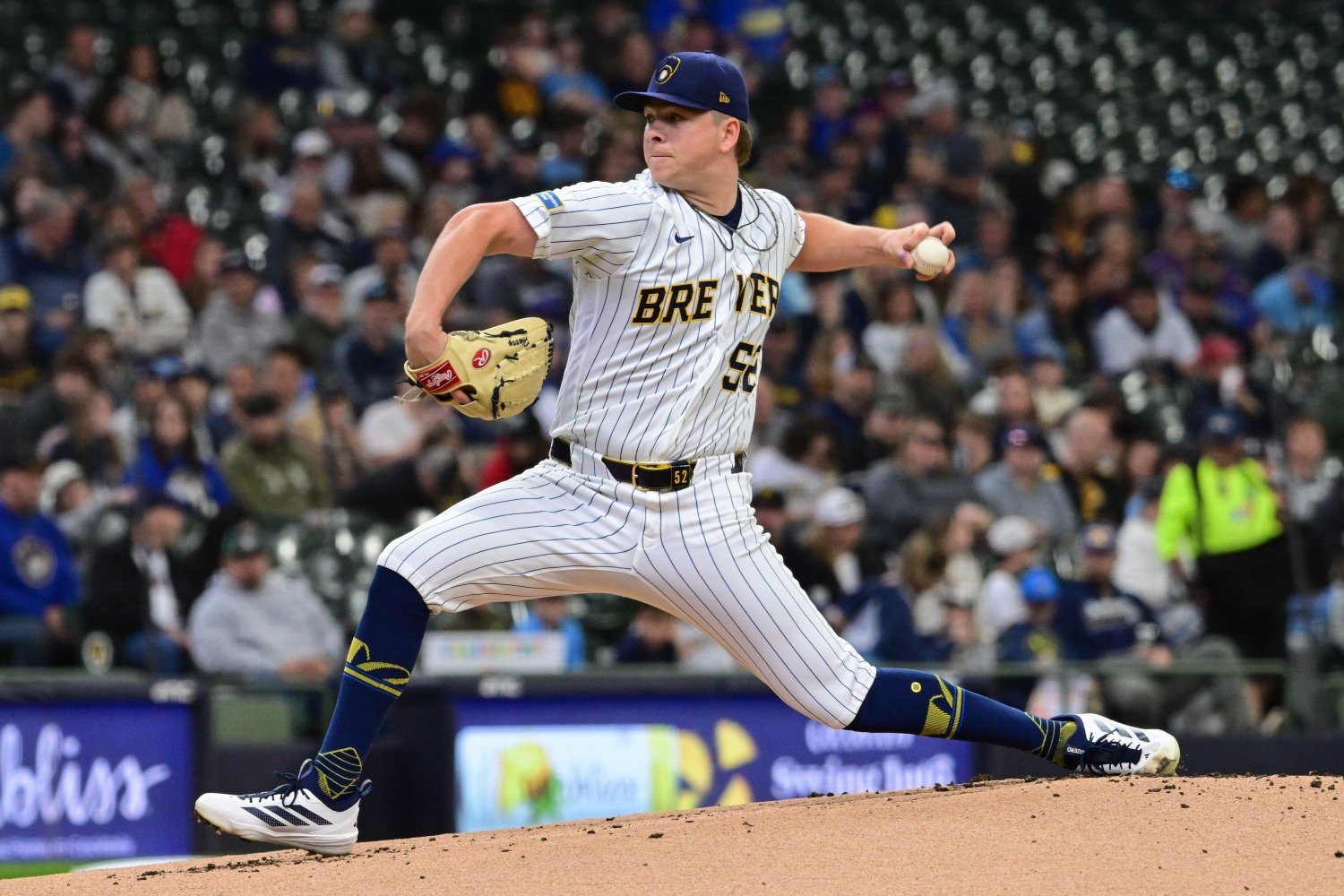
If you put the phrase "side of the rubber" in the Brewer Fanatic search tool, you'll be inundated with a plethora of Matthew Trueblood articles. The Brewers have used this with aplomb in the past to change how pitches tunnel as they approach home plate, and to change the angles they arrive at to either keep them over home plate for longer or shorter periods of time, and Matt loves to write about it. In Kyle Harrison's case, what they've managed to do is create an angle for him to pitch from that really emphasises his breaking ball, while creating an even more unique fastball for the hitter to deal with. It's a familiar formula; I just beat Matt to writing about it this time.
Fastballs aren't straight. The majority of true four-seam fastballs have an element of tailing action, moving toward the pitcher's arm side. Harrison was already an outlier in this respect because of his low arm slot, which traditionally makes getting a fastball to "rise" more difficult and emphasizes that tailing action. Where some pitchers try to cut their fastballs and emphasize the vertical movement, Harrison has an outlier combination of both vertical and horizontal movement.

The only starter in baseball with a comparable fastball from the left side is Cole Ragans, with 17" of induced vertical break and 13.6" of horizontal break. That's quite the comparison, with Ragans's four-seamer performing to an expected batting average of just .188 in 2025.
It feels important to preface this article by also admiring how the Brewers have put in a lot of work to clean up Harrison's delivery, and have managed to access more induced vertical break than ever. He averaged 13" with the Red Sox in 2025 and is now up to 15" on average. That makes a heck of a difference in the batted-ball quality for opposing batters.
Now, on to the juicy stuff. If we compare the pitch chart above for 2026 with his chart from 2025, there are some notable changes. The breaking pitches are breaking slightly less; the fastball is rising more; there's been a small change in arm angle; and, of course, the changeup profile was altered when he moved to a "kick-change". What I'd like to focus on, however, is the HAA, or the horizontal approach angle.
.png.6b805e0d665a97aa286697f8bf57367b.png)
There's been a lot of talk about vertical approach angles on fastballs, making them appear as though they're still rising by the time the pitch reaches the plate. Vertical approach angle is affected by spin rates, arm angles and location (i.e., there will be a lower vertical approach angle on pitches at the top of the zone than at the bottom). Horizontal approach angles, accordingly, are affected by arm angles, release points and horizontal break.
When talking about the usefulness of this approach angle, imagine yourself in a batter's box, with a coach lobbing balls toward you. The first coach lobs from right in front of you, and your brain finds it easy to pick up the point at which you'll make contact. Now, imagine the coach changes position and throws from a 45° angle. That ball is now coming toward you at a different trajectory, and your brain is forced to decipher movement on two planes.
We have to remember as well that, although the ABS system uses a two-dimensional "pane" to assess whether a pitch is a ball or strike at a fixed point halfway from the front of the plate to the back, hitters have different positions within the batter's box that can change the point at which they impact the ball. Most make contact significantly in front of the ABS zone, which can neutralise some of the angular momentum of a pitch, but there is an interesting tradeoff. Waiting farther back in the box to make contact will reduce the vertical approach angle of a pitch, as gravity has more time to win its battle with a fastball's spin, but it exacerbates the sweeping horizontal angle of an incoming pitch.
It's this secondary movement that Harrison's move across the rubber optimizes for his two main offerings. On the fastball, where previously it actually entered the zone quite straight, it's now boring in on the right-handed hitter, with his changeup as a real threat to veer the other way. As for the slurve, this is perhaps the most meaningful change. The graph below highlights the relationship between Harrison's horizontal approach angle and his hard-hit rate:

We can see a clear correlation between Harrison's slurve performance in each of his seasons in the big leagues, tying in well with the line of best fit. While the regression line expects some, well, regression, this season, it still predicts that the slurve will be measurably more successful with an increased horizontal approach angle (HAA). In short, the more the slurve is sweeping across the front of the strike zone, the more Harrison can avoid barrels and reduce the quantity of hard-hit balls.
While there are some changes in locations with the slurve, the quality of contact seems to be controlled more by its change in shape, based on a new angle. In 2025, the pitch had an expected Weighted On-Base Average (an overall expected metric covering strikeouts, quality of contact, walks, etc) of .356. That figure was .347 across a larger sample in 2024, and .402 in 2023.
In 2026, his xWOBA is just .197 on the pitch. It's a small-ish sample, but the trend lines suggest a direct correlation between his HAA and the quality of contact given up, such that we should expect this to continue.
One final point based on his last start. Looking at the 2026 pitch map, his slurve has been anything but a consistent, downward-breaking shape throughout the season. He's seen it back up quite regularly and failed to get that downward movement. In his last start, however, you can see how much tighter and more consistent the slurve shape was, with how clustered together the blue dots are:

As a result, the whiff rate skyrocketed. He could command it better as a result, finding locations in the shadow areas that encouraged chase and some really uncomfortable swings. He showed that, even with the early success of his slurve, there's more in the tank.
The Brewers have made some simple adjustments that have allowed yet another pitcher to take a leap forward. It's almost comical at this point. And Harrison is taking full advantage of the H&H Car Wash.
Have you enjoyed Kyle Harrison's start to the season? And perhaps for myself, do you enjoy these kinds of analytical pieces? Let me know your thoughts in the comments below!
Do you approve of the job Pat Murphy is doing as Brewers manager?

Follow Brewer Fanatic For Milwaukee Brewers News & Analysis



-
 3
3


Recommended Comments
Create an account or sign in to comment
You need to be a member in order to leave a comment
Create an account
Sign up for a new account in our community. It's easy!
Register a new accountSign in
Already have an account? Sign in here.
Sign In Now