


Brewers Video
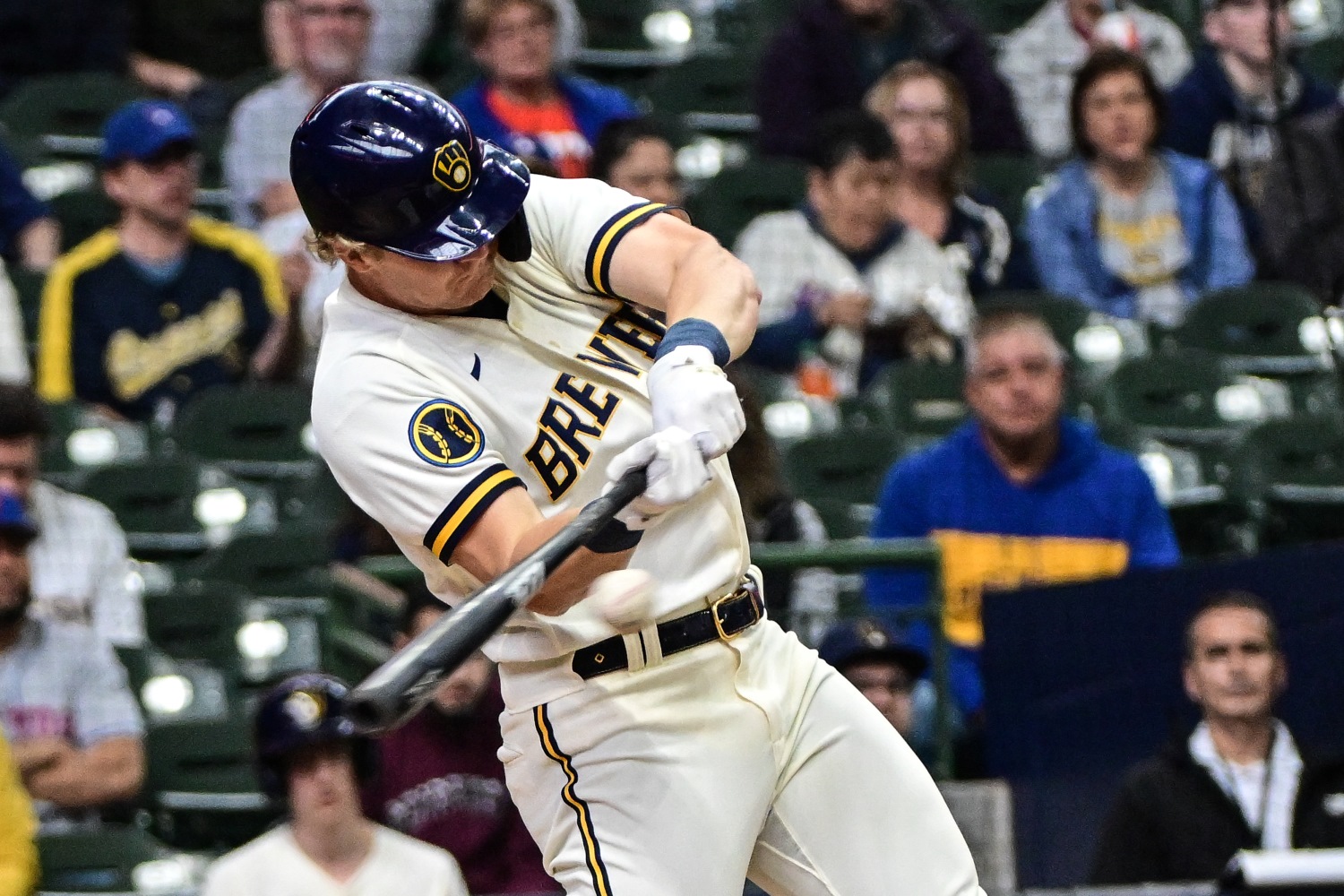
Last year, only the Yankees and Braves hit more home runs than did the Brewers. Already this season, despite playing half their six games in frigid conditions at Wrigley Field, Milwaukee is ninth in MLB in slugging. How do the Brewers do it?
It's been a brief tenure for Connor Dawson and Ozzie Timmons as the Milwaukee Brewers' hitting coaches, and it's too early to say that they'll be immune to the prevailing trend in MLB, which is toward very high turnover in that role. However, those two have done an excellent job of implementing and teaching the core principles to which the organization has cleaved for several seasons. They're finding power in unexpected places and generating more of it from the expected ones by doing some simple stuff well.
A decade or two ago, it was common for teams to have instructional identities. Certain teams ardently taught a particular kind of pitch, or even pitching mechanics, and they didn't brook any dissent from players who didn't fit into their molds. One of the very welcome changes to player development over the last several years has been the end of that style of coaching. Players are now invited and encouraged to be themselves, and plans for their improvement are shaped around what both the player and the organization do well. Any organizational predilections have become guidelines, rather than rules.
The Brewers' hitting instruction is a terrific example. They don't make everyone do things the same way. They do drill hard on good swing decisions, though, and especially on swing decisions that favor a hitter's power. Even before Dawson and Timmons arrived, but especially since the start of 2022, it's possible to watch a Brewers game and see how their hitters dismiss certain areas of the strike zone when the count, situation, or opponent dictates it, giving them a greater chance of taking a called strike but also a greater chance of hammering a mistake pitch if a pitcher throws one. Tightening players' zones and reducing chases has been a strength for Milwaukee going back at least half a decade.
That can make the team a great landing place for players with good bat-to-ball skills, including some power, but with confused or underdeveloped approaches. The number and caliber of players who have come through Milwaukee recently and seen their power output and overall value rise are impressive, and they're a huge part of why this team has had a great run of contention.
Milwaukee is also very good at a tidbit of mechanical instruction that helps hitters generate more power, though, and that deserves a little bit longer a look. Be it Willy Adames, Luis Urías, Mike Brosseau, or Owen Miller, guys tend to make a specific change when they come to Milwaukee: they get more upright in the batter's box.
The clearest way to see this, though, is by looking at one of the team's internal projects, Tyrone Taylor. Here's a video of a hit Taylor collected in May 2021:
And here's one from the middle of last season:
Note the change in his setup. In the video from 2022, Taylor has his back much more straight at the plate. He's almost leaning backward. That sets him up to a couple of things differently than he did in the past. As he lifts his leg to begin his stride, he's almost forced to lean forward, which engages his core muscles and starts a sequence of movements that can generate a steeper bat path without losing bat speed. It's subtle, but that first forward movement and clenching of the big muscles throughout the torso can be key to creating power.
As it happens, this setup change didn't work for Taylor in the long run, and he found his September success last year after changing things up. That's a story for another time, but it's a good reminder that Dawson and TImmons aren't being dogmatic. They're just trying things they know will work for most hitters, on most hitters. Seeing the way Taylor leans back above, you probably flash on Urías's distinctive lean in the box. It's born of the same cues. Miller has started to do a smaller version of the same thing already this year.
That tilt in one plane of movement is one thing the staff is teaching well, and it's contributing to the power the team is generating. The other thing is harder to see from the predominant modern camera angles, but equally important: the Brewers are keeping their upper half back well as they gain ground on the pitcher with their legs, creating the torque and the lift that power requires.
Take another look at Joey Wiemer's first hit in the majors:
Wiemer takes a big stride. He closes the gap between himself and the pitcher and creates a lot of energy flowing into the path of the pitch. With his upper half, though, he stays back a moment, letting his hips bear much of the weight transfer and leaning slightly back to steepen the angle of his bat path, without dropping his back shoulder or hands and creating a swoop or slowdown in his swing.
Interestingly, William Contreras has a new mechanical quirk this spring. Just before truly starting his swing, he lifts and steps away from home plate with his back foot, going from a neutral to a closed stance even as the pitcher is making his delivery. That's partially just about seeing the ball well, while still creating the torque and lift with which a closed stance can help, but it's also about rhythm. As Dawson and Timmons try to fix Contreras's launch-angle problem, they're having him try this as a way to both move his contact point further in front of his center of gravity and get his swing started sooner. Nolan Arenado famously taps his back foot as a way of starting the rocking motion that is a powerful swing. He comes forward, goes back, and then explodes forward again, and the back-foot tap lessens the risk that he gets "stuck" on his back side and is too slow in making that weight transfer. There's a little bit of that thought in Contreras's new move, too.
The Brewers aren't likely to finish third in MLB in home runs again. They've already proved, though, that they can get more power from many players than other teams might, simply by offering unorthodox moves and concepts to players who need new ways to visualize the essentials of a power approach and swing. So far, it's working.
Which team do you dislike the most in the NL Central?

Follow Brewer Fanatic For Milwaukee Brewers News & Analysis



-
 1
1


Recommended Comments
Create an account or sign in to comment
You need to be a member in order to leave a comment
Create an account
Sign up for a new account in our community. It's easy!
Register a new accountSign in
Already have an account? Sign in here.
Sign In Now