


Brewers Video
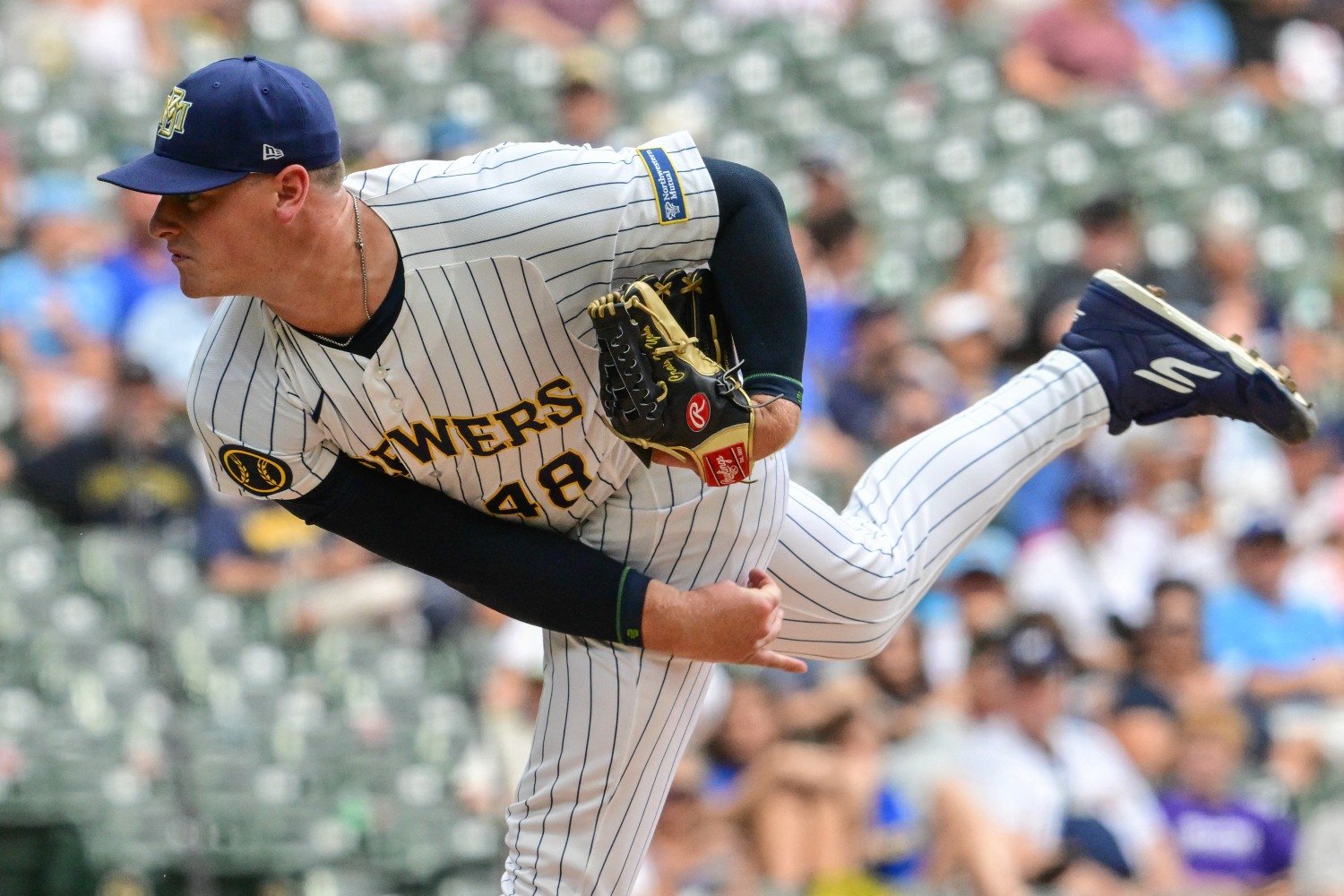
Craig Yoho ascended so quickly to the big leagues as a reliever that it's easy to forget he's only in his fourth season as a pitcher. A position player for most of his injury-riddled college career, the 26-year-old didn't move to the mound until 2023 at Indiana and was drafted by the Brewers that summer. He's now trying to find his footing in the majors in just his third full professional season.
"This is, what, my third-and-a-half year pitching, something like that?" Yoho said at his locker in the Milwaukee clubhouse over the weekend. "So there's still a lot of stuff I'm learning about myself and stuff in the game of baseball that I haven't experienced yet. It's been, in a way, just a learning experience through it all."
Yoho's elite movement, particularly the screwball-like shape of his changeup, helped him tear through college and minor-league hitters with ease. In the majors, he's encountered more first-time challenges. Some of the lessons have been mechanical, but most have related to the mental game and his daily work with the Brewers' big-league pitching coaches.
"Just going in each and every day, understanding the work I need to put in to be ready to go that night, and just having the right mindset of going into the game," Yoho said.
He's also learning the best way to use his arsenal. The pitches Yoho originally threw after converting to pitching were effective until he reached the majors, so he never needed to think much about which pitches he should throw to perform at the game's highest level.
That changed after Yoho struggled to a 7.27 ERA, 6.48 FIP, and 6.61 SIERA in 8 ⅔ innings in his debut season last year. Late in the year, he experimented with a shorter slider to replace his curveball, but he ditched it when it started to blend with his cutter. He made a grip change this year to give his changeup even more depth, increasing its induced vertical break from -3 inches to -4.4 inches.
During his most recent stint in Triple-A Nashville, Yoho made his most substantial yet simplistic change: he added a sinker and has since used it as his primary fastball instead of his four-seamer.

"I decided to start pitching my last year of college, and [the four-seam was] the grip I chose," Yoho said. "It wasn't necessarily like a rhyme or reason to it. So, for the most part, my arsenal hadn't changed since the day I picked up a baseball."
The four-seamer moved inconsistently because it wasn't the best fastball grip for Yoho. He's an extreme pronator, which means his palm turns outward, away from his body and over the top of the baseball as he releases it. That allows him to create the sideways spin that makes his changeup drop and fade, but it also produces a four-seamer with lots of arm-side run and very little carry, instead of a normal four-seamer that looks like it's rising due to more vertical backspin.

In other words, Yoho's four-seamer is a worse version of a sinker with less sink. Why not add a real sinker instead?
"It's always crossed my mind because his four-seam is kind of like a two-seam anyway, so might as well just get some depth to it," Brewers pitching coordinator Jim Henderson said.
"It's something I've thought about pretty much every offseason, but hadn't actually done anything with," Yoho said. "I always kind of wondered if it would actually help my arsenal or not."
At the beginning of July, he finally added the sinker. Yoho is using a standard two-seam grip with his fingers riding along the parallel laces of the ball, with the friction of those seams allowing him to rip the ball off his fingertips more comfortably than he can with a four-seam grip.
"The hand coming off the ball feels great," he said.
Unsurprisingly, the sinker has nearly the same amount of run as Yoho's four-seamer, but it has more depth. It has averaged 6.7 inches of induced vertical break, while the four-seamer has averaged 11.4 inches (excluding his outings at Coors Field, where the ball moves less due to the high altitude). Yoho has still mixed in some four-seamers to show hitters slightly different versions of two similar fastballs.

In addition to generating more sink to induce more ground balls, Yoho and the Brewers are hoping that more consistent movement will help him throw more fastballs for strikes.
"I got to start my line a little bit more on my glove side, just so that way when the ball runs, it comes back [into the strike zone]," Yoho said. "With the four-seam, I felt like sometimes it would come back a lot, sometimes it wouldn't as much, and so it was a little bit working against what I was trying to do. So the two-seam has helped kind of clean some of that up."
"I like it because I think it's a training tool for his mechanics," Henderson said. "When you throw sinkers back-door [to righties], you can't come out of your delivery."
The improved control has yet to materialize, as Yoho has thrown fewer sinkers in the strike zone (47.7%) than four-seamers (52.6%). That's what Henderson and lead pitching coach Chris Hook are monitoring most. Their main message to Yoho has been that he must force hitters to honor his fastball in the zone to get chases and early swings against his changeup.
"If he commands the fastball, if they have to respect the fastball, then the changeup, no matter what [the velocity] is, is going to have them out in front," Henderson said.
One of the reservations the Brewers have with Yoho's changeup is its low velocity, which can give hitters time to recognize the pitch and take it for a ball or foul it off, even if they were initially fooled by it. During the second half of July, his changeup has gone from sitting around 77 mph to more than 80 mph. That velocity bump wasn't by design, but it's a welcome improvement.
.jpeg.cb8ec38e8529df25a620ae438ceaf97a.jpeg)
"Movement's great, but when it's big and it's early, big-league hitters are good enough to spoil it or take pitches that aren't tracking [in the zone]," Henderson said. "So for him to be able to sell it a little bit more with some velo is good if he can maintain movement, and then there's still the Bugs Bunny one that can mess different hitters up."
Yoho has done a solid job of missing barrels this year, posting a 29.1% whiff rate and 32.6% hard-hit rate. However, his current success is not sustainable. He's allowed three home runs and walked 10.8% of batters faced while benefitting from a .116 batting average on balls in play. For those reasons, his 4.84 FIP and 3.90 SIERA are both higher than his 3.32 ERA.
As a result, the Brewers have used him mostly in a low-leverage role. Yoho still profiles as a potential trade candidate with a murky future in Milwaukee, but he's trying to adapt and do what he can to become a reliable member of the bullpen.
"It hasn't really been a conversation about roles," Yoho said. "Honestly, from pitch one, I'm ready to go, to the last pitch of the game."
Do you approve of Brewers' ownership?

Follow Brewer Fanatic For Milwaukee Brewers News & Analysis



-
 3
3
-
 1
1


Recommended Comments
Create an account or sign in to comment
You need to be a member in order to leave a comment
Create an account
Sign up for a new account in our community. It's easy!
Register a new accountSign in
Already have an account? Sign in here.
Sign In Now