


Brewers Video
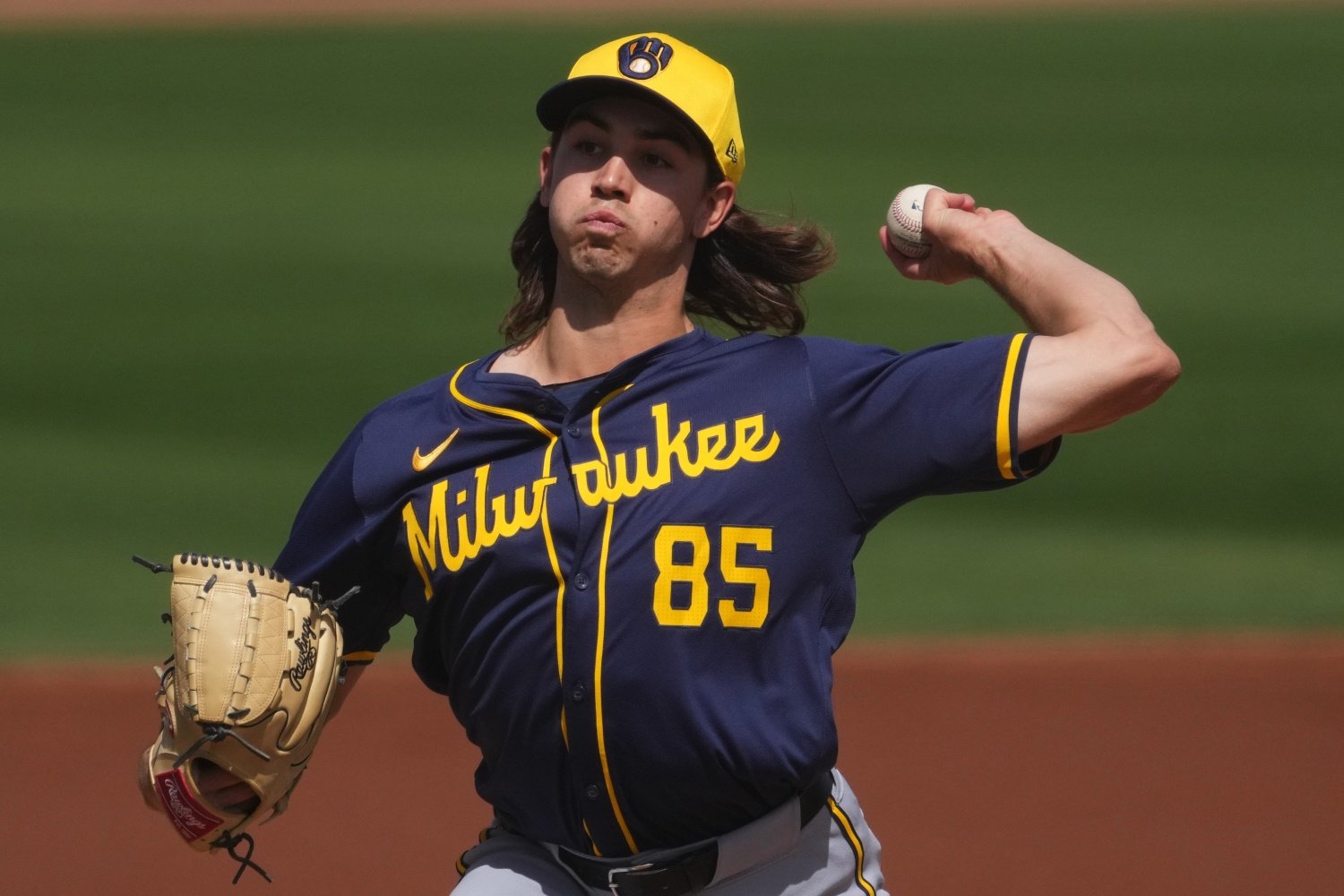
With their ace forced to wait an extra game for his turn in the rotation due to suspension, the Milwaukee Brewers are calling up their long-awaited southpaw starter prospect for an MLB debut.
Acquired in the infamous Josh Hader trade with San Diego, Robert Gasser was the 71st pick in the 2021 draft for the Padres. He rose quickly through the ranks in his year in their farm system before moving to Milwaukee, who pushed him aggressively to both Double-A and Triple-A ball. Spending the entirety of 2023 at the upper level of the minors, Robert Gasser won the International League Pitcher of the Year Award, with 166 strikeouts in 135 ⅓ innings of work and a 3.79 ERA in very hitter-friendly conditions.
The automatic ball-strike system (with an infamously tight zone) forced him to refine his command even further, and one could argue that had the Brewers suffered any further pitching injuries last season, he would have been the next man up. After an issue with bone spurs at the outset of the 2024 season, he’s built up his workload again, with some interesting improvements to boot. He will make his first start in the majors Friday night against the St Louis Cardinals.
His arsenal is that of a traditional starter, with a four-seamer, cutter and sinker as fastball variations, combined with a sweeper and changeup that provide a lot of different movement profiles. He isn’t a high-octane arm, but his mix of pitches has produced a 29% strikeout rate in Triple-A since the start of 2023, so perhaps we should take a more complex dive into his arsenal;
(As a side note, if you’re curious about any of the statistics mentioned here and what they might mean, I have written a biography of them here, which covers what they mean and what constitutes good or bad in the overall context of the league.)
Four-Seam Fastball
Robert Gasser’s most effective swing-and-miss fastball is his four-seamer, which (like most such offerings) works best when located up in the zone. With the pitch generating a 28% whiff rate since the start of 2023, Gasser is throwing it harder than ever so far this season, touching 96 mph and sitting a solid mile per hour higher than he managed in 2023. Combine this with strong movement characteristics from a lower-than-average arm slot, and he has a vertical approach angle (VAA) of -4.17° since the start of ‘23, which would be good enough for 11th in MLB over that period.
Despite this, he doesn’t generate a lot of induced vertical break, so it can be a hit-or-miss pitch in some ways, depending on location. Keeping it up in the strike zone will really let the pitch play up, but throwing it low in the zone will reduce his VAA and make him considerably more hittable--as you can see below, with how hitters slugged against him by location. Notice the damage comes when he drops into the middle of the strike zone or below:

If he can successfully command that fastball up, he’ll be very successful this season but it does rely heavily on being able to locate and take advantage of that vertical approach angle.
The Cutter
Throwing it primarily on the outer half of the plate for left-handed batters, or to get inside to right-handers, Gasser commands his cutter relatively well. However, it has shown a tendency to get hit hard in these areas. It has a traditional cutter’s profile, with minimal horizontal break, and is used to keep hitters off his four-seam heat. Unfortunately, the damage has been significant, with a .968 OPS against it since the beginning of ‘23, but it also has the best exit velocity numbers of any of his fastball variations, at just 85.9 mph on average. A big reason for this is how effective the pitch has been at the top of the strike zone (although he doesn’t use it up all that often) and a 31% line-drive rate.
The reason Gasser endeavors to force the cutter inside, despite some high-quality contact against it there, is that it’s been a good place for ground balls. He's been using the four-seamer for swings and misses and the cutter to try and get weaker contact in play. It hasn’t always worked out, and there may be tweaks to how his arsenal is used to get more out of the pitch, but in using it as such, it will also tunnel well with the fastball at the top of the strike zone.
Sinker
Gasser’s most lightly-used fastball variation, the sinker has a 51% ground-ball rate. This skyrockets to 64% when facing left-handers. It should, maybe, be confined to use against same-side hitters. He gets four more inches of vertical drop than the average MLB sinker, which is a big reason for the ground balls, and it works well at the bottom of the zone, allowing him to use differing fastballs to all locations. I think it shows some promise, with more work, and could potentially see more usage than the cutter as time goes on, but whether it gets more contact with that increased usage is something only time will tell.
Sweeper
Gasser’s sweeper has proved an almost unhittable pitch at the upper level of the minors, with five inches above the MLB average in horizontal break. With a 37% chase rate, the sweeper even induces right-handed hitters to swing over pitches that sweep far inside the strike zone, producing a ton of weak contact on top of a 35% whiff rate. When he throws it anywhere but right down the middle, the quality of contact on this pitch is startlingly low:
- Average EV - 83 mph
- Hard hit rate - 17%
- xFIP - 1.09
- Pop Up Rate - 24%
The pop-up rate may be surprising for a breaking pitch, but because Gasser sacrificed some vertical drop for more horizontal break, hitters have a tendency to get underneath the pitch and give up cheap outs. Overall, his quality of contact on the sweeper is phenomenal; he commands it well both inside and outside the strike zone; and it bears out in the background numbers with a LOT of blue:

All told, it's a very underrated pitch, and it's likely to be a big reason for his success in the big leagues throughout the rest of 2024.
Changeup
Gasser’s final offering, he uses the change almost exclusively to right-handed hitters; it performs about how you would expect. Front-dooring the pitch hasn't gone well for him, but when he can drop in on the outside corner to righties, it’s proved mightily effective:

Generating a strong ground-ball rate and again minimizing hard contact well, the changeup doesn’t generate a lot of swing-and-miss, so Gasser will be relying on his fielding unit to make the plays behind him. It has roughly league-average vertical drop, while producing 10” more horizontal movement, but his biggest issue is that the velocity differential from his fastball isn’t all that great, at just 6 mph on average. It also blends in quite closely with his sinker in terms of the movement he gets, which is a stark reminder of a strange principle. Very often, a pitcher's sinker and their change share a movement profile, but the firmer pitch works well against same-handed batters and the change of pace works against opposite-handed ones.
Gasser has five effective pitches with which he can bamboozle an offense, and has made strides with his command since May 2023 that leave little doubt as to his readiness to join the major-league rotation. He can go deeper into games, with a better track record of health and durability, than most of the Brewers' current rotation, and he provides an upgrade in quality at the back end of said rotation. It’s very likely that Gasser will stick in the big leagues. He could be a valuable addition to what is proving a surprisingly successful season for the Brewers. Everything here makes sense, and he'll be a fascinating watch for the rest of the season.
Best of Luck Robert!
Do you approve of the job Pat Murphy is doing as Brewers manager?

Follow Brewer Fanatic For Milwaukee Brewers News & Analysis



-
 1
1


Recommended Comments
Create an account or sign in to comment
You need to be a member in order to leave a comment
Create an account
Sign up for a new account in our community. It's easy!
Register a new accountSign in
Already have an account? Sign in here.
Sign In Now