

.thumb.png.97a48f5e988eb5cd844bab443feb771d.png)
Brewers Video
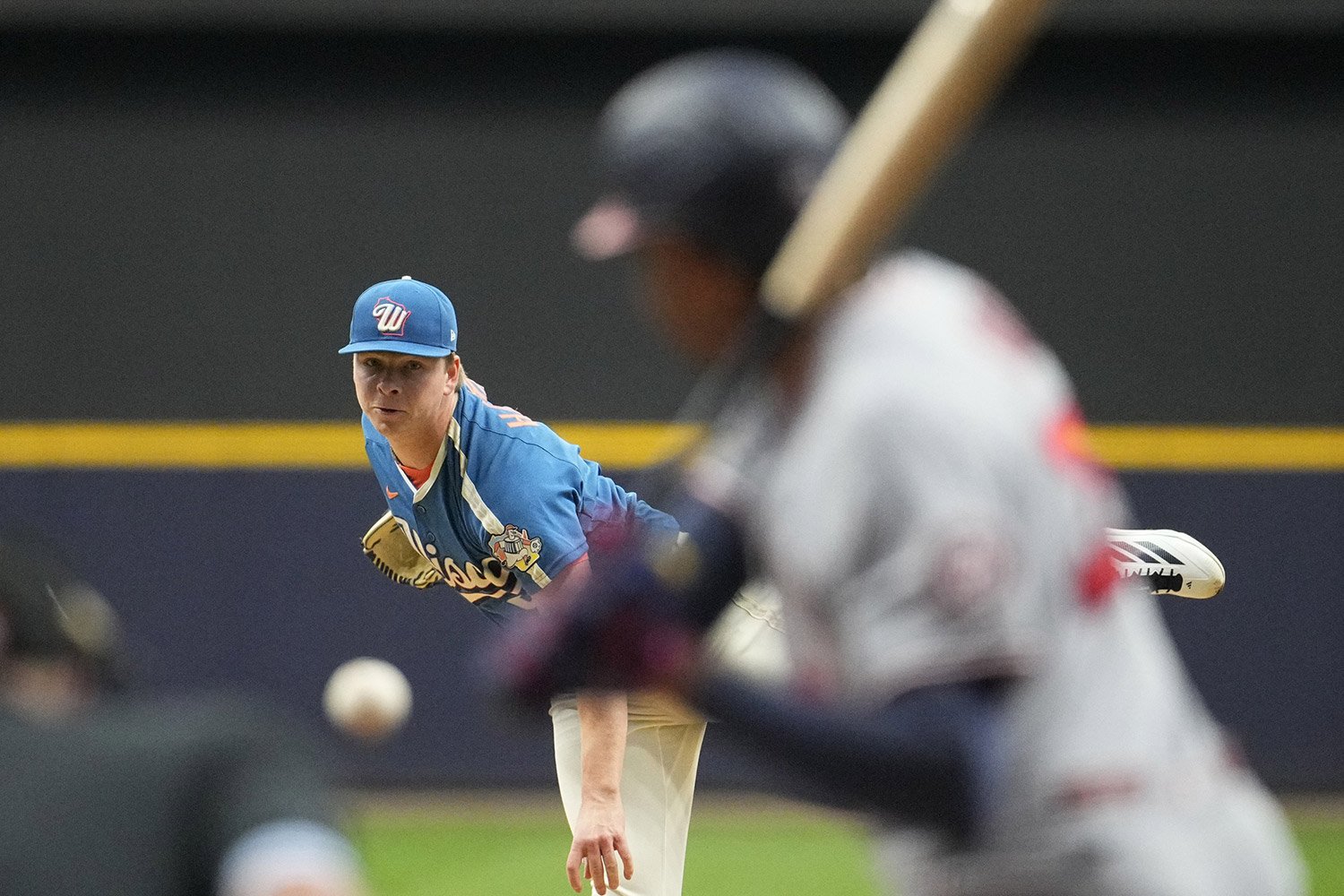
There was a moment, not too long ago, when Kyle Harrison seemed trapped between two different versions of himself.
The first was the electric prospect who tore through the minor leagues with a lively fastball and a natural ability to generate whiffs. The second was the young starter who arrived in the majors only to discover something nearly every young pitcher eventually learns the hard way: having stuff does not automatically mean knowing how to pitch.
Drafted into the San Francisco organization in the 2020 MLB Draft, Harrison could survive some nights simply by attacking hitters at the top of the zone and trusting his talent to handle the rest. But Major League Baseball rarely allows long careers built purely on electricity. Hitters learned to sit on the fastball, punish the slurve whenever it stayed up, and constantly force him to work from behind in the count.
The swing-and-miss ability was there, but not on consistent display. The strikeouts were there, too. But so was the damage. Too many home runs. Too many extended innings.
Now, in Milwaukee, something has changed. And the most important difference does not live only in the ERA or the strikeout totals. It lives in the rhythm of his starts. For the first time in his career, Harrison looks like a pitcher who understands exactly how he wants to attack a lineup.
The first seven starts of each season tell part of the story.
|
Team |
Span Started |
Span Ended |
W |
L |
GS |
IP |
ERA |
H |
R |
ER |
HR |
BB |
SO |
BF |
|
SFG |
22/8/2023 |
1/10/2023 |
1 |
1 |
7 |
34 ⅔ |
4.15 |
29 |
19 |
16 |
8 |
11 |
35 |
147 |
|
SFG |
29/3/2024 |
2/5/2024 |
2 |
1 |
7 |
38 |
3.79 |
39 |
16 |
16 |
5 |
10 |
38 |
159 |
|
SFG |
6/5/2025 |
4/6/2025 |
1 |
1 |
3 |
18 ⅔ |
4.34 |
17 |
9 |
9 |
2 |
7 |
19 |
79 |
|
MIL |
30/3/2026 |
9/5/2026 |
3 |
1 |
7 |
33 ⅔ |
2.41 |
28 |
9 |
9 |
3 |
13 |
41 |
140 |
The difference in what Harrison is accomplishing now is substantial: not only is Harrison allowing fewer flyballs to leave the park (8.8% in 2026, versus 10.3% in 2025 and 12.3% in 2024), but he's also allowing fewer flyballs (36.6% in 2026, versus 39.0% in 2025 and 40.3% in 2024). But even then, the real transformation appears once the at-bat starts getting complicated.
Just one year ago, falling behind in the count practically tilted the entire plate appearance toward the hitter. In 2025, opponents hit .414 against Harrison when he worked from behind, and once he lost leverage, the at-bat often unraveled quickly. Today, the story looks completely different. His first-pitch strike rate has jumped from 60.3% to 70%. Once he gets ahead, the direction of the matchup now tilts heavily in his favor in most situations.
|
Count Situation |
2025 AVG Allowed |
2026 AVG Allowed |
2025 K/9 |
2026 K/9 |
|
Behind in Count |
.414 |
.296 |
4.8 |
8.5 |
|
After 2-0 Count |
.333 |
.091 |
6.0 |
18.9 |
|
0-2 Counts |
.154 |
.087 |
14.2 |
20.7 |
That probably explains the most important part of his entire evolution: Harrison no longer looks like a pitcher surviving pitch by pitch. Now he looks like someone controlling the entire geometry of an at-bat.
Even after falling behind 2-0 — situations that once felt like automatic damage — Harrison continues finding ways to regain leverage. And when he gets ahead early, many plate appearances end before they ever fully develop. His first-pitch strike percentage has climbed to 70%, the best mark of his career, and that single detail completely changes the structure of a start. With leverage in counts, the new Harrison has generated 15.1% more chase on pitches outside the strike zone. Hitters are now missing on 16.5% of their swings, 7.1% more than in 2024.
For the first time in the majors, Harrison appears to be pitching that way. And that probably explains why his fastball and slurve have finally started working together.
For much of his time in San Francisco, both pitches almost existed independently from one another. The fastball had life, but not enough deception. The slurve showed depth, but also became vulnerable whenever it failed to finish its break. Eventually, hitters found the pattern and waited for mistakes.
In 2024, Harrison allowed 26 extra-base hits against his four-seam fastball: 15 doubles and 11 home runs. But that was not even the worst part. The .432 xSLG allowed was actually slightly higher than the real .425 slugging percentage. The damage was entirely legitimate.
Now the entire sequence looks different.
Harrison’s fastball is generating chase outside the zone like never before in his career. Two years ago, hitters chased his four-seamer only 22.7% of the time. In 2026, that number has exploded to 43.8%. And once a fastball begins generating that kind of uncomfortable decision-making, the entire arsenal changes around it. Especially the slurve.
The Evolution of Harrison’s Slurve
|
Year |
Run Value |
HR/FB |
IFFB% |
|
2025 |
-4.6 |
25% |
0–12% |
|
2026 |
3.8 |
0% |
55.60% |
The difference is not simply that the home runs disappeared. It is the type of contact he is producing now. Before, too many fly balls against Harrison ended up traveling into the seats. Now, many of them simply die in the air.
That detail sounds small until you understand what it really means: Harrison is not necessarily generating more ground balls or reinventing himself as a completely different pitcher. What he has done is transform dangerous fly balls into automatic outs. And that is often one of the biggest differences between a talented arm and a starter who can consistently work deep into games.
That is also where Milwaukee’s influence starts to appear.
Many young pitchers spend too much time insisting on mediocre pitches because they feel the need to prove they have depth in their arsenal. Harrison did the opposite. The cutter has completely disappeared this season. Milwaukee apparently understood that simplifying the arsenal carried far more value than continuing to add pieces to it.
Now everything feels connected around one central idea: attack early with the fastball and use the slurve to finish at-bats once the hitter has already lost comfort.
And perhaps that is the most interesting part of this entire evolution.
Kyle Harrison no longer looks like a prospect trying to prove how many pitches he owns. Now he looks like a pitcher who finally understands which pitches he actually needs to dominate in the major leagues.
The season is still young. Adjustments will come. There will be bad starts. Hitters will eventually respond. That always happens.
But the important change here does not feel accidental.
Because the difference no longer lives only in the ERA. It lives in the way innings unfold. It lives in how at-bats begin, belonging to him from the very first strike. It lives in the way talent has finally started coexisting with intention.
And when a 24-year-old left-hander finds that balance point, the ceiling stops feeling like a distant promise and starts looking dangerously real for the rest of the National League.
Do you approve of Brewers' ownership?

Follow Brewer Fanatic For Milwaukee Brewers News & Analysis



-
 2
2


Recommended Comments
Create an account or sign in to comment
You need to be a member in order to leave a comment
Create an account
Sign up for a new account in our community. It's easy!
Register a new accountSign in
Already have an account? Sign in here.
Sign In Now