


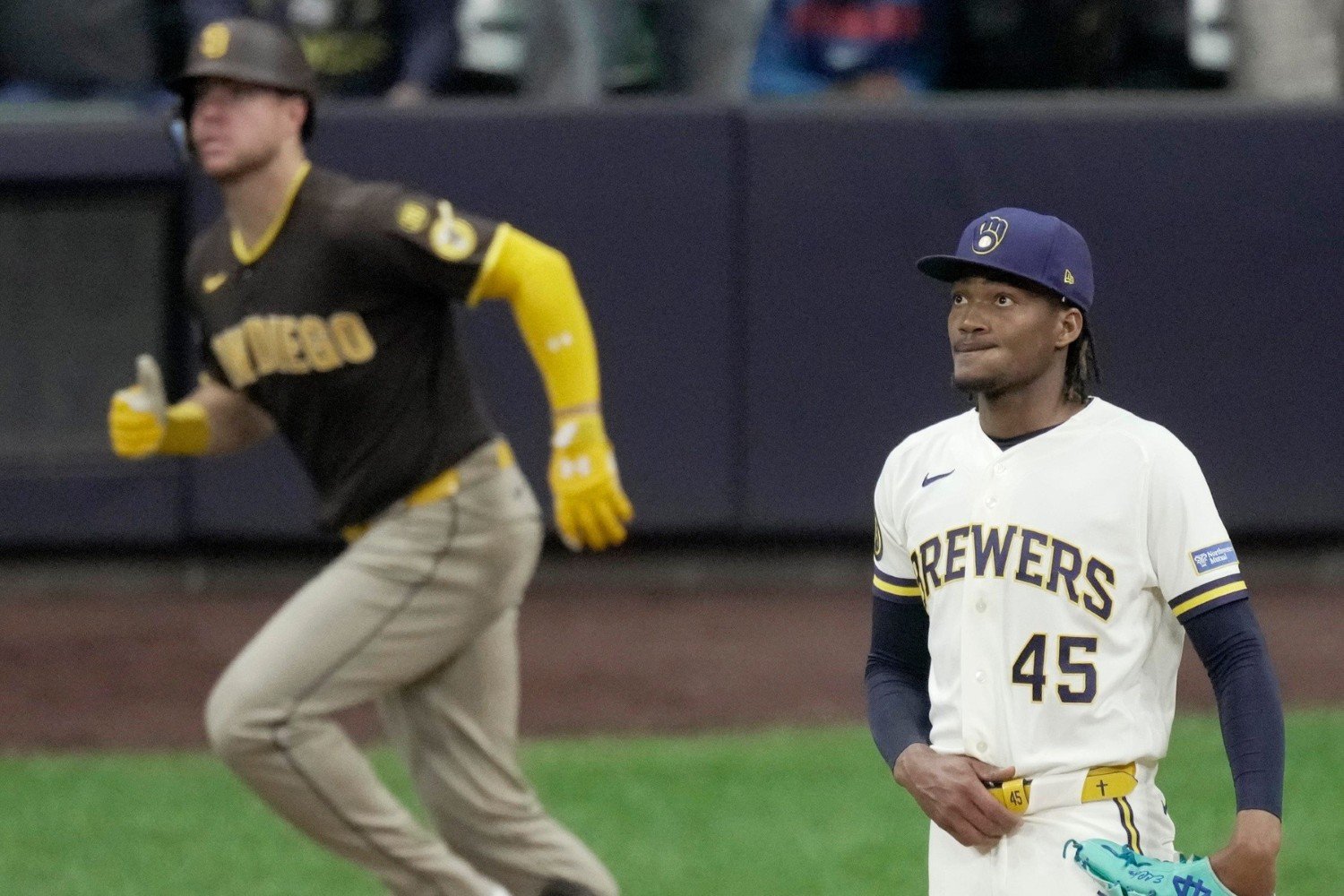
Brewers Video
It's always jarring to realize, after all the money spent finding elite athletes and turning them into optimized baseball machines, that their excellence remains so fragile. Tiny grains of sand can interfere with the vast, otherwise beautiful construction. There is no such thing as a small mistake.
That's the takeaway from the Brewers' loss Wednesday night against the Padres. An offense still trying to find its groove scored just one run, but Jacob Misiorowski and Aaron Ashby made that tally stand tall through eight frames. Abner Uribe came on to close out the win, but he simply didn't have it—and the problem all came down to a patch of dirt a few inches wide, at the front of the mound.
Here's what it looks like when Uribe executes his slider exactly as he intends to.
There's a ton of violence in Uribe's delivery, from the ground up. His arm works exceptionally quickly—he's what pitching coaches call "whippy". He gets much of the energy for that whiplike action from his long legs, though. He flies down the mound and spins off to the first-base side of it after he releases the ball; that's just how his body operates.
The intensity and immensity of his limbs in motion create deception for the batter, and are part of both why his stuff is so good and why hitters struggle against it so badly. Nothing comes without costs, though. Sometimes, moving that fast means a loss of stability or consistency. In Uribe's case, that chaos can be both productive and dangerous.
Here's a slight variation on the pitch above, from his appearance last night against the Padres.
Everything is almost the same, but Uribe lands slightly more closed with his left foot. He has to get around his front side a bit more, which flattens out the break on the pitch. He's also a hair early with his arm, which (in combination with the alteration in the landing spot) makes it easier for Xander Bogaerts to see that the ball will break out of the zone. This kind of variation from pitch to pitch is very much the norm, but its effects are no less real because everyone experiences them.
Here's another pitch from last night, with a better result for Uribe.
This one is a lot like the ball thrown to Bogaerts later in the inning, in that Uribe lands almost undetectably farther toward third base than when he snaps off his very best, two-plane sliders. This time, he's on time with the arm, which creates a pitch with lots of sweep and power—but it stays up. That works in Uribe's favor, rather than against him, because he locates well and the horizontal movement takes the pitch away from Fernando Tatis Jr.'s barrel.
Now, here's what trouble looks like.
I bet you thought that would be Gavin Sheets's home run. We'll get there. No, this pitch worked, in that it stole a strike for Uribe to start the at-bat. But he missed his landing spot by a bit more this time, and it carried his release point rightward. He couldn't get depth on the pitch, and this time, he couldn't steer it across the plate, either. Sheets was frozen, but not for long.
Same mechanical mistake—a small but noticeable change in stride direction that leads to a pitch with more carry. This one turns the corner just a little, horizontally, but it runs right into Sheets's bat. He had just seen the exact same pitch. He was ready for it.
Not all mistakes get punished. Not all of them even should be punished, by a smart and talented hitter. Some backup sliders are good pitches. They fool the hitter, because all that happens is that the pitcher slightly errs in the spin direction by releasing the pitch a tiny bit wrong. It's impossible to read that kind of mistake, and often, it's maddeningly hard to hit it.
However, when a pitcher puts a foot wrong—when the stride is a bit off, forcing a different arm path and/or throwing off the hurler's timing—it gets easier to spot and to attack the resulting meatball.
Here's where Uribe was at foot strike (the moment when the front foot first engages with the ground) on four of the pitches above.
.png.2e3647add9b8e440790075d5a63ee081.png)
On the left, we have the best version of a Uribe slider. His stride is direct, or slightly open. His hip-shoulder separation is huge, which gives the resulting pitch speed and snap and makes the hitter instinctively gear up for a fastball. The arm is on time; that's the position you want it in. Next, we have the Bogaerts pitch, on which you can just see the front foot having landed farther to the right and the arm being slightly early in coming around. Second from right, we see the pitch with which he beat Tatis: stride a little closed, but the arm on time, creating more of a sweeper and less of a depth-oriented slider than his usual but still making it hard for the same-handed batter.
Finally, at right, you see the pitch on which Sheets homered. The stride is slightly closed, but this time, the arm is also late. That results in a miss both high and arm-side, but because of the stride direction and its effects on his mechanics, it's more the former than the latter. If he'd been on time, he would have thrown a vicious pitch, perhaps down on the lower third of the outer edge for another called strike. If he'd been similarly late with the arm but strode more directly, he'd have produced a pitch that looked more like a mistake than the actual one did—but it would have been more deceptive to Sheets, who might well have whiffed on it like Jose Tena did in the final video above.
Pitches spun the way Uribe's was spinning are also more prone to backspin off the bat than better-executed ones. That's why mistake breaking balls often carry so well, and why Sheets's liner managed to stay up long enough to clear the wall in right-center field. It was a confluence of things that, had any of them not been true, would have resulted in a more manageable result for the Brewers. Unfortunately, success in this game is fragile, and Uribe's almost imperceptible mistakes turned into game-altering damage on Wednesday night.
Do you approve of the job Pat Murphy is doing as Brewers manager?

Follow Brewer Fanatic For Milwaukee Brewers News & Analysis



-
 1
1


Recommended Comments
There are no comments to display.
Create an account or sign in to comment
You need to be a member in order to leave a comment
Create an account
Sign up for a new account in our community. It's easy!
Register a new accountSign in
Already have an account? Sign in here.
Sign In Now