


Brewers Video
Brice Turang enters Thursday third among qualified second basemen with 2.4 fWAR. That’s also the 24th-best figure among all qualified players, at any position. Baseball Reference is even more bullish on his value, pegging him at 3.0 WAR less than halfway through the season.
Much has been made of the offensive transformation that, in tandem with Turang’s already elite defense, has turned him into a worthy All-Star candidate. His improved ability to reach base has also allowed him to take advantage of another top-tier skill that flew under the radar in his rookie year: baserunning.
According to FanGraphs, Turang has been the most valuable baserunner in baseball this year, accruing 5.5 baserunning runs above average. He has stolen 24 bases, second only to Cincinnati Reds speedster Elly De La Cruz. Dating back to last year, Turang was successful on 36 straight steal attempts, before being caught for the first and only time so far this year.
Turang’s average sprint speed of 29.2 feet per second makes him one of the fastest players in baseball. It takes more than speed to run the bases as effectively as he does, though. Exceptional awareness and the ability to get good jumps separate decent baserunners from the elite ones, and can sometimes make a slightly slower runner more valuable than his even speedier peers.
Turang has those additional qualities to supplement his speed. He’s also an informed baserunner.
“He takes a lot of pride in understanding what the situation is, and he takes a lot of pride in understanding and doing his preparation for the pitcher-catcher combination,” Pat Murphy said. “What their tendencies are and what they may have as tips or clues to what they do.”
“We have videos of basically everything,” Turang explained. “I go in there, me and [first base coach Quintin Berry] talk about it, watch the video, see if we can pick up on anything, and go play the game.”
Variables they study for each pitcher include his time to the plate, pickoff tendencies, and how he sequences pitches. That information helps Turang perfect his jumps and pick the best times to run. It’s a complicated puzzle to piece together, and the weight of each element varies depending on the matchup or situation. For pitchers who hold runners well, following along with pickoffs and sequencing is crucial.
“Some guys won’t pick over. Some guys pick over on the first pitch, some guys pick over on the third. Everybody’s different," Turang said.
“If a guy’s down in the count, he’ll maybe try to get back into the count with fastballs, or if he gets ahead in the count, he’ll want to throw some breakers to try to get [the batter]. You play that game, and you can guess wrong. We don’t know exactly what he’s throwing. I don’t want to run and the pitch be fastball up in the zone and get thrown out.”
Berry is an invaluable resource for Turang in identifying and processing data in the video room and on the field. A veteran of five MLB seasons, Berry made a career as a late-season baserunning specialist when teams were still allowed to expand their active roster to 40 players during the final month of the regular season. That experience made for a natural transition to his current role as Milwaukee’s first base coach and baserunning guru.
“He helps me a ton,” Turang said. “Every pitch, he’s in my ear talking. And I’ll let him know if I think something or if I’m not seeing what he’s seeing. Sometimes he says, ‘Hey, good time to throw a fastball up, don’t run,’ or, ‘Hey, good time to throw a curveball, just a heads up.’ Sometimes he’s just there, like, ‘Hey, relax, dude, you’re too tense. Just relax.’”
Stealing second base moves Turang into scoring position. Stealing third positions him to score on a flyout or groundout. Brewers personnel argue he's adding value even before he runs by influencing opposing pitchers with the mere threat of a steal.
“He’s a big part of our offense because the pitches that he gets the next guy, that's what I think is big,” Murphy said. “Because when he’s on base, that pitcher is focused over there [on the runner].”
“Sometimes I get there and the pitcher who’s usually a 1.6 [seconds to home] is now a 1.3,” Turang said. “So he’s now speeding up to make sure that I’m not running, but that’s going to leave pitches for whoever’s hitting to hit. They’re going to throw fastballs because they’re trying to throw me out.”
It’s a challenging effect to quantify, but rudimentary research indicates that it’s more of a potential benefit than a consistently realized one. Brewers hitters are not seeing more fastballs or pitches classified by Statcast as being over the heart of the plate with Turang on first base. The splits are similar after limiting the pool of hitters to William Contreras and Christian Yelich, the duo who bat behind Turang the most, and looking exclusively at pitches thrown with fewer than two outs (a stolen base threat becomes less relevant when the pitcher can escape the inning by retiring the hitter).

Still, the value of Turang’s baserunning reverberates throughout the Brewers’ offense. He’s been part of a balanced run-scoring recipe by stealing and taking extra bases on balls in play.
“Turning a single into a double, running hard, or a ball hitting a gap that you’re scoring on that people usually don’t score on, or running first to third. Taking that extra base is so big in this game,” he said. “Just putting yourself in situations to score on a base hit or a sac fly, that’s what I think is so important.”
Turang did just that on the last road trip. With the Brewers trailing the Detroit Tigers by two runs in the fourth inning, Turang tagged from second to third on a Christian Yelich sac fly to left field. He scored on a Willy Adames groundout a few pitches later to make it a one-run game. That positioned Jackson Chourio’s go-ahead double in the sixth to serve as the game-winning run in a 5-4 win.
Many runners would have remained at second and been left stranded. Turang knew the situation, observed the play as it unfolded, and moved up a crucial 90 feet.
“You’re trying to advance. I’m watching the throw. If the throw is high, I’m going. If he’s trying to make the play at home, I’m going to go. If he throws it low, I can’t go because if he catches it, I’m out at third. He threw it high, so I took off running.”
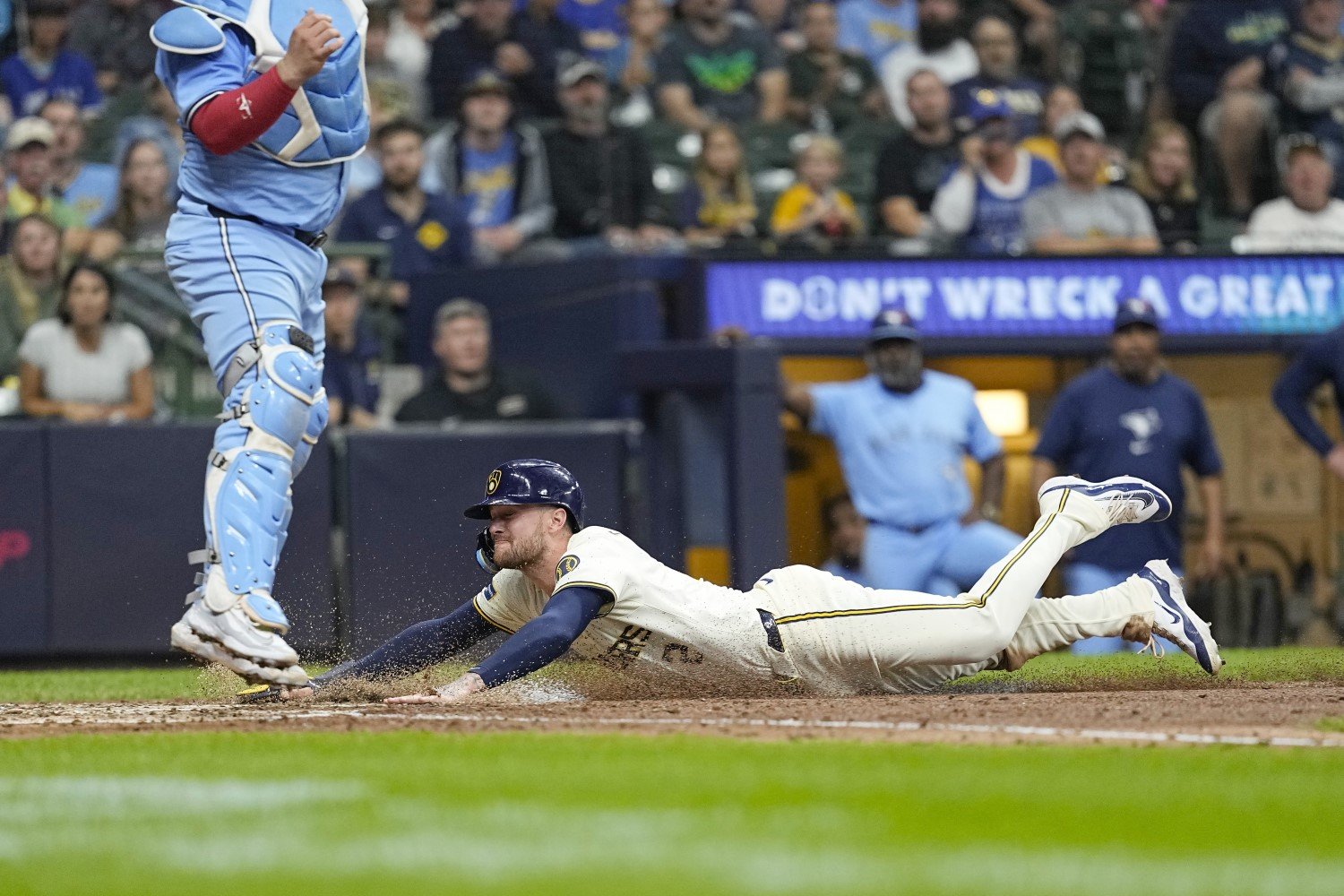
Turang’s baserunning helped create a big run again on Wednesday against the Blue Jays.
Trailing 1-0 in the sixth inning with runners on the corners, the Brewers called for a double steal with Turang and Blake Perkins. Turang took off for second, and Perkins broke for home once the throw went down. It skipped into center field, ensuring that Perkins scored and allowing Turang to advance to third.
The play tied the game and released the floodgates for a struggling Brewers offense, which scored four more runs in the inning en route to a win in the series finale.
“Sometimes you try to create something,” Murphy said of the play. “Sometimes we have it in our bag to be able to do that.”
Turang’s ability, preparedness, and awareness on the bases are valuable tools in that bag. His summary of the tag-up play in Detroit also encapsulates the approach he and many of his teammates employ to score runs.
“It’s all about trying to get to the next base.”
Do you approve of the job Pat Murphy is doing as Brewers manager?

Follow Brewer Fanatic For Milwaukee Brewers News & Analysis



-
 1
1
-
 1
1


Recommended Comments
Create an account or sign in to comment
You need to be a member in order to leave a comment
Create an account
Sign up for a new account in our community. It's easy!
Register a new accountSign in
Already have an account? Sign in here.
Sign In Now