


Brewers Video
Imagine that you're a lineup tasked with facing Freddy Peralta on a given day. In addition to the sheer nastiness of Peralta's stuff, you have some tough extra layers with which to contend. Peralta has an increasingly robust four-pitch mix, but he also has a unique release point, with terrific extension and a low slot. He releases the ball more than two and a half feet wide of the center of the rubber, and less than five feet above the ground, on a regular basis.
Eventually, of course, Peralta comes out of the game. You might have the good fortune to chase him, as the Pirates did Thursday. More often, he twirls six or seven brilliant innings. Either way, though, as soon as you get into the bullpen, you have a very different (but equally uncomfortable) set of problems to try to solve. Imagine, for example, that Hoby Milner comes in to relieve Peralta, as he did Thursday. Milner has an even lower, even wider release point, with roughly equal extension, and it comes from the other side of the mound. Good luck.
If Milner is down for the day, though, you're not getting any kind of reprieve. Bryan Hudson, despite being gigantic, throws from almost as low a point as Milner, and almost as far toward first base. He has even better extension than either Milner or Peralta, and throws harder than the former, with a four-seamer as his primary fastball instead of the sinker.
Maybe you get extra unlucky, and see both Milner and Hudson, with Abner Uribe breaking them up. There's nothing especially unusual about Uribe's arm slot, but because he works from the first-base side of the rubber, his average release point is about two full feet farther toward first base than Peralta's. That, plus, he throws 100 miles per hour. So you get Peralta, then Milner, then Uribe, then Hudson.
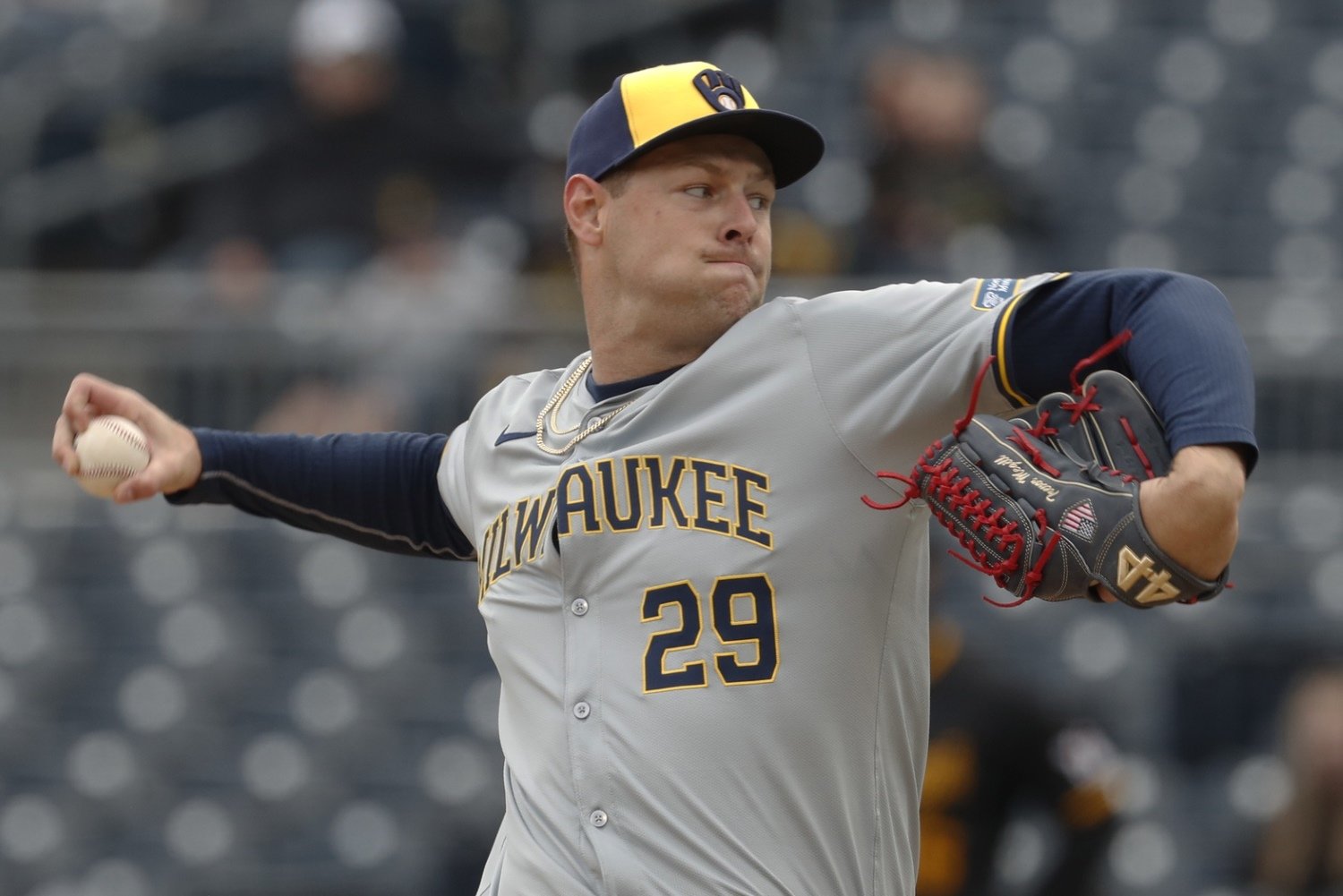
Did you extend the game long enough to make it matter who's next in line? Great. Congratulations. Now comes Trevor Megill, whose release point has migrated even farther toward first base this year, relative even to where he finished last year.

His release point is almost perfectly in line with the center of the rubber, and it's about two and a half feet higher than those of Peralta, Milner, or Hudson. He throws 100, like Uribe, but the shape of that heat is drastically different than Uribe's. Uribe pairs his sinker with a big sweeper, but Megill's new innovation this year has just been to add an even harder, tighter breaking ball (a true slider) to the knuckle curve he used in concert with his rising four-seamer late in 2023.

Without delving at all into the singularly heavy sinker of Elvis Peguero or the herky-jerky left-handed stuff of Jared Koenig, we've begun to capture why teams have such a hard time with the Brewers. The team doesn't have a corps with stuff any more intense, on average, than that of the rest of the league. They're not leading the way in strikeouts or showing the best control in baseball.
They are, however, holding opposing offenses to some of the lowest average exit velocities in baseball, and getting plenty of grounders. They're doing it by forcing hitters to reset and recalibrate their eyes almost every time through the order. They're doing it with an extremely deep roster of guys who offer extreme looks.
This is quantifiable, to some extent. There are five teams who haven't had a single pitch thrown this year more than 30 inches (in either direction) from the horizontal center of the rubber, and with a vertical release height south of five feet. There are three more who have thrown fewer than 10 such pitches as a team. The Brewers have thrown 307 such pitches, all by Peralta, Milner, and Hudson, which is easily the most in baseball. Meanwhile, only the White Sox and Rays have thrown more pitches from at least six and a half feet off the ground and within 10 inches of the center of the rubber than have the Brewers (with all theirs coming from Megill).
It's harder to show numerically how having these hurlers as anchors of the pitching staff makes normal arm actions and release points (like those of Joel Payamps and Colin Rea) deceptive in their own right, but that's another aspect of the conversation. They just keep adding to pitchers' arsenals, and increasing the variety in the angles and shapes they show hitters. It's a tough way to dominate, but the Crew have proved they have a real and sustainable sense of how to do it.
Do you approve of the job the Brewers' front office is doing?

Follow Brewer Fanatic For Milwaukee Brewers News & Analysis



-
 3
3


Recommended Comments
There are no comments to display.
Create an account or sign in to comment
You need to be a member in order to leave a comment
Create an account
Sign up for a new account in our community. It's easy!
Register a new accountSign in
Already have an account? Sign in here.
Sign In Now