


Brewers Video
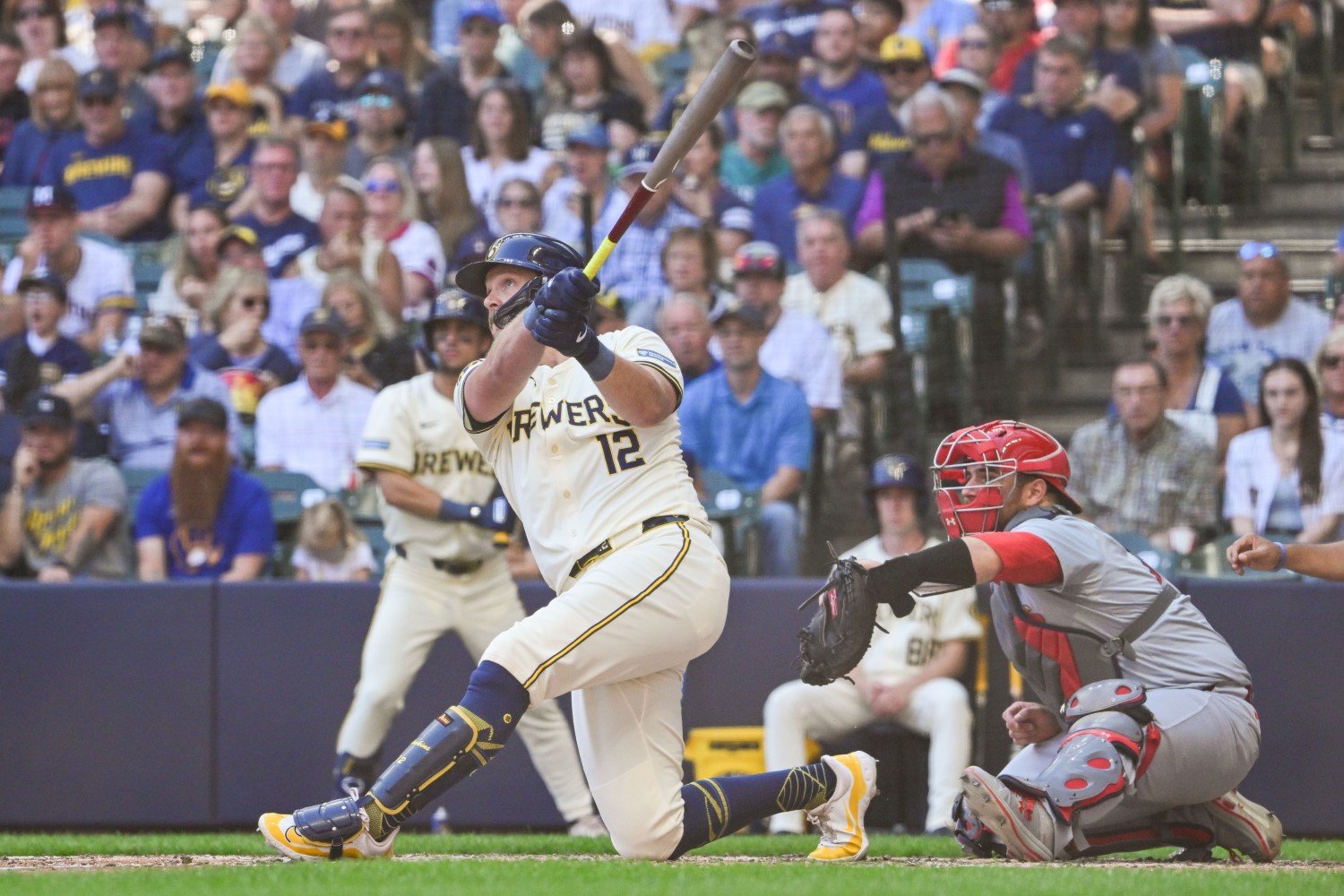
The slugger hit just .189/.260/.344 in August, completely unable to square up the ball for long stretches. Even his “hot” July showed some considerable regress under the surface. Can the Brewers fix him before the playoffs?
For a hitter like Rhys Hoskins, who features a lot of power to the shorter fields on his pull side, expected statistics aren’t an ideal measurement of his prowess. However, compare him to his own production month-to-month (rather than league averages), and a very stark trend begins to show: Hoskins has just not squared the ball up with any consistency since coming back from the IL. Two key metrics for the quality of contact and output by Hoskins are his expected weighted on-base average and his expected slugging marks, both of which show a considerable decrease since his hamstring injury.

Hoskins is never going to hit for a high average. He's too slow, and he whiffs too much. No matter where or how hard it’s hit, Hoskins has almost no chance of legging out a single on a ball that's nabbed by an infielder. In addition to that, even balls pounded into a gap don’t guarantee him a double. Factoring in the amount of swing and miss and strikeouts in his game, in order to bring value, Hoskins has to be either walking a lot or crushing the ball when the pitcher errs.
These two can go hand-in-hand, in that if pitchers feel a hitter can hurt them, they’re more likely to nibble, and the likelihood of a walk rises. The freefall Hoskins has been in, however, has led them to be aggressive in the zone, especially attacking some gaping holes in his swing. As you can see in the table above, his xWOBA and his expected slugging have been in a sharp decline since he returned in June. This emphasizes just how fortunate the surface numbers in July were.
He’s a far cry from the Hoskins we saw pre-injury, with the high walk rates and slugging rates, so what’s changed?
Well, first off, Hoskins's long swing and modest bat speed require a very strong eye at the plate. He needs to recognize pitches much earlier than most hitters, to make high-quality contact. It’s a big reason why he talks a lot about swing decisions when things are going well for him, and also why he can chase some ludicrous pitches on occasion. I’d like to take things a little further in terms of the quality of his swing decisions and suggest he’s become a little too swing-happy, especially in areas where he struggles to create quality contact:

Hoskins has an xWOBA of just .142 in 2024 when swinging down and away in the zone, yet he’s swinging 10 percentage points more often in this zone than he was earlier in the year. You might ask whether this is a factor of good sequencing, and him being forced to swing in two-strike counts. Instead, when you strip out those situations, the disparity grows. In April and May, he swung in that zone just 30% of the time with zero or one strike, whereas since the return in June, that number has skyrocketed to 52%.
His swing doesn’t have a lot of adjustability, and he struggles to even stretch the barrel of the bat to cover this zone--which makes it all the more perplexing how often he’s swinging at these pitches. Combine that with the heavy slider usage to that down-and-away location, a pitch Hoskins has a measly .313 OPS against from the start of June, and it begins to explain some of the issues he's had in recent months. In this three-month period, against the slider, Hoskins has one bloop double down the left-field line and one warning track flyball out to show any sign of pop.
His bat speed has stayed consistent throughout the year, if not a little faster since returning from injury so it seems like the hamstring injury hasn’t affected him in this particular way. It has seemed to affect his comfort at the plate more, with a far less confident and patient approach.
Although I’ve dumped a little on his July numbers belying some of the underlying numbers, there’s a clear pattern in terms of his approach, and it feeds into his struggles down and away. One thing you pretty much can’t do with that pitch is attempt to pull it, and yet, look at Hoskins's trends on a month-by-month basis:

His best three months (ignoring March, for sample size reasons) have all come with comfort hitting to the opposite field. June and August, on the other hand, have been about as pull-heavy as you’ll see from any hitter. He has the raw power to torch balls out to center field, unlike the mold of an Isaac Paredes, and it should allow him to find the barrel with more consistency against all pitches. Perhaps that will play a big factor in whether he can rekindle some of his early-season heroics down the stretch. One thing’s for sure, the Brewers with a fully firing Rhys Hoskins are a truly fearsome lineup.
What do you think of Hoskins's struggles? Can you see a quick fix? Let us know your thoughts in the comments below!





Recommended Comments
Create an account or sign in to comment
You need to be a member in order to leave a comment
Create an account
Sign up for a new account in our community. It's easy!
Register a new accountSign in
Already have an account? Sign in here.
Sign In Now