


Brewers Video
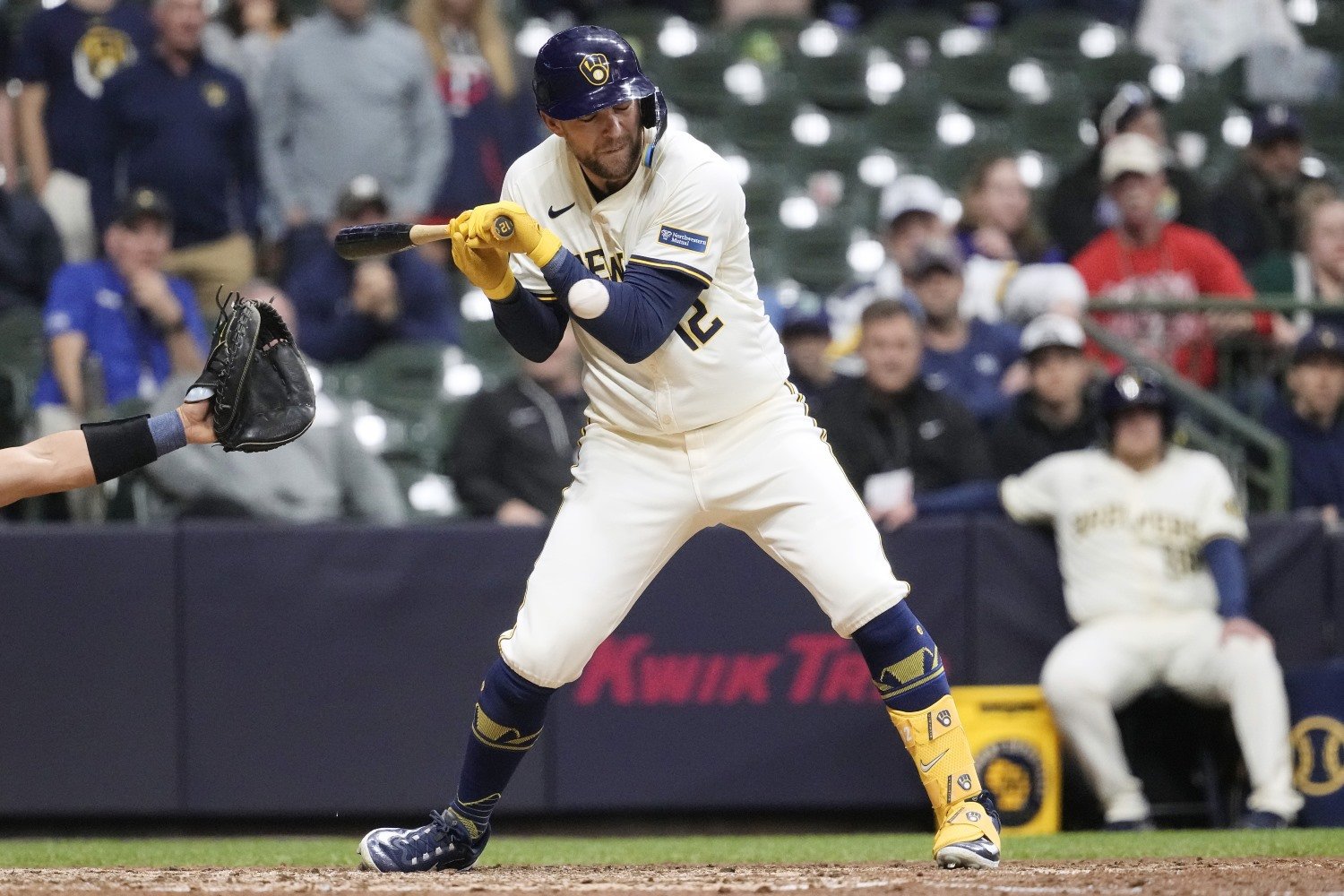
Tuesday night saw Milwaukee Brewers slugger Rhys Hoskins hit his seventh home run of the young season. That's the main reason why the team wanted the erstwhile Phillies first baseman, but he also derives considerable value from his plate discipline--even in a way you would never expect.
This statement will sound preposterous at first. Hear me out, though: Rhys Hoskins is one of the best pitch-framers among big-league hitters.
For many fans, the very existence of pitch framing is anathema. The ability of some catchers to frame pitches and earn their batterymate more called strikes than others would has been part of the conversation about that position for 50 years, and the first efforts to loosely quantify it go back 35 or 40 years, but since it was first comprehensively quantified using PITCHf/x data almost 15 years ago, framing has become controversial.
First, many fans were dubious that the skill existed. Some persist in that disbelief, even though the reality of the effects involved has now been exhaustively demonstrated. More common now, though, is the lament that framing is nothing more than evidence of the brokenness of the game--that deceiving umpires shouldn't be a valuable skill, and that we need to hurry up and automate the strike zone.
I deeply and fundamentally disagree with those assertions. Principally, I would note that every other sport has situations in which the players involved are trying to make a play, and in which the judgment of the official is required to determine whether they were in bounds (physically or legislatively) or not. Catcher framing only comes into play when a hitter decides not to swing. Once that happens, it's not clear to me what's wrong with catchers doing their best to earn a called strike and take advantage of their opponent's passivity.
This article isn't about that, though. It's about the other interactions that shape the strike zone within a plate appearance. About a decade ago, Baseball Prospectus (where some of the first and best catcher framing data appeared) rolled out research demonstrating that pitchers, too, play a role in earning extra strikes on the edges when a hitter doesn't swing, independent of their catchers. That's not that surprising, but it was interesting. Pitchers aim for the edges of the zone most of the time, anyway, but those who can hit their spots in a more accurate way (or whose delivery or pitch movement is especially funky or deceptive) can induce an umpire to stretch those edges a bit. Unskilled hurlers, like unskilled catchers, can lose a lot of should-be strikes, too.
Hitters, however, never got the same treatment. That's strange, because the most influential decision-maker in shaping the zone isn't the pitcher, the catcher, or the umpire. It's the guy who decides when to swing, and thus, whether the catcher or umpire get any say in the matter at all. Obviously, we capture the value of those decisions in different ways, when we track and evaluate swing rates both inside and outside the zone. We see and value their strikeout rates, their walk rates, and their batted-ball profiles, all of which are influenced by their swing decisions.
Those swing decisions do even more than all that, though. They (in combination, perhaps, with a few other things) exert an influence over the likelihood of a strike being called on the fringe of the zone. That has value to a hitter (be it positive or negative), just as it does to a pitcher and a catcher. The pertinent questions are whether the hitter's share of that value is significant, and whether or not there's an underlying skill driving that value in one direction or the other.
To the first question, the answer is yes. Batters' framing value is pretty small; no batter is worth even 10 runs a year based on their "framing". It does exist, though, and it's non-negligible. Here are the guys who have gotten the most value from framing (using a count-sensitive framework, because unlike a hypothetical umpire who should be impartially calling every pitch like it's 0-0, a batter makes their swing decisions based heavily on the count) since the start of 2022.
| Player | CSFRAA | Player | CSFRAA |
| Ryan McMahon | 14.9 | Ian Happ | 9.3 |
| Ha-Seong Kim | 10.2 | Alex Verdugo | 9.2 |
| Ronald Acuña Jr. | 9.7 | Shohei Ohtani | 8.6 |
For the very ends of the scale, then, "framing" can earn or cost a hitter five or six runs per season. As it turns out, the Brewers have a player who occupies that territory: Rhys Hoskins, who's 12th on the MLB leaderboard for "framing" runs since the start of 2022 despite missing all of 2023. Hoskins has earned 6.6 runs via batter framing effects.
The answer to the second question also turns out to be yes, although as you'd expect, it's not a skill without noise or complicating factors. I first checked whether a player's first-half count-sensitive "framing" runs above average (CSFRAA) was any good at predicting their second-half number.

There's certainly a relationship here, but it's not a strong correlation. I then turned to full-season samples, seeking to find out whether a player's 2022 CSFRAA would predict their 2023 figure with those larger samples and a bunch of changes taking place between the two seasons.

Same song, different verse. The correlation between one year's CSFRAA at bat and the same number for the next year is about as strong as that between a player's fly-ball rate in one season and the same number the year after. It's a small effect, and there are certainly things a hitter controls more tightly, but the skill exists.
The next, most interesting question is: How? With catchers, we can point to tangible movements--the mechanics they use to catch the ball--as important factors in gaining or losing strikes. With hitters, it's different. They don't avoid called strikes with good body language, or with some subtle move of their bat or body. They do it, mostly, through indirect means.
Over the 20-plus years since QuesTec was installed to let the league objectively study and evaluate umpires, the strike zone has changed size, then shape. Quickly, that system proved that umpires weren't calling enough strikes, so the zone had to grow a bit in the first half of the first decade of this century.

Back then, though, the zone was a shorter, wider thing than it is now. Even a decade ago, it had loose lateral edges. Pitchers and catchers were routinely able to move the ball off the plate and earn favorable calls, but umpires wary of calling the high strike often cut off the zone too low. Here's the league's strike zone, as of 2008.

And here's the zone with which the league played in 2014.

With each passing year, umpires get more accurate. That means a cleaner, more consistent zone, and it tends to mean a little bit more in the way of high and low strikes, and a little bit less wiggle room on the corners.

So, how does a hitter best rack up framing value, given the modern zone? Firstly, they should have the ability to cover the zone from top to bottom well. The cold zones, where a pitcher might seek an advantage over the hitter, should be on the edges of the plate, with horizontal movement involved. A hitter who is disciplined and capable of owning the zone vertically forces a pitcher to work in a space where their catcher can't as readily increase their margin for error.
A good hitter-framer should also protect the plate well. That means swinging at more pitches on the edges of the zone, when the situation demands it. It's not just about covering multiple pitch types in multiple areas of the zone; it's also about strike-zone judgment from inside the batter's box. There are both patient and aggressive hitters who rate well in "framing" runs, but guys like Hoskins (who doesn't swing much and is good at telling balls from strikes) have an edge. Power is also a factor. Pitchers will nibble when they face hitters who can punish them for letting the ball meander over the middle of the plate. When that happens, they'll miss further out of the zone, and the risk of getting a bad call against the batter drops.
TruMedia has a model that estimates the probability of a given pitch being called a strike, based on its characteristics and location. This season, of the 257 batters with at least 80 plate appearances, only 15 have yet to have a true ball (with a called-strike probability under 25%) called a strike on them. Hoskins is one of those 15. Among that group, he's also the only player with 10 true strikes (called-strike probability over 75%) called a ball against him.
That's the last way a hitter can rack up framing value. If (when the count allows one to do it without giving away an at-bat) a hitter lays off pitches just inside the zone, but which they know they won't be able to hit hard, they give themselves a chance to get a bad call in their own favor. Hoskins is good at that, as are hitters like Trent Grisham and Anthony Rizzo. Not swinging at strikes is rarely a good strategy, but just as a mishit single can reward the occasional flail by an undisciplined hitter on a ball in the dirt, a missed call can bail out a hitter whom a pitcher had beaten with an unexpected pitch in the zone.
Hitter framing is a weird concept. Baseball is a weird sport. May we never get robot umpires; I want to see Hoskins continue to derive a small advantage over other hitters because of his ability to manipulate the strike zone.
Which team do you dislike the most in the NL Central?

Follow Brewer Fanatic For Milwaukee Brewers News & Analysis



-
 1
1


Recommended Comments
Create an account or sign in to comment
You need to be a member in order to leave a comment
Create an account
Sign up for a new account in our community. It's easy!
Register a new accountSign in
Already have an account? Sign in here.
Sign In Now