


Brewers Video
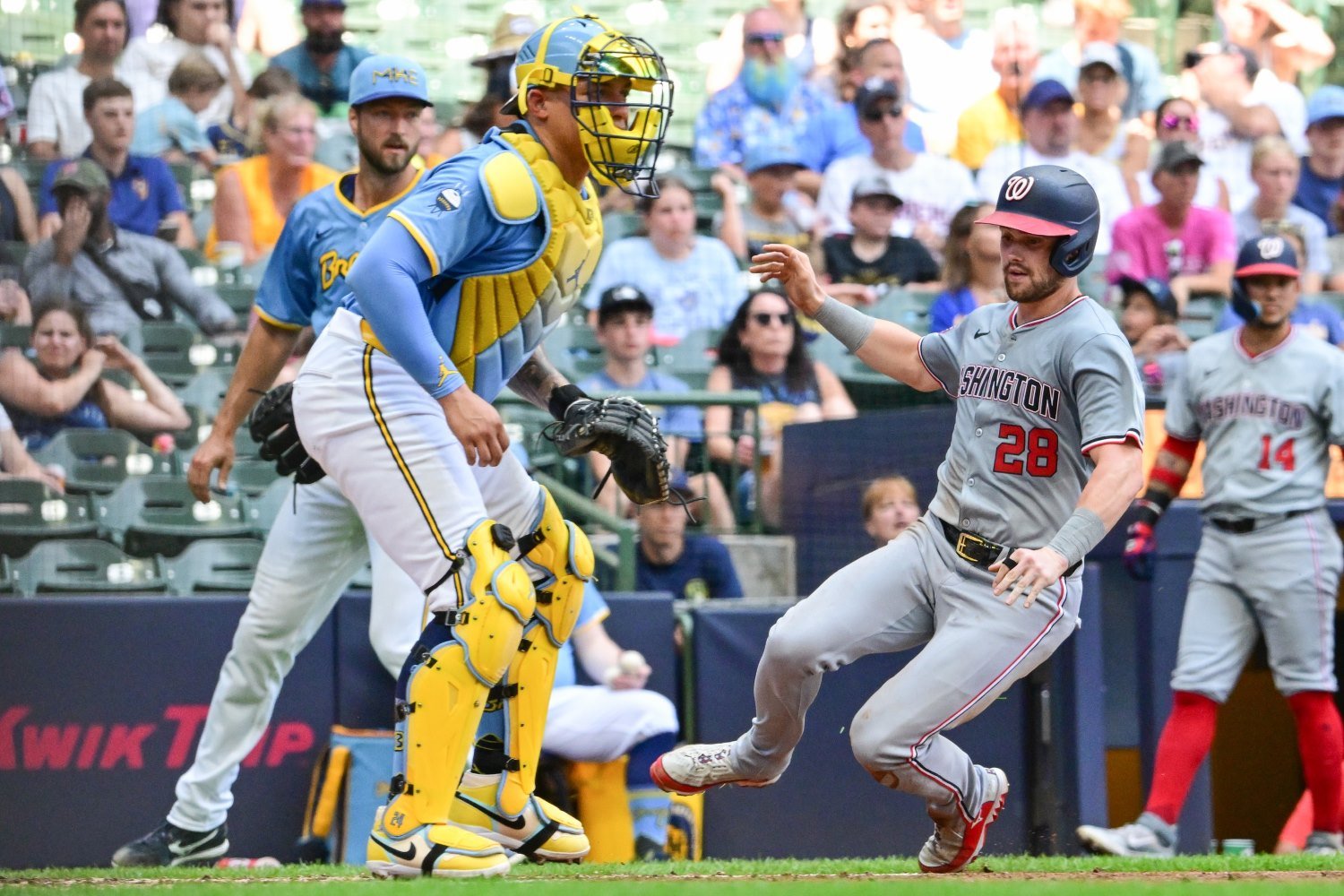
Let's set the stage. In the bottom of the eighth inning Saturday evening, the Brewers clung to a 1-0 lead over the Twins, but the speedy Willi Castro stood at third base, and there was just one out. Castro had doubled, then moved up on a wild pitch by Elvis Peguero. That forced the Brewers infield to come up and play on the edge of the grass. Pinch-hitter Diego A. Castillo hit a grounder that took Brice Turang slightly to his right, and though Turang threw quick and hard, it wasn't quite on the money.
"The key—we practice it every day, as infielders—infield in, the key is an accurate throw on [the third-base, forehand] side," Murphy explained, miming the easy receiving action on a ball that would have led William Contreras right into a tag of Castro. "Turang’s throw put him on [the backhand] side."
That wasn't what caught Murphy's attention most, though. He understands that Turang had very little time to cleanly field and release the ball, and perfect throws under such circumstances are too much to ask. When asked about the way Contreras caught the ball and attempted to tag Castro, Murphy went into the finer details of the play from the catcher's perspective.
"You shift your body, and let the ball travel and tag down," Murphy said, describing how he believes the play is best and most properly made. "Hard to do."
Instead of that, Contreras did what virtually every catcher does on similar plays, be it on long relays from the gaps or on those quick 100-foot throws with absolutely no time to spare: set up in front of home, go snatch the ball, then try to turn, lunge, and sweep the tag onto the runner before they find the back corner. Over the last decade and a half, especially, there have been new emphases placed on letting throws carry deeper and catching them late, in order to apply quick tags. It's now the conventional wisdom, and the state of the art of the tag on steal attempts at second or third base. Not so at home, though. Does Murphy believe it's even possible for catchers to shoot up out of their crouch, get themselves in an adjustable position, and receive throws that way, with a catcher's mitt instead of a shortstop's glove?
"That’s what you have to do. You have to get out there and you become an infielder," he said. "Same with receiving that short hop [on throws in from the outfield]. There’s nothing wrong with waiting, waiting, waiting. You’re down low, you’re at eye level with it, you see it’s gonna be a bad hop, you can open up and take it back here. just like an infielder would, come back to tag—instead of trying to go out and get it, now the catch, and now the time it takes to bring your hand back. Just open up, BOP!, boom; straight down.
"Yeah, you become an infielder. Big pet peeve of mine. Little-known."
In other words, Murphy not only believes catchers can start orienting their bodies and making more efficient tag plays, but that they must--and he has conviction about the right way to do it. He wasn't singling out his own player, though. As he well knows, you can count the number of backstops who make that play that way on one hand--and you might not need to take off your own mitt to do it.
"But it is where the game’s going. It has to go there," Murphy said. "Super, super huge pet peeve of mine. Not catching the ball at home plate. Whatever it takes to catch the ball, that’s the only way there’s going to be an out recorded. So it is the first priority. [If] I can't short-hop it, try to pick it, whatever. That’s all fine, but if it takes your hand out away from your body, then you’ve gotta come back with the tag. It doesn’t make any sense. You’ve gotta take it deep, and go straight and direct with the tag."
There are, of course, two more major hurdles we must mention to a catcher playing the plate the same way a middle infielder plays the bag on a tag play. The first is the most obvious: the rules governing blocking the plate. That most catchers set up a yard in front of the dish on these types of plays is not a coincidence, but the product of the so-called Buster Posey rule. The unfortunate unintended consequence of that well-intentioned rule has been for some runners who were plainly destined to be out to be ruled safe because the catcher never gave them a lane to reach the plate without obstruction. It's possible to provide that lane even while having the front edge of the plate covered by a cleat, but in practice, players don't want to risk it. The frustration of a key run scoring on a technicality is so great that catchers try to avoid it even to the point of letting a runner beat a play on which they could have had an out.
The second reason is also rule-related, but not as visibly--and again, partially because of the mental blocks that creep in and shape our decision-making, even when they shouldn't. A runner sliding into second or third base has to hold that base, so while first contact is to be denied to him whenever possible, a fielder setting up to receive a throw will always try to position themselves so they can apply a strong tag and keep it there. The runner might very well pop off the base, especially if the fielder's position already forced them to aim for an edge of it.
At home, the moment the runner touches the rubber of the dish, the play is over. There are no second chances, and again, the stakes are higher than on the opposite corner of the diamond. Catchers know they have to have the tag down before the runner touches the base--and they probably overestimate the extent to which being in front of the plate and getting the ball earlier permits them to do that. In fact, as Murphy wants to make his charges understand, doing so hurts their chances.
How far off is Murphy's vision of a glorious defensive future? Well, again, no one in the league consistently does what he wants to see, but there are a few plays this year on which you can see the seeds of the revolution being planted.
While it's nice to see catchers open their body toward the oncoming runner when the throw is to the correct side, in those cases, it's also much easier, and the value of that turn is lower. The runner should be out, even if you stay square to it, as long as your tag is quick and accurate. Here, the Phillies' Rafael Marchan still innovates in the receiving of such a throw, with what seems to be a carefully timed dive-tag: wait for the throw, then lunge backward into the lane of the sliding runner, letting your body get moving toward the same destination of the ball and not intercepting it until slightly later than would be typical.
Javier Báez used to do something similar on certain throws down to second. There's a stretching of the metaphorical rubber bands of the musculature here, quickening your movements but not substituting them for the speed of the ball in flight until absolutely necessary.
Here's a play more akin to the one Turang and Contreras tried to make Saturday night, but with a different catcher mechanic, courtesy of St. Louis's Iván Herrera. Instead of letting the throw turn him toward his backhand side, he has his hips more open, and lets them drift one way, then the other. The glide is more efficient than the twist, because the ball isn't caught on the backhand, requiring further rotation of the arm. It's a true sweep. It's not perfect, but it might be a good compromise between what Murphy wants and what catchers can convince their brains to do.
When the throw is coming from a first baseman, the angle of it does some of the work of getting the catcher into the position Murphy thinks everyone will soon adopt. Here, Justin Turner throws it slightly too far toward the left-handed batter's box, but Danny Jansen is squared up to the oncoming runner and right on the front edge of the plate, because of where the throw is coming from. Jansen doesn't turn and take the ball on a deeper hop, as Murphy imagines, but he does shorten the rotation and tag distance, and it works.
It's not easy to overhaul this kind of playmaking, because so much of it is instinctive and the stakes of almost every version of this play are so high. Players' brains--full of emotions, including fear of a sense of loss, as much as fear of a real loss--can struggle with changes and new concepts, so at the very least, teams would need to assiduously practice this type of play in a new way during spring training, to re-train their catchers on how to receive the close throw home. Catchers also spend a lot of their time extending through the ball, beating it to its spot and meeting it with their hand going outward. That's how they frame pitches. It's more hardwiring to undo, if a team wants a catcher to start letting the ball travel and dropping the glove lightly on a sliding runner. Still, Murphy believes it possible and prudent.
Unlike first base where you time it up and you meet it—you should never reach at first base, because the reach happens as the ball arrives—when the ball’s coming toward you and it’s gonna be a tag, you’ve gotta let it come as close to you as you can, so you can tag. The game’s changing."
It's never too early to learn, or too late to unlearn. The Brewers have more close and crucial games ahead. Contreras might yet win one of them by opening himself up to a new way of making the tag at home plate.
Do you approve of the job Pat Murphy is doing as Brewers manager?

Follow Brewer Fanatic For Milwaukee Brewers News & Analysis



-
 2
2


Recommended Comments
There are no comments to display.
Create an account or sign in to comment
You need to be a member in order to leave a comment
Create an account
Sign up for a new account in our community. It's easy!
Register a new accountSign in
Already have an account? Sign in here.
Sign In Now