


Brewers Video
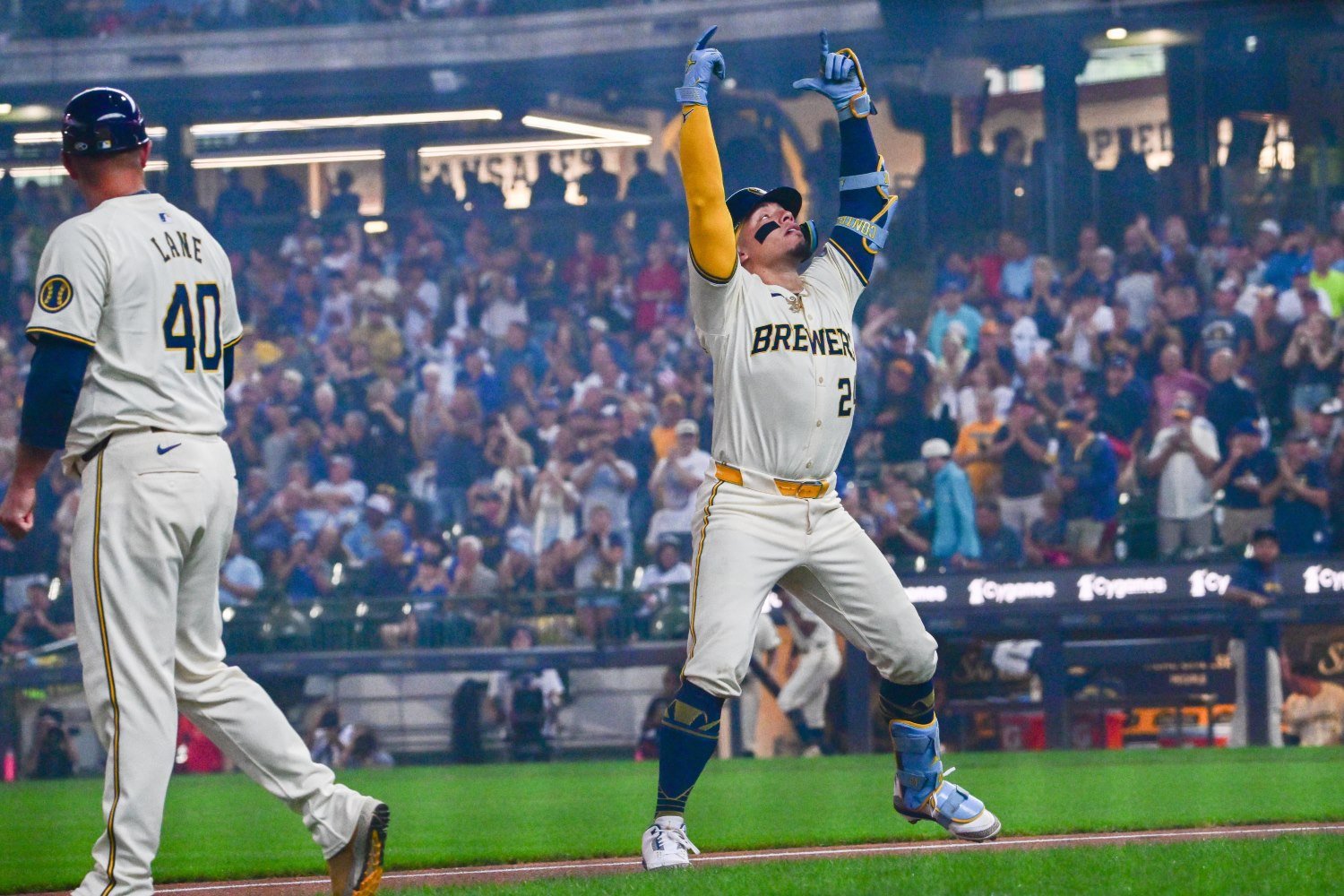
This kind of power explosion was always within the range of possibilities for William Contreras. Early this year, he was one of the darlings of the new Statcast bat-tracking data released at Baseball Savant, because few players in baseball swing harder, and fewer still match that ability with the skill of meeting the ball squarely. Contreras can, when he's going well, generate high exit velocities to all fields, about as well as anyone in baseball.
Alas, Contreras wasn't ready to fully weaponize that ability at the beginning of this season. He was a terror, for opposing pitchers, because he could hit for average, accept his walks, and split plenty of gaps, but he didn't have the same lethality that elite power hitters bring to the table. As has been the case for most of his career, he was looking to hit the ball hard wherever it was pitched, rather than to do a particular thing with it. The results were impressive, but not quite game-breaking. Through the end of May, he batted .323/.394/.502. He was maintaining a lower-than-average strikeout rate and walking often, but his overall line leaned on great outcomes on balls in play. His whiff rate, on a per-swing basis, was quite high, and he hit the ball on the ground a little bit too much.
As spring gave way to summer, Contreras stayed in the lineup more often than any other catcher in the league, and his heavy workload began to catch up to him. Instead of hitting grounders a little bit too often, he hit grounders far too much--especially the kind that went more or less right into the ground. His batting average on balls in play sagged, his slugging evaporated, and despite continuing to hit the ball reasonably hard and making slightly more contact, he wasn't a productive hitter. In June and July, he batted .230/.301/.337, with just three home runs in 206 plate appearances. There was a slight uptick after the All-Star break, but he wasn't yet fully tapping into his skill set.
He is now. Since Aug. 1, Contreras is batting .313/.389/.734. He's already hit six home runs this month. He's actually striking out more, despite swinging and missing less, for a simple reason: he's gotten more selective within the zone. In turn, he's gotten more selective within the zone for a slightly more complicated (but simple-sounding) reason: he's no longer trying to go with the pitch and hit equally to all fields. He's trying to crush the ball, and he's trying to crush it to left field, and he's trying to crush it to left field in the air. And it's working.

Contreras's hard-hit rate and average exit velocity are each higher than in April and May, but only by a little bit. His average launch angle is up by a bit more, but it's not night and day. He didn't turn into Rhys Hoskins or Willy Adames. He merely morphed into the most dangerous form of himself, which has a chance to be a more dangerous hitter than Hoskins, Adames, or even Christian Yelich. This version of Contreras is the outright, unmitigated superstar the team has needed all along.
In April and May, 3.9% of Contreras's plate appearances (that weren't walks or hit-by-pitches) ended in pulled balls with an exit velocity of 95 miles per hour or more and a launch angle of 10 degrees or higher. I call this mini-metric Pulled Hard in the Air Rate (PHiA%). In June and July, Contreras's PHiA% only dipped slightly, because it didn't have much room to fall; it was 3.7% for those two months. In August, in the admittedly modest sample of 72 trips to the plate, Contreras's PHiA% is 12.5%.
Another metric of my own creation, weighted sweet-spot exit velocity (wSSEV), predicts overall production better than any other single metric available. Contreras's was a very solid, though sub-elite, 90.3 MPH through the end of May. In June and July, as he rolled over so many balls and the steam came out of his swing, it sagged to a pedestrian 86.0. In August, it's 94.9. Of the 144 batters with at least 60 plate appearances this month, Contreras ranks 12th in wSSEV and 14th in PHiA%. The only players ahead of him in both metrics for the month are Elly De La Cruz, Brandon Lowe, Juan Soto, Jackson Merrill, and Austin Riley. Contreras has a higher actual weighted on-base average (wOBA) than all of them.
Is this a hot streak? Absolutely. Will Contreras sustain an OPS pushing 1.200 for the balance of the season? No. However, this is not just a hot streak. It's a material improvement, rooted in a neeced process change. It's an emergence--a glow-up. It's Contreras replacing Yelich, and then some, and its staying power could determine how far the Brewers go this October.
Do you approve of Brewers' ownership?

Follow Brewer Fanatic For Milwaukee Brewers News & Analysis



-
 2
2


Recommended Comments
Create an account or sign in to comment
You need to be a member in order to leave a comment
Create an account
Sign up for a new account in our community. It's easy!
Register a new accountSign in
Already have an account? Sign in here.
Sign In Now