


Brewers Video
It was right after the All-Star break, and the Brewers were in Minnesota, playing the Twins. During the morning media session with manager Pat Murphy, the skipper asked the assembled group where his club ranked in terms of total bunt attempts. He was aghast to learn that they were just fourth in MLB, and appalled by the low total number of bunts the team had actually laid down, which then lingered just south of 40.
That's not because Murphy is a fanatical believer in the dying art of the sacrifice bunt, though, or even because he believes especially fervently in bunting for hits. Indeed, while he wants his team to make use of the tactic, he has pointed out several situations over the course of the season in which players bunted without his say-so--even, at times, when he would have strongly preferred that they swing away.
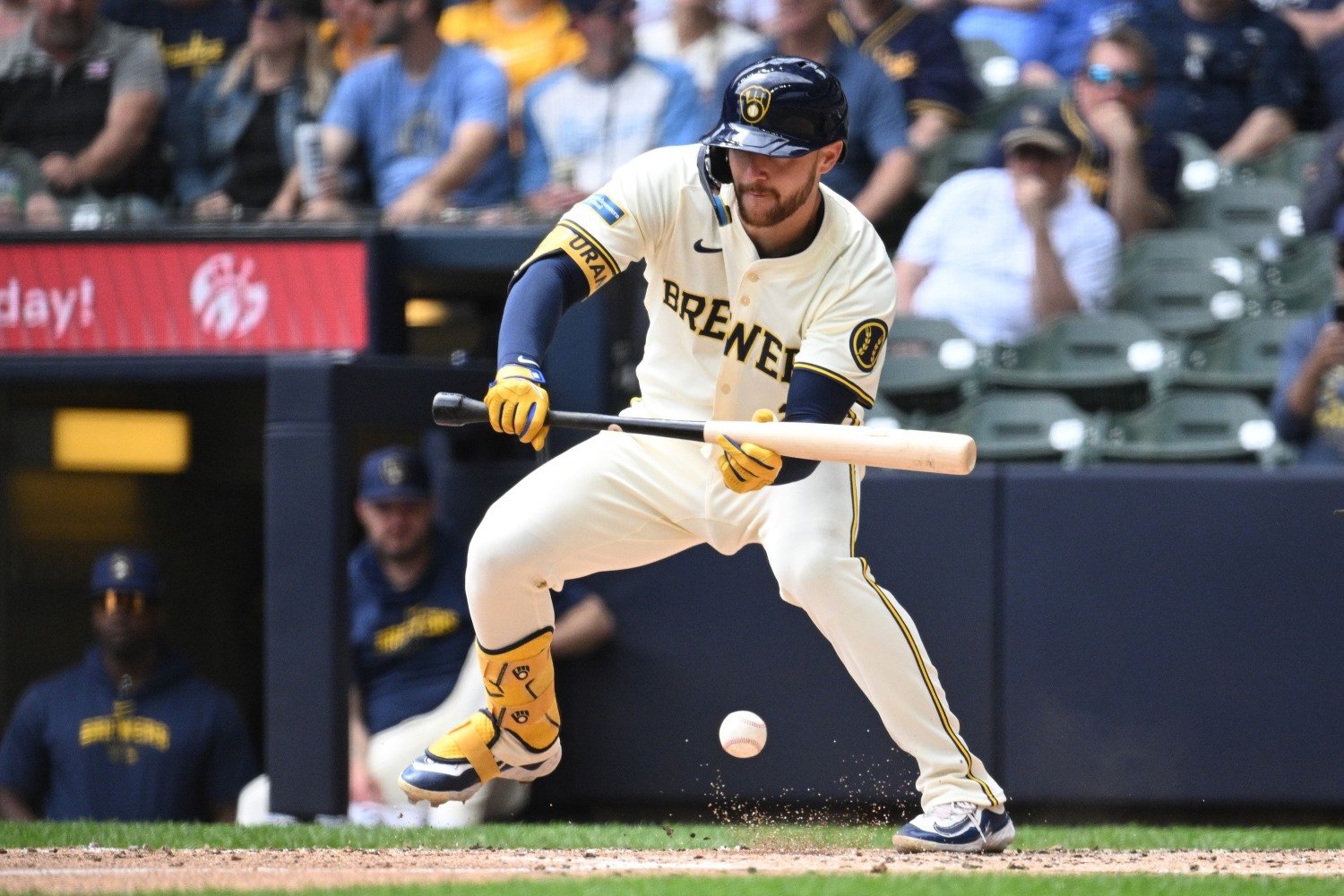
No, what Murphy likes about the bunt is the threat of it. Far beyond the mere impact of bunts that actually land in play, he sees value in squaring around often, for the effects it has on pitchers and defenses.
"What's amazing," he said that morning in July, "is how many bunts where we put it out there and pull back, and how that leads to a result. People don't measure that; you can't measure that. The immeasurable--that's a good article. The immeasurable effect of the unsuccessful bunt attempt."
Hopefully, he won't regard this as an act of aggression, but almost two months later, I've collected the very best data I can, and today, we're going to try to measure the effect of the unsuccessful bunt attempt. That doesn't have to come at the expense of a discussion of the immeasurable effects it also has, and Murphy is right that perfectly measuring it still isn't even possible. So, let's just let the concept of measuring it start a conversation.
The first major hurdle to capturing the value of squaring to bunt is that, if you do just pull the bat back and take a called strike or a ball, the dataset goes blind to your flash of the bat. Perhaps, behind some velvet rope and heavy curtain, teams have data on aborted squarings-around, but the very best public data only captures the bunt attempts that are technically that: an attempt. We can only measure what happens after a missed or foul bunt, as opposed to one successfully laid down in play.
The Brewers have made 134 of those full-fledged bunt attempts this year, and about half of them have resulted in balls in play. I went through all of them, though, and found 69 total plate appearances that included a foul or missed bunt, then ended on some other kind of batter-pitcher interaction: 38 in the first half, and 31 in the second half.
When you first hear a manager allude to the intangible impact of an unsuccessful attempt to get a bunt down, you might think about the defense. Do they subtly shift in response to this apparent information about the batter's intention? Do they tense up and become more error-prone? Maybe so, in some specific cases. At the very least, that's a plausible hypothesis, especially if the batter wielding the bunt as a weapon has speed on his side. Here's Brice Turang shooting a single through an infield that, yes, might have reshaped itself a bit to try to take away the bunt he'd attempted earlier in the plate appearance.
We think a lot about how bat control and tactical hit placement can force a defense out of shape. It's a natural way to apply pressure to a defense: force them to defend small, often insignificant areas of the field, opening up more appealing and more reachable real estate. In practice, though, defenses don't just fold themselves up and step aside when you show bunt. The bunt isn't that scary. So, most of the time, hits that come after a failed bunt attempt look much more conventional. Here's one from Garrett Mitchell.
That ball was smoked, and well it should have been. In fact, this is where we start to really tap into something, measurable or not: it sure seems like a mislaid bunt invites a pitcher to get themselves in trouble by grooving a pitch in the immediate wake of that pitch. Baserunning hijinks aside, look what a good, hittable pitch Turang gets on this should-have-been double, right after a foul bunt.
No left-handed pitcher should ever throw a lefty batter that good an 0-2 pitch. They do it anyway, sometimes, but the bad bunt seems to increase the frequency of that category of pitching error a bit. Turang, who doesn't have a whole lot of power in general, has gotten quite good at capitalizing on this specific vulnerability in opposing pitchers. Early in the season, he would get hangers on the heels of abortive bunts and foul them off. Now, he knows what to do with them.
The collective stress we imagine the bunt exerting on a defense isn't really there, but even with infrequent bunters who are excellent hitters--the kind of guy whom a hurler should least worry about bunt attempts from, and against whom the pitching approach should change least after one--there does seem to be a freakout factor for the battery. Jackson Chourio fouled off a bunt try in the shadow of some freeways north of Atlanta several weeks ago, then got an absolute meatball and absolutely meatballed it.
Again, pitchers make mistakes at times other than the immediate aftermath of a bunt attempt. There really does seem to be something wanting in the execution of certain pitch types by a hurler after such offerings, though, and if a hitter can be ready for it, the opportunities created by those mistakes can be highly valuable. Right, Joey Ortiz?
This all feels highly anecdotal; so be it. We'll get to the numbers in a moment, but first, let's savor one more highlight. It comes to us all the way from mid-April, while much of this young team was still learning how to bunt and how to make use of whatever chinks in pitchers' armor those bunts opened up. Blake Perkins attempted to lay one down for a single late in a tie game, but when that didn't work, he was ready to compensate.
These are all the homers the Crew hit in at-bats that included failed bunts, but they've got a handful of other extra-base hits, too--plus a few very hard-hit outs, from fly balls caught at the wall to wicked one-hoppers by Christian Yelich at 107 miles per hour, snapped up on the infield. Pitchers throw fat strikes, sometimes, after a hitter puts the bunt in the back of their mind. It's not unlike the way a pitcher can flummox a hitter by putting their soft stuff in the back of their head early in the count, then throwing a fastball by them in the zone for a third strike.
In plate appearances that include a bunt attempt, but don't conclude on one, the Brewers are batting .262/.294/.538 this year. That includes at-bats by Mitchell, Turang, Perkins, Chourio, Ortiz, Yelich, Sal Frelick, and more. A failed bunt attempt is, by definition, a strike, so it's not a surprise to see a low walk rate for such moments, but the power the group is able to generate by luring the pitcher with a bunt try is massive. I wasn't able to search for pitch locations immediately after bunt attempts, but it sure looks like pitchers make a lot of mistakes over the heart of the plate.
When Murphy talked about eliciting a result on the heels of an unsuccessful bunt, this is the kind of thing he was talking about. Sometimes, it's about focusing a hitter and helping them see the ball longer or better. Sometimes, it's about the defense being dragged out of position. Most often, though, it's about putting a subtle, even sneaky pressure on the pitcher. They probably don't even realize it, but when a bunt rolls foul, they're heading for a trap. They're mentally processing what the batter just attempted, and maybe it's giving them unearned confidence. Maybe it's leading them to chase an easy out by throwing a more buntable ball. Maybe it's just changing the way they see the strike zone. Whatever the cause, they're now primed for an ambush, and few of them seem cognizant of the danger.
We're not mapping the entire topography of this iceberg. We'll have to be happy with the tip of it, where we can see and understand what's going on. If you dislike the frequency with which the team tries to bunt, though, or if you doubt that that tactic has game-changing, galvanizing power for an offense, these are some good reasons to believe. The Brewers have gotten better at this as the season has progressed. They're a team full of interested bunters, and while some of the bunts they do get down might be aggravating, others will put pressure on the defense and spark rallies. Meanwhile, the ones they don't get down are having an impact, too--immeasurable or otherwise.
Do you approve of the job Pat Murphy is doing as Brewers manager?

Follow Brewer Fanatic For Milwaukee Brewers News & Analysis



-
 4
4


Recommended Comments
Create an account or sign in to comment
You need to be a member in order to leave a comment
Create an account
Sign up for a new account in our community. It's easy!
Register a new accountSign in
Already have an account? Sign in here.
Sign In Now