


Brewers Video
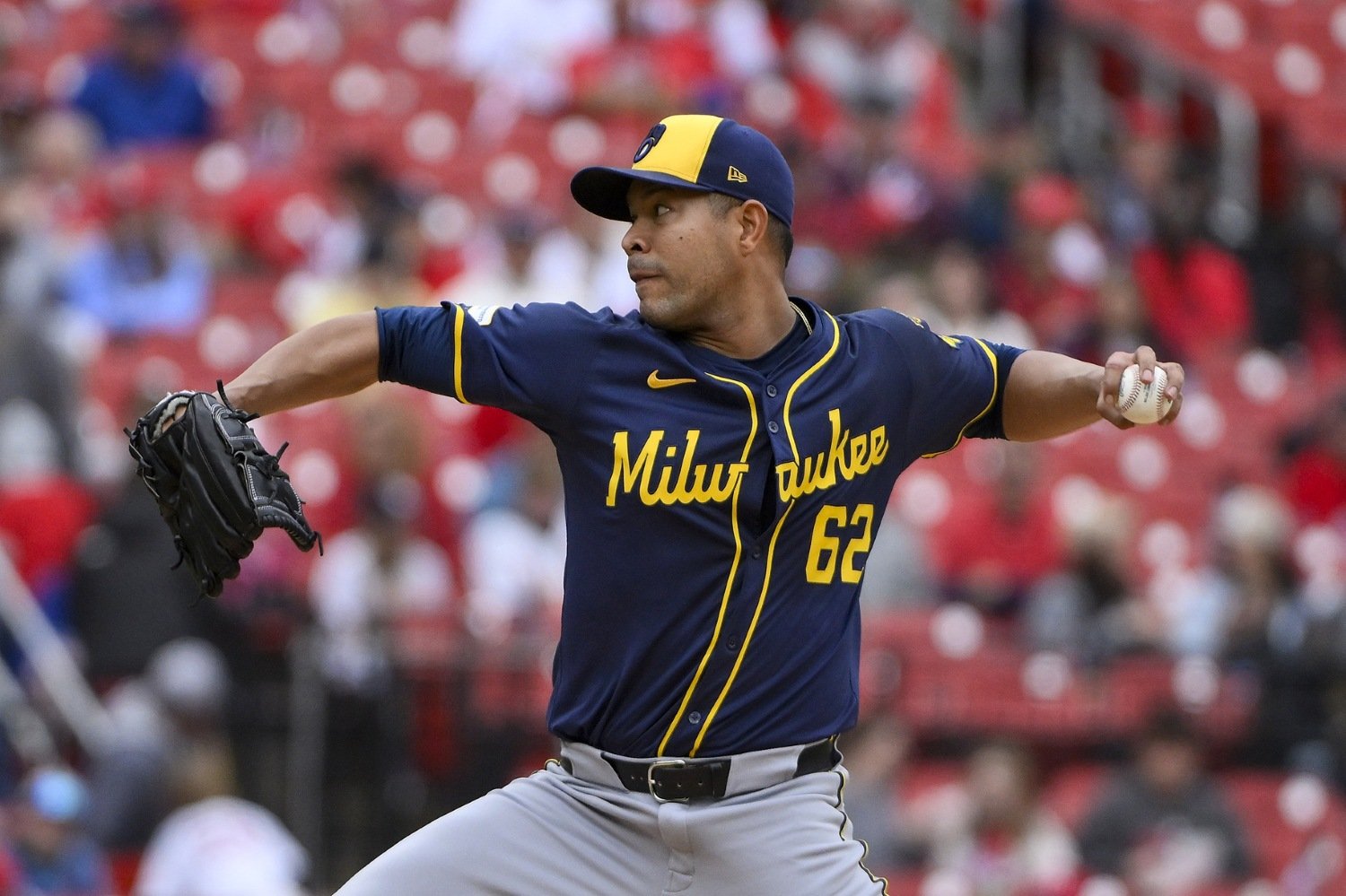
When the Brewers scooped up Jose Quintana for just $4 million in March, even the veteran southpaw's biggest boosters—including manager Pat Murphy—couldn't have foreseen this great a return on investment.
The Brewers didn’t do much this past winter. In fact, they rarely ever do much, when it comes to signing big-name starting pitchers. While the world was busy signing aces to fancy nine-figure deals, Milwaukee took a far more conservative approach. Even after losing franchise titans Colin Rea and Frankie Montas, they didn’t seem too gung-ho about reloading the rotation. After all, Brandon Woodruff was slated to return at some point, Tobias Myers looked like an ace in the making, and they still had Freddy Peralta hanging around.
The one semi-proactive deal they struck was to acquire Nestor Cortes from the Yankees. Obviously, he brought a certain gravitas and track record, but things haven’t worked out for him in a Brewers uniform so far. Shortly after pitching poorly enough to single-handedly start a social media firestorm about illegal bat construction and ordnance-shaped sports equipment, he hit the 60-day IL with an elbow strain. At first, it seemed like Brewers fans would have to suffer through yet another year of a starting rotation held together with Elmer’s glue and Scotch tape—but they were, all of them, deceived, for another lefty was signed.
It was almost as if the Brewers intended to keep his contract under the radar. They didn’t come to an agreement with Jose Quintana until March 5th, inking a one-year, $4.25-million deal with the 36-year-old former workhorse. He had just come off of a solid year with the Mets, posting a 3.75 ERA over 170 ⅓ innings, but is on the older side, a likely contributor to his availability stretching well into spring training. He was signed so late that he wasn’t even able to ramp up quickly enough to start the season with the team.
When he finally got around to making his debut on April 11th against the Diamondbacks, however, he threw seven scoreless innings, masterfully utilizing soft contact to limit his own pitch count to just 80. His next three starts would be more strenuous, but each would be at least five innings and include just one earned run, giving him a cumulative ERA of just 1.14 this season and making him the most valuable player on the team by rWAR. How is he getting away with this?
It’s not obvious at first glance. His whiff rate, fastball velocity, and many other Statcast metrics are in the bottom quartile of qualified pitchers. But what he lacks in brute force, he has made up for in deception. Jake McKibbin wrote about it when he signed, but Quintana is what some might call a “crafty lefty.” Acknowledging that his intrinsic stuff isn’t nearly enough to beat average major-league hitters, he tends to rely on expanding the zone and using breaking balls to induce ground balls up the middle or fly balls to the opposite side. Both batted-ball outcomes limit the total damage opposing hitters can do, and create an overall frustrating experience.
If we take a closer look at his toolkit, we can see that this is accomplished through commanding his arsenal. His most valuable pitches, the changeup, curveball, and slurve, all end up in the lower portion of the zone. The only pitch that fills up the strike zone is the sinker, and even that is closer to the outer portion than it is the heart.

Despite a lack of velocity, the movement and placement make it difficult to square up the ball. Batters may make contact, and it may even be decent contact, but it won’t be as hard-hit as they want it to be. Quintana’s average exit velocity is 91.1 mph, which places him in the 19th percentile, but his opponents' maximum exit velocity so far is just 107.3 mph, meaning the distribution of exit velocities off of his work doesn’t stray far from his average. Hitting a ball in the low 90s is rarely enough to do serious damage.
We can see a quick example of this in a recent at-bat against Willson Contreras. After getting ahead in the count with a changeup on the outside edge and another changeup fouled away, Quintana eventually sets him up with another sinker just outside of the zone—but close enough to get a swing from Contreras—and inducing a harmless lineout to right field.
In another at-bat against Matt Chapman, we find him (again in a 1-2 count) set up the hitter in a similar fashion, before a diving changeup causes a well-hit ball to die at the warning track.
Nothing lasts forever, and you wouldn’t be out of your mind to expect some regression. In fact, the Brewers found themselves in a similar situation with Julio Teherán in 2023. A late May signing, he got off to an unbelievable start, before his ERA blew up in July following four rough outings. While his numbers will likely take a step back, Quintana was never meant to lead this rotation. It would be surprising if he was seen as much more than a stopgap. Woodruff has continued to make good progress, and DL Hall (whose move to the 60-day IL opened the roster spot for Quintana to be added) has been throwing and recently participated in a bullpen session, so the front office likely hoped the veteran would hold down the fort before reinforcements arrived.
Optimists would remark that this was yet another brilliant move by the front office (followed by stellar work by the team’s pitching development program), which will culminate in the greatest-ever season by a Brewers lefty. A more realistic prediction would be that Quintana regresses slightly to be a more middle-of-the-rotation arm—someone who still contributes while the squad navigates their current injury problems. Regardless of what he accomplishes in the future, what he has done already is enough for him to be one of the most underrated signings of the offseason.
Which team do you dislike the most in the NL Central?

Follow Brewer Fanatic For Milwaukee Brewers News & Analysis



-
 1
1


Recommended Comments
Create an account or sign in to comment
You need to be a member in order to leave a comment
Create an account
Sign up for a new account in our community. It's easy!
Register a new accountSign in
Already have an account? Sign in here.
Sign In Now